
Building area category
Urban areas: Opportunities and risks of a building law amendment
The challenges facing modern urban development are well known: Reurbanization, e-commerce and a shortage of space. These need to be addressed by both politicians and project developers - with changed framework conditions and new concepts.
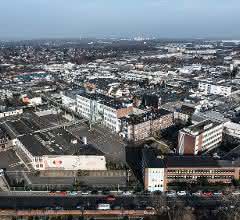
A first important step towards better meeting these challenges was the amendment of the BauNVO. This is because it is virtually impossible to develop new areas, especially within the major cities. While there may still be the odd brownfield site in Berlin, cities such as Frankfurt, Düsseldorf and Munich are already extensively sealed. Existing areas need to be revitalized or densified. In order to create a suitable basis for this, section 6a of the BauNVO has included the building area category "urban areas" since last year. By significantly increasing the scope for the development of alternative approaches, this is intended to promote inner-city redensification. The declared aim is to achieve a better mix of residential and commercial areas. In order to achieve this, the permissible noise levels were increased by three decibels during the day compared to the classic mixed-use area and a higher target floor area ratio (GFZ) was approved. This means that areas can be used more efficiently, as the development can be much more compact. Another important innovation compared to the classic mixed-use area is the unspecified quota for residential or commercial use in urban areas - in mixed-use areas, at least 50 percent of the area must be used for commercial purposes.
Residential conversion as a risk factor
This is one of the innovations that also harbors one or two dangers, especially for project developers of commercial and logistics properties. Due to the ever louder calls for affordable housing, politicians are coming under increasing pressure when it comes to allocating land. The amendment to the building law could now make it much easier for cities and local authorities to respond to this call. This applies in particular to sites for which there is not yet a fixed development plan. However, existing conversion areas of former industrial estates could also be converted into a residential area if the planned urban area is primarily designated as such. Another danger is the subdivision of existing commercial areas and their piecemeal conversion into residential space. These scenarios show the potential dangers of the new building area category - to counteract these, project developers must respond with well thought-out concepts. These should show how a successful mixed use can be realized so that it is not either or, but both.
Upward densification
There are already successful examples of mixed-use developments outside of urban areas - be it underground car parks as a starting point for last-mile deliveries or former retail spaces converted into inner-city distribution centers. In the development of new properties, especially business parks within urban areas, the focus will increasingly shift to multi-level solutions - for example, properties over several floors. The first property of this type is located in Munich: The goods handling for an online retailer takes place over two floors. As the individual floors can be accessed separately, the property can also be divided up between different tenants. The task now is to adapt this concept to different forms of use in order to establish sensible mixed use within the cities. Here, it will be particularly important to create the conditions for an increased interlinking of production, logistics and service - and the basis for combining different types of use. Be it a day care center, an office space or living space. The first "lived" implementation of a similar approach has been demonstrated by the two large food discounters Aldi and Lidl: they are adding further floors to existing supermarkets to create apartments.
Best practice instead of prototype development
This approach must now be applied to future logistics properties in urban areas and developed further: in the form of mixed-use multi-level properties that offer the possibility of integrating other types of use on the upper floors. A wide variety of combinations are conceivable. One possible usage approach would be to implement a cross-docking area in the basement and first floor of a new building, which would be vertically supplemented by space for offices, a medical center or a daycare center. Such an inner-city logistics property combined with a daycare center requires good planning, not only in terms of access and delivery, but also for the safety of all parties involved. At the same time, the requirements for alternative means of delivery transportation, such as e-bikes and e-scooters, must be taken into account. These are the key challenges that already need to be taken into account when developing new properties and will play an even greater role in newly developed urban areas. The possibilities are diverse and are shaped not only by the requirements of the tenants, but also by regional circumstances and the respective municipalities. This means that there will be no prototypes. Rather, the aim is to use best practices in order to adapt them for subsequent real estate developments. This will give rise to completely new types of commercial real estate that do not follow a standard pattern.
Successful integration into an existing living environment
When developing and marketing individual properties, it is important to consider which mixed uses are compatible in day-to-day operations and which are not. Not only the operating hours must be taken into account, but also various other factors. If the property is integrated into an existing residential environment, it must blend in as seamlessly as possible. This is initially a question of design. But the factors of pollutant, noise and light emissions must also be taken into account. To improve acceptance among residents and local authorities, it is also important to strive forCO2 neutrality. This is a particularly important factor in areas with increased electricity consumption, such as fresh produce logistics - which will become significantly more important in the coming years.


You might also be interested in
Automation Is Driving Up Demand for Logistics Space
Warehouse automation is growing significantly in Europe. According to a study by Prologis, 50 percent of modern logistics space is expected to be automated by 2035.
 read more...
Prologis starts first construction phase
Major project in Dortmund
Prologis has started construction of the Dortmund DC4WARD logistics, commercial and light industrial park. Around 130,000 square meters of modern space with a focus on sustainability and energy-efficient operation will be built on the former...
read more...Logistics real estate: Logivest brokers in Bielefeld to Qtrado
In Bielefeld, logistics real estate consultant Logivest has brokered around 6,000 square meters of warehouse space for rent to Qtrado. The property belongs to the Fixemer Real Estate Group, an international real estate company.
read more...Dachser strengthens logistics location...
Investment worth millions in the Allgäu
Dachser is investing around EUR 30 million in the expansion of its Allgäu logistics center in Memmingen. A new facility for industrial and consumer goods with additional handling, storage and office space will be built by spring 2027.
read more...MLP Group plans second city logistics property in Vienna
The MLP Group is further expanding its Austrian portfolio with a second project in the capital city of Vienna. With the acquisition of a site near Vienna Central Station, the developer is pursuing the goal of consolidating its role in an expanding...
read more...Arvato further expands customs logistics in Turkey
With a new type A customs warehouse in Istanbul-Tuzla and additional capacity, Arvato is strengthening its cross-border logistics expertise and positioning Turkey as a strategic hub between Europe and Asia.
read more...Gebhardt expands into France
The Gebhardt Intralogistics Group is expanding into France and opening its first location in Paris. This strengthens the company's presence in one of Europe's most important logistics markets.
read more...11,000 square meters of logistics space for Magnera
In Gaggenau, Baden-Württemberg, the logistics real estate consultant Logivest has brokered a logistics location for Magnera for long-term rental.
read more...Arvato expands AutoStore system in the UK
Arvato and AutoStore have expanded the automated warehouse system at the Hams Hall site near Birmingham by over 30 percent in just three months. The aim is to support the growth of international customers in the UK market more quickly and flexibly.
read more...