
Transportation Logistics
What Really Happens on the Road: Data Loggers Reveal Risks
Shipping damage often goes unnoticed and only becomes apparent at the destination. Data loggers provide objective information about vibrations, temperature, and humidity conditions throughout the entire supply chain. In this way, they help companies identify risks, document damage, and continuously optimize their shipping processes.

The volume of global shipments is immense and continues to rise: In 2024 alone, more than 183 million TEU (twenty-foot equivalent units) were transported via shipping containers—representing a six percent increase over the previous year. Damage during transport must be prevented, especially for sensitive capital goods—these goods are often custom-made and high-value; transport damage results in additional time and financial costs.
“While shippers try to protect their goods with sturdy packaging and professional load securing, even elaborate protection strategies can reach their limits,” says Peter Adam, Marketing Manager at Aspion. The Karlsruhe-based company, which specializes in sensor technology, offers innovative and user-friendly data loggers that can be used to monitor and secure valuable goods during transit. In practice, it’s become clear time and again that cargo shifting due to emergency braking, rough handling at transshipment points, or even the opening of packaging at customs are not uncommon and can lead to significant damage.
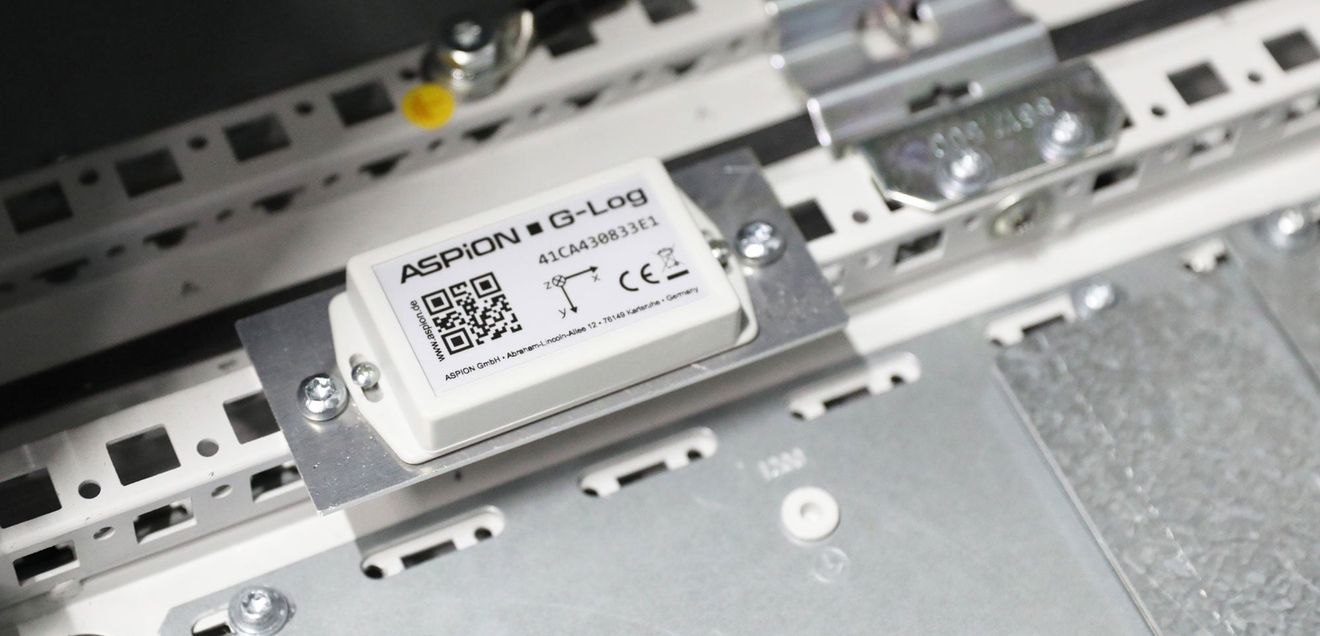
Five areas of application demonstrate how data loggers enhance transparency and safety in transportation logistics.
1. Objectively Evaluate Packaging Protection
High-quality packaging is an important prerequisite for safe transport, but it does not provide complete protection. Impacts during loading, overturned shipping crates, or packages opened during customs inspections can still cause damage. Data loggers record vibrations, temperature fluctuations, and humidity changes throughout the entire transport process. This provides companies with objective evidence of the stresses their products were actually exposed to. The data collected not only aids in damage analysis but also helps companies optimize their packaging designs in a targeted manner. “Data loggers ensure transparency and show just how well packaging actually protects the goods. This enables companies to identify and eliminate weak points.”
2. Choose the right mode of transportation
Whether by truck, train, ship, or plane—each mode of transportation subjects the goods to different stresses. The solution best suited for a product can often only be determined based on real-world transportation data. Data loggers record relevant events such as vibrations or climatic influences, thereby enabling an objective comparison of different transportation routes. In the future, companies will be able to base their decisions on reliable data rather than on experience alone. “If companies then find that a product is repeatedly damaged when transported by a particular mode of transport, they can opt for a different one from the outset and minimize the risk,” says Adam.
3. Identify Critical Transport Routes
Not every route poses the same challenges for sensitive goods. Poor road conditions, significant temperature fluctuations, or long layovers at terminals can significantly impact the quality of transport. Data loggers record stresses throughout the entire journey and time-stamp them. This makes it possible to trace when and where critical events occurred. Models with live tracking also provide real-time information on the location and condition of the goods. “For example, if it becomes apparent that the goods were damaged early on in the route, companies can halt further transport and thus save time and money,” explains Adam.
4. Continuously improve supply chains
Shipping damage is a daily occurrence in global supply chains. This makes it all the more important to be able to clearly identify the causes. Data loggers comprehensively document events that cause damage, thereby providing transparency into critical process steps. The information gathered helps companies identify weaknesses in the supply chain, adjust transportation processes, or evaluate service providers in a targeted manner. “Unfortunately, damage caused by so-called rough handling is all too common,” the expert notes.
5. Process and settle claims more quickly
In the event of damage, it is crucial to be able to document the sequence of events as clearly as possible. Without objective data, determining liability is often a time-consuming process.
Data loggers provide verifiable evidence of stresses and environmental factors during transport. This enables companies to document the causes of damage more quickly and simplify communication with insurance companies and logistics service providers. “This makes it possible to assign responsibility, avoid disputes with insurance companies and service providers, and settle claims quickly,” says Adam.
Conclusion
Shipping damage to sensitive capital goods is not an isolated incident, but rather a structural risk in global supply chains. The assumptions widely held by companies—ranging from the belief that packaging is sufficient to the false sense of security provided by insurance—do not hold up to data-driven analysis. Data loggers provide a new level of transparency: They deliver objective evidence of stresses, environmental influences, and the exact timing of critical events. This not only gives companies a reliable basis for damage assessment and communication with service providers and insurers, but above all, an effective tool for continuously improving packaging, the choice of transportation modes, and route planning. Those who base transport safety in the future not on assumptions but on reliable data can measurably reduce risks, lower costs, and make their own supply chain more resilient in the long term.


You might also be interested in
New Podcast: “AGVs: The Silent Logistics Pros”
AGVs in Use in Logistics and Production
Autonomous guided vehicles (AGVs) are becoming increasingly important in industry and intralogistics. In Phoenix Contact’s “Elektrisiert” podcast, Jörn Dauer explains the applications, technical requirements, and future prospects of these autonomous...
 read more...
Autonomous Forklift in the ABB Robotics Portfolio
With the new Flexley Stack F712 autonomous forklift, ABB Robotics is expanding its portfolio of mobile robots. The system is designed to automate material flow and intralogistics processes more efficiently and flexibly using AI-powered Visual SLAM...
read more...Arvato Takes Over European Logistics for Mister Spex
Starting September 1, 2026, Arvato will take over key logistics and fulfillment processes for Mister Spex in five European countries. The partnership is intended to create a scalable supply chain and support the continued growth of the omnichannel...
read more...The Right Warehousing Solution for Every Logistics Need
Whether it’s an S/4HANA implementation, the urgently needed replacement of the traditional SAP WM, or the growing demands for digitalization and automation—many companies are faced with the question of which warehouse management system will best...
read more...Frank Weber to Become COO of the LGI Group
LGI Logistics Group International is strengthening its senior management team: Frank Weber assumed the position of Chief Operating Officer (COO) on July 1, 2026. He will be responsible for the day-to-day operations of the group, which has more than...
read more...Standardized in design, flexible in use
Automated guided vehicles are increasingly in demand in production and logistics as they automate processes efficiently - but in addition to the vehicle, the right peripherals are also crucial for safe operation. A new solution consisting of a...
read more...LTW Intralogistics at the Logimat 2026
Efficiency and quality in the material flow
LTW Intralogistics is presenting its holistic approach to future-oriented material flow solutions at Logimat. Under the motto "Flow. In every detail", the company will be demonstrating how integrated systems, intelligent software, design and service...
read more...Neura Mobile Robots at the Logimat 2026
Cognitive robotics meets transportation expertise
Neura Mobile Robots will be presenting the X MOVE driverless transport platform in combination with the MAiRA cognitive robot from Neura Robotics for the first time at Logimat 2026 in Stuttgart.
read more...Kion significantly increases order intake
Kion holds its own in a difficult environment in 2025, increases order intake significantly and looks ahead to profitable growth in 2026 with a new segment name and efficiency gains.
read more...