
Inventory Management Software
The Right Warehousing Solution for Every Logistics Need
Whether it’s an S/4HANA implementation, the urgently needed replacement of the traditional SAP WM, or increasing demands for digitalization and automation, many companies are faced with the question of which warehouse management system will best suit their processes in the future. Logsol presents a comparison of five systems.
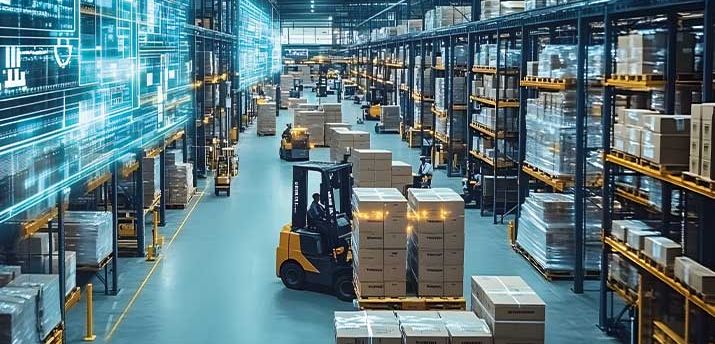
The digital transformation of the supply chain is forcing companies to reevaluate their existing processes. There is rarely a one-size-fits-all answer. A small production warehouse with a limited variety of items has completely different requirements than a highly automated distribution center. A simple black-and-white decision between “no warehouse management” and “SAP EWM” falls short. Depending on process complexity, the degree of automation, and future requirements, SAP now offers a wide range of solutions.
The current options can be broadly divided into two categories: traditional SAP warehouse solutions and newer, cloud-based approaches.
Traditional SAP Warehouse Solutions
- Inventory Management (IM): Simple and Clear
Inventory Management is the basic form of inventory control. Inventory is managed at the plant and warehouse level, without detailed storage location control.
"IM is perfect when basic inventory management is sufficient. However, as soon as actual storage locations, mobile processes, or operational control become necessary, IM should not be artificially expanded but rather replaced."
The solution is particularly well-suited for small warehouses, production buffers, or spare parts warehouses with a manageable variety of items.
- Stock Room Management (StRM): The Next-Generation Solution for Simple Warehouse Processes
Stock Room Management was developed for companies that are migrating from SAP WM to S/4HANA and wish to largely retain their existing warehouse processes. The solution supports simple storage location management and manual warehouse processes.
"However, a detailed functional fit-gap analysis is absolutely essential before switching from LE-WM to StRM."
StRM is particularly well-suited for small- to medium-sized warehouses with low process complexity and minimal automation
- Extended Warehouse Management (EWM): The Solution for Complex Logistics
EWM offers the broadest range of functions within the SAP portfolio and enables the control and optimization of entire intralogistics processes. The solution can be operated as an embedded component within the ERP system or as a standalone system.
"For complex, dynamic, or automated warehouses, SAP EWM is simply the only option. For very small warehouses, however, it is often overkill."
Its strengths include high scalability, integration with conveyor systems and robotics, and comprehensive functions for automated warehouse environments.
The newer, cloud-based approaches
- Warehouse Management in the Public Cloud
The warehouse management functionality of the S/4HANA Cloud Public Edition is designed for companies with a consistent cloud strategy. It is based on standardized processes and utilizes modern user interfaces as well as automatic innovation updates.
"The right choice for companies that are already using the Public Cloud Edition and are ready to align their warehouse processes with SAP best practices."
- Logistics Management (LGM): Connecting Warehousing and Transportation
Logistics Management is a new SaaS approach that integrateswarehousingprocesses with transportation management. The solution is particularly well-suited for decentralized logistics networks and locations that rely on close collaboration with external partners. "Exciting for distributed logistics networks looking for a lean, modern cloud solution to coordinate the interaction between the loading dock, warehouse, and transportation."
The Key Differences at a Glance
- Inventory Management: Inventory tracking without storage location management
- Stock Room Management: Simple storage location management for manual warehouses
- EWM: Comprehensive warehouse control for complex and automated environments
- Public Cloud Warehouse Management: Standardized cloud processes with minimal customization
- Logistics Management: SaaS solution for integrating warehouse and transportation processes
The selection of a warehouse management system should be consistently based on actual requirements. While smaller warehouses can operate efficiently with simple solutions, complex and automated logistics centers require high-performance systems such as EWM. A thorough analysis of current processes as well as planned growth and automation goals helps prevent over-engineering and future limitations. Logsol offers comprehensive logistics consulting.


You might also be interested in
Arvato Takes Over European Logistics for Mister Spex
Starting September 1, 2026, Arvato will take over key logistics and fulfillment processes for Mister Spex in five European countries. The partnership is intended to create a scalable supply chain and support the continued growth of the omnichannel...
 read more...
Frank Weber to Become COO of the LGI Group
LGI Logistics Group International is strengthening its senior management team: Frank Weber assumed the position of Chief Operating Officer (COO) on July 1, 2026. He will be responsible for the day-to-day operations of the group, which has more than...
read more...Standardized in design, flexible in use
Automated guided vehicles are increasingly in demand in production and logistics as they automate processes efficiently - but in addition to the vehicle, the right peripherals are also crucial for safe operation. A new solution consisting of a...
read more...LTW Intralogistics at the Logimat 2026
Efficiency and quality in the material flow
LTW Intralogistics is presenting its holistic approach to future-oriented material flow solutions at Logimat. Under the motto "Flow. In every detail", the company will be demonstrating how integrated systems, intelligent software, design and service...
read more...Neura Mobile Robots at the Logimat 2026
Cognitive robotics meets transportation expertise
Neura Mobile Robots will be presenting the X MOVE driverless transport platform in combination with the MAiRA cognitive robot from Neura Robotics for the first time at Logimat 2026 in Stuttgart.
read more...Kion significantly increases order intake
Kion holds its own in a difficult environment in 2025, increases order intake significantly and looks ahead to profitable growth in 2026 with a new segment name and efficiency gains.
read more...Who will make it into the Logistics Hall of Fame 2026?
The Logistics Hall of Fame is entering a special election year: in 2026, several new members will be inducted by decision of the Council. Nominations are now open and the gala will return to Vienna in December.
read more...Cooperation agreed for the logistics circular economy
Booxit aims to make logistics processes more efficient and sustainable with intelligently networked reusable boxes. The start-up is receiving support from plastics specialists Haidlmair and Polytec.
read more...CTP builds another business park in the Dresden area
CTP Eigentümer, a developer and portfolio holder of logistics and industrial real estate, has acquired a plot of land in the Cossebaude district of Dresden to begin the development of a modern business park.
read more...