
Modular Shelving Systems
Shelving Systems for Dynamic Environments
In modern production and logistics environments, modular shelving systems do much more than simply serve as storage solutions. They improve material flow, reduce travel times, and support efficient processes in line with lean management principles. materialfluss presents selected real-world examples.

Thanks to their flexible design, modular shelving systems can be easily adapted to new requirements and seamlessly integrated into existing production and logistics processes. Solutions that specifically support material flow—such as flow racks—are particularly important in this context. These systems enable a flow of goods based on the FIFO principle (“first in, first out”), whereby the goods stored first are also the first to be retrieved. Containers or boxes move automatically from the storage side to the retrieval side via inclined roller conveyors. This reduces walking distances, makes materials available more quickly, and supports continuous production processes. FIFO solutions are particularly relevant wherever time-critical material consumption and clearly defined material flows are crucial, such as in production and warehouse logistics, the pharmaceutical industry, the food industry, or cosmetics manufacturing.
With additions such as roller conveyors, mobile versions, or ESD-safe components, these types of shelving systems become functional components of an integrated material supply system.
BeeWaTec: Flow Racks for FIFO Material Flow
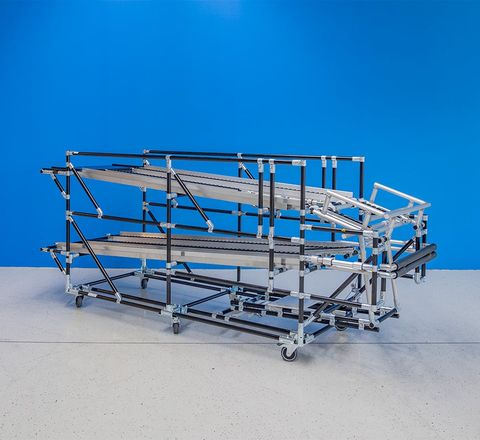
BeeWaTec’s flow racks are designed as modular FIFO racking systems. Containers or cartons move automatically by gravity along slightly inclined roller conveyors toward the retrieval side. Typically, loading occurs from the rear and retrieval from the front, thereby consistently implementing the FIFO principle. The systems are particularly well-suited for production and logistics environments where short transport distances, high transparency, and a continuous supply of materials are required. Thanks to their modular design, the racks can be flexibly adapted to different processes and space constraints.
Karl: FIFO systems all the way to the picking zone
Andreas Karl ’s FIFO racks also optimize material flow according to the “first in, first out” principle. The direct integration of this principle into modular workstation systems is particularly practical: materials are guided right into the employees’ reach. This reduces search times, unnecessary movements, and potential sources of error. Components can thus be fed in the correct order, which supports low-waste processes.
In addition, many systems are optionally designed to be ESD-safe in accordance with IEC 61340-5-1. This makes them particularly suitable for electronics manufacturing environments where sensitive components must be protected from electrostatic discharge.
Bosch Rexroth: FIFO Stations as Flexible Supermarkets
Bosch Rexroth ’s FIFO stations are designed as flexible “supermarkets” for floor trolleys and carts and also support a consistent “first in, first out” strategy. The goal is structured and rapid material provision while simultaneously reducing inventory in line with the Kanban principle. The modular systems can be adapted to different production areas and promote a smooth flow of materials. The FIFO logic reduces obsolescence and scrap, which both improves product quality and lowers operating costs. At the same time, standardized receiving areas and information boards enable the implementation of the 5S principles (sort, set in order, shine, standardize, and sustain) and create additional transparency within materials logistics.
Neolog: Shelving Systems as Part of the Material Flow
Neolog’s racking systems are based on a fully modular design. Adjustments, expansions, and retrofits can be implemented flexibly without having to redesign entire systems. Neolog views the racking system not merely as a storage location, but as an integral part of material handling. Instead of standardized catalog solutions, Neolog creates systems that are specifically tailored to the respective processes. Whether it’s a flow rack, a shelving solution, or a custom design—the shelving systems are designed to support workflows, reduce physical strain, and be adaptable for automated processes in the future. The modular product systems Logiform, Aluform, and Tetriform serve as the technical foundation. These can be combined on a project-by-project basis and integrated into existing production and logistics structures.
According to documents provided by Andreas Karl, Beewatec, Bosch Rexroth, and Neolog.


You might also be interested in
Bosch Rexroth at the Logimat 2026
Humanoid robot on AMR platform
Mobile robotics is well established in intralogistics, now humanoid robotics is moving more into focus. At Logimat, Bosch Rexroth is presenting a mobile humanoid robot on an AMR platform for the first time.
 read more...
Workstation system for shipping and logistics
With Sintro Packing, Karl is launching a workstation system that is designed to meet the specific requirements of shipping and logistics. It is characterized by modular adaptability and ergonomic efficiency.
read more...Ricola modernizes intralogistics with Stöcklin
Ricola relies on Stöcklin for the retrofit of its high-bay warehouse at the Laufen site.
read more...Shelving technology - these are the trends
The most frequently mentioned trends in intralogistics at the moment are artificial intelligence, robots and automation. However, every efficient warehouse solution is still based on the right racking technology. Giovanni Cataldi from heavy-duty...
read more...Highly automated in all product ranges
Richard Kearns knows how his supply chain and his new warehouse in Hernando (Mississippi, USA) are doing because he receives feedback every day.
read more...PepsiCo Polska relies on Mecalux
PepsiCo Polska is working with Mecalux to drive forward the automation of its logistics and is planning an intelligent warehouse.
read more...Sixth AutoStore project for New Wave
Element Logic is implementing its sixth joint project with the New Wave Group: a future-proof AutoStore system for the logistics center in Geiselwind.
read more...One of the largest Autostore facilities in...
Buttinette automates with Element Logic
For the new logistics center of Buttinette Textil-Versandhaus GmbH, the system integrator Element Logic is responsible for planning and implementing the automated intralogistics solutions for storage and order processing. One of the largest...
read more...System Logistics implements new high-bay warehouse at Asahi Poznań
With the construction of a modern, automated high-bay warehouse at Asahi Poznań, System Logistics wants to set an example for the future of intralogistics. The project, which is being implemented in close cooperation with a total of twelve...
read more...