
Warehouse automation
PepsiCo Polska relies on Mecalux
PepsiCo Polska is driving forward the automation of its logistics together with Mecalux and is planning an intelligent warehouse. In future, the company is to combine production and shipping with an automated system that can operate around the clock. The aim is to increase capacity and reduce carbon dioxide emissions.
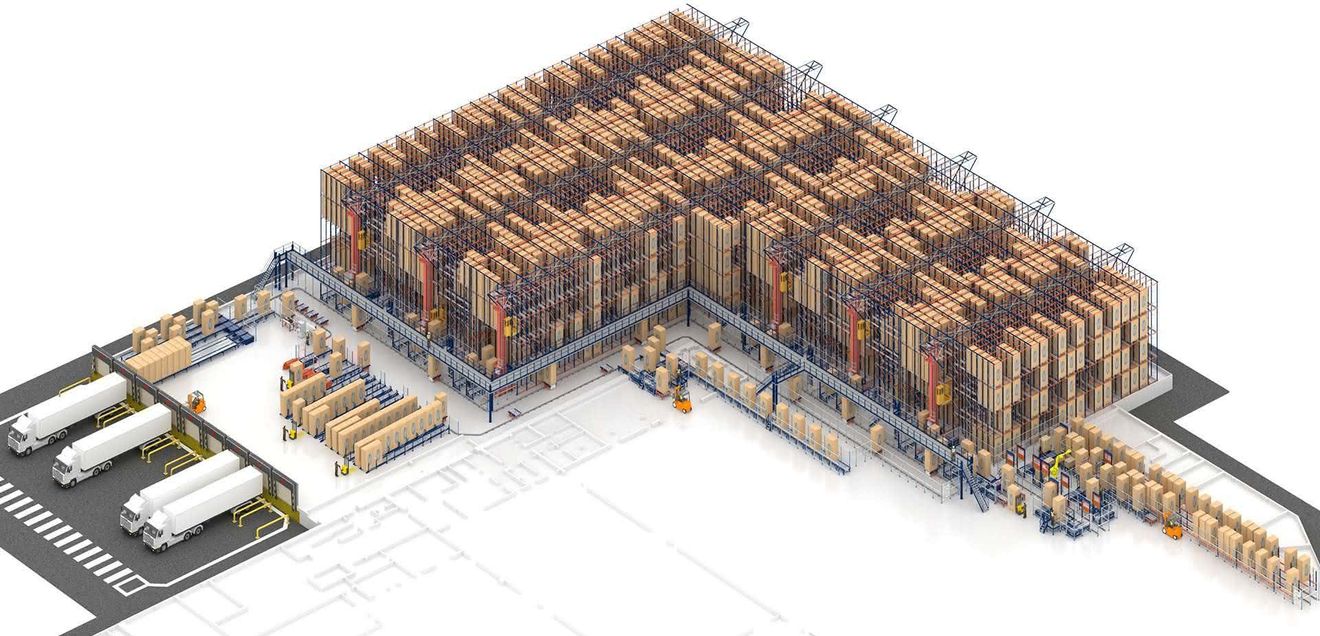
In the third quarter of 2026, PepsiCo plans to commission a new automated warehouse in Grodzisk Mazowiecki (Poland) with Mecalux technology. The facility, which is connected to production to store snacks and potato chips, has been designed to increase logistics capacity and optimize operations without having to expand the existing building.
Modular design for more flexibility
The project provides for the implementation of a complete solution with six storage and retrieval machines that support automatic pallet storage in racks equipped with the automatic Palle-Shuttle system. A system of electric pallet conveyors and automatic pallet conveyor technology will connect the warehouse with the production lines, enabling continuous pallet receipt around the clock. Intelligent warehouse management will be carried out using Mecalux's Easy WMS software, which will be integrated into PepsiCo's SAP eWM system. All logistics processes are precisely coordinated via this bidirectional connection, from goods receipt to dispatch.
"Thanks to the logistics automation project, we will achieve an automatic connection between production, warehouse and dispatch. We have opted for a modular design that offers us great flexibility for future adjustments," says Bartłomiej Lesiuk, Head of the Warehouse Automation Planning Department at PepsiCo.
Savings through energy recovery
This new automated warehouse is the third project that Mecalux has implemented for PepsiCo Polska. In addition to the connection to production and 24-hour operation, the facility in Grodzisk Mazowiecki features important technological innovations. The storage and retrieval machines are equipped with an energy recovery system that can save between 15 and 20 percent energy with every movement. They also have an AI-supported image processing system that replaces conventional light barriers and thus enables precise and safe pallet placement.
"With this new investment, we hope to optimize operations, increase storage capacity and reduce logistics costs," adds Lesiuk. "Automation will also allow us to make direct deliveries, avoiding double handling and unnecessary transportation. We also expect to reduce greenhouse gas emissions by 200 tons per year."


You might also be interested in
Visual Guidance for More Efficient Picking
Kardex announces the launch of the Intuitive Picking Assistant for the Kardex Shuttle. The new solution supports operators with intuitive visual guidance and is designed to make order picking even easier. The solution was unveiled for the first time...
 read more...
Efficiently Modernizing Loading Stations
Redesigning loading stations is a challenging task. Variations in pit dimensions and conditions make it difficult to replace loading bridges.
read more...Productivity guaranteed all day long
Rugged tablets for a wide range of applications
With the new 8-inch ZX80W and ZX80W-EX tablets, Getac is launching two rugged Windows 11 devices based on ARM architecture. The tablets are designed for mobile use in logistics, warehousing, and transportation.
read more...Unitechnik modernizes Hela logistics
Retrofit and new build closely linked
Hela Gewürzwerk Hermann Laue has laid the foundations for further growth at its Ahrensburg site by comprehensively modernizing its logistics. Together with Unitechnik Systems, a logistics center was created that combines new and existing structures.
read more...Movu Robotics at the Logimat 2026
Transformation to a 4-way pallet shuttle system
Movu Robotics, a member of the stow Group, will be demonstrating at Logimat how it is driving the large-scale transformation of automated storage and retrieval systems (ASRS) to 4-way pallet shuttle technology.
read more...Shelving technology - these are the trends
The most frequently mentioned trends in intralogistics at the moment are artificial intelligence, robots and automation. However, every efficient warehouse solution is still based on the right racking technology. Giovanni Cataldi from heavy-duty...
read more...Highly automated in all product ranges
Richard Kearns knows how his supply chain and his new warehouse in Hernando (Mississippi, USA) are doing because he receives feedback every day.
read more...Sixth AutoStore project for New Wave
Element Logic is implementing its sixth joint project with the New Wave Group: a future-proof AutoStore system for the logistics center in Geiselwind.
read more...Arvato further expands customs logistics in Turkey
With a new type A customs warehouse in Istanbul-Tuzla and additional capacity, Arvato is strengthening its cross-border logistics expertise and positioning Turkey as a strategic hub between Europe and Asia.
read more...