Storage and shelving systems
Shelving technology - these are the trends
The most frequently mentioned trends in intralogistics at the moment are artificial intelligence, robots and automation. However, every efficient warehouse solution is still based on the right racking technology. Giovanni Cataldi from heavy-duty storage technology specialist Ohra knows the most important current developments in the field of modern shelving systems.
The market environment for intralogistics solutions is currently characterized by a multitude of challenges. Nevertheless, or perhaps precisely because of this, the outlook for versatile and robust shelving systems in industry, trade and commerce is positive. This is because companies are increasingly recognizing the importance of optimizing storage space to increase productivity, streamline processes and improve customer service.
Automation requires scalable shelving systems
Trends in intralogistics are currently dominated by topics such as the increased use of autonomous systems, AI-supported robotics and IoT integration. Collaborative robots (cobots), AGVs/AMRs and real-time localization via SLAM (Simultaneous Localization and Mapping) and sensor fusion address the growing complexity in dynamic environments. Increasing automation in the warehouse requires correspondingly dynamic and scalable shelving systems. Intelligent shelving with IoT sensors and weight detection enable real-time inventory and predictive reordering. In addition, systems such as shuttle technologies are transforming static racking into flexible, high-density storage that adapts to variable demand.
Shelves grow upwards
The aim of making better use of the available space in the warehouse has a very specific impact on racking construction: racks of all types have become higher in recent years. This trend is taking place in conjunction with developments in industrial trucks, which are not only reaching ever greater heights, but can also store and retrieve goods safely at these heights thanks to new technologies such as driving aids, improved stability systems or camera systems on the load supports.
At the same time, companies are increasingly using the full range of available racking systems: they are equipping the racking with guide rails for narrow-aisle forklifts and can thus significantly improve space utilization. While a conventional pallet racking warehouse operated with a front forklift truck achieves a space utilization rate of 40 percent, narrow-aisle warehouses enable a space utilization rate of around 55 percent. The use of mobile racking is also becoming increasingly common - especially when space is particularly tight and the requirements for turnover rates are rather low, they can score with a space utilization rate of up to 75 percent.
Flexibility with mesh shelves on cantilever arms
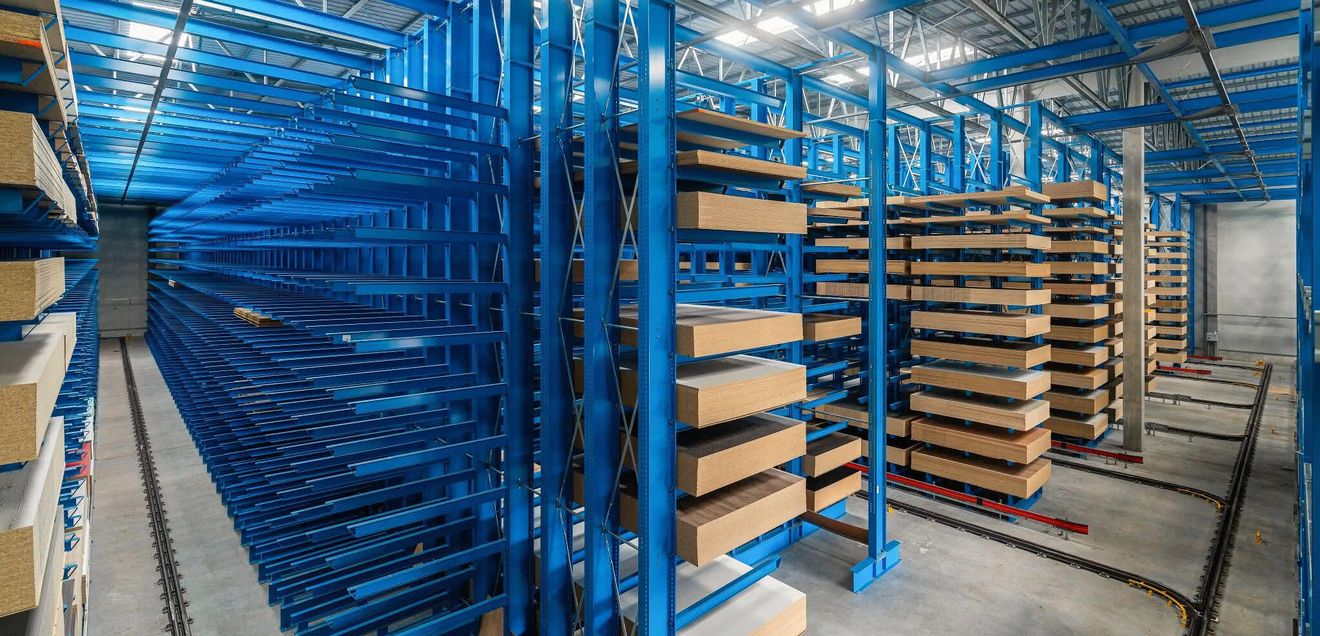
Another trend is the need for more flexible systems that can efficiently manage heterogeneous inventories. Here, cantilever racking with overlaying mesh shelves is taking center stage. Originally designed for long goods, they are becoming universal shelving systems with continuous lattice shelves, on which different loading aids and individual goods can be stored. The mesh shelves span the entire length of the shelving row and eliminate fixed shelf widths or obstructive access stands. Particularly in sectors with widely varying dimensions - such as the building materials trade - this creates "endless storage": bathtubs and washbasins, for example, can be placed close together on one level without unused residual space. This also makes it easier to adjust the product range at a later date, as the system does not specify a rigid grid.
Professionalization of warehouse organization
Many companies that have not focused on intralogistics for a long time are currently professionalizing their warehouse processes. Instead of complete automation - which is particularly worthwhile for very large sites with high volumes - they are initially focusing on partial automation and system support. These include forklift guidance systems that guide drivers efficiently through the warehouse, reduce empty runs and shorten routes. Warehouse management systems (WMS) also ensure transparency in inventories and storage locations and enable optimization based on key figures. The digitalization of warehouse processes requires the shelves to be equipped accordingly: for example, holders for signs or barcode labels to clearly identify storage locations and integrate them into higher-level IT systems.
Shelving replaces floor storage
The replacement of unstructured floor storage with shelving systems can be observed in many industries. This leads to greater efficiency in warehouse processes, a better overview of the stored goods and quick and direct access to individual items. A wide variety of shelving systems are used for this purpose. In the building materials trade, flow racks are particularly popular at the moment: they allow a similarly high level of space utilization as the classic floor block storage system, but enable significantly better access to the stored goods and the implementation of a FIFO strategy. Trade businesses are also increasingly relying on professional shelving systems: the reasons for this include more efficient processes, greater occupational safety and the implementation of legal requirements. However, the focus is also shifting to the customer's image: in contrast to chaotic floor storage, even a single, neatly organized row of shelves creates more trust and signals structure and reliability. It can also be observed that newly founded companies and start-ups are now investing directly in professional shelving systems. They attach particular importance to adaptable systems that can be easily expanded and can therefore grow with the business.
Sustainable solutions in demand
A trend towards sustainable shelving solutions can be seen in all investments in shelving systems. However, sustainability is not only limited to the lowest possible carbon dioxide emissions during production, but above all to aspects of longevity. This includes the longest possible guarantee against rusting through, resistance of the structure to knocks and damage and a long-term supply of spare parts so that systems can be usefully expanded or maintained over many years.
Across all developments, three leitmotifs can be identified in warehouse technology: Efficiency, safety and flexibility. Companies expect modern racking technology to make the best possible use of available space, support high turnover rates and at the same time guarantee safety for employees and goods. Equally important is the ability to react to changing product ranges, quantities and service requirements without having to plan the warehouse from scratch.


You might also be interested in
Visual Guidance for More Efficient Picking
Kardex announces the launch of the Intuitive Picking Assistant for the Kardex Shuttle. The new solution supports operators with intuitive visual guidance and is designed to make order picking even easier. The solution was unveiled for the first time...
 read more...
Efficiently Modernizing Loading Stations
Redesigning loading stations is a challenging task. Variations in pit dimensions and conditions make it difficult to replace loading bridges.
read more...Productivity guaranteed all day long
Rugged tablets for a wide range of applications
With the new 8-inch ZX80W and ZX80W-EX tablets, Getac is launching two rugged Windows 11 devices based on ARM architecture. The tablets are designed for mobile use in logistics, warehousing, and transportation.
read more...Unitechnik modernizes Hela logistics
Retrofit and new build closely linked
Hela Gewürzwerk Hermann Laue has laid the foundations for further growth at its Ahrensburg site by comprehensively modernizing its logistics. Together with Unitechnik Systems, a logistics center was created that combines new and existing structures.
read more...Movu Robotics at the Logimat 2026
Transformation to a 4-way pallet shuttle system
Movu Robotics, a member of the stow Group, will be demonstrating at Logimat how it is driving the large-scale transformation of automated storage and retrieval systems (ASRS) to 4-way pallet shuttle technology.
read more...Highly automated in all product ranges
Richard Kearns knows how his supply chain and his new warehouse in Hernando (Mississippi, USA) are doing because he receives feedback every day.
read more...PepsiCo Polska relies on Mecalux
PepsiCo Polska is working with Mecalux to drive forward the automation of its logistics and is planning an intelligent warehouse.
read more...Sixth AutoStore project for New Wave
Element Logic is implementing its sixth joint project with the New Wave Group: a future-proof AutoStore system for the logistics center in Geiselwind.
read more...Arvato further expands customs logistics in Turkey
With a new type A customs warehouse in Istanbul-Tuzla and additional capacity, Arvato is strengthening its cross-border logistics expertise and positioning Turkey as a strategic hub between Europe and Asia.
read more...