
Software
A Centralized View of Complex Processes
Today, medium-sized logistics companies must manage an increasingly diverse range of operations efficiently and reliably. Different modes of transport, customized customer solutions, and established workflows can hardly be accommodated by simplified, standard processes. One example of this is Ebeling Logistik, a company based in the Hanover region.
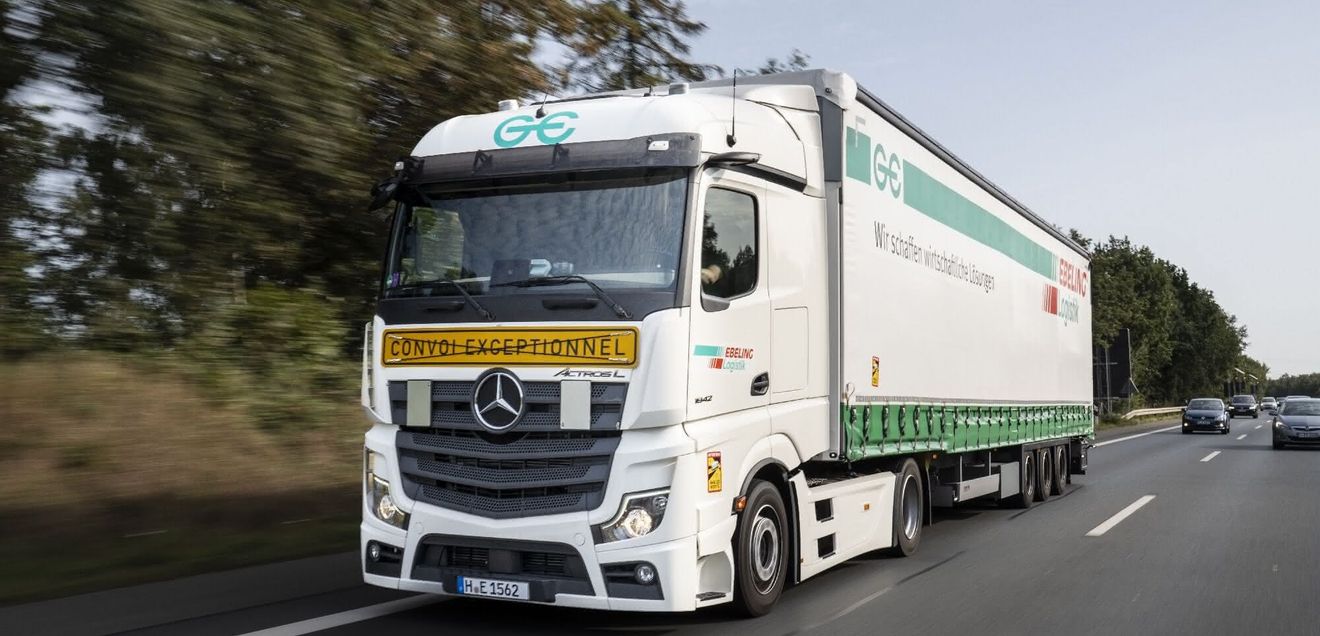
The company’s service portfolio—with 450 employees and approximately 170 vehicles—ranges from the distribution of food and retail goods to industrial transport, special and customized shipments, and warehouse logistics with value-added services. This diversity entails a high degree of operational complexity. “As a medium-sized logistics company, we must continue to develop our processes without limiting the diversity of our business model,” says Hendrik Ebeling, Managing Director of Ebeling Logistik. “For us, digitalization is not an end in itself, but a means of managing this complexity in the long term.”
A Scalable Platform Is Needed
To efficiently manage the diversity of its business areas, Ebeling Logistik relies on the WinSped Transport Management System (TMS) from LIS. This system brings together and centrally manages the various requirements for scheduling, billing, and communication with customers and partners. The requirements for the TMS include, among others, that processes must function seamlessly, be adaptable, and remain stable in day-to-day operations. Automation, interoperability, and meaningful analytics play a central role in this. “We don’t need a system that simplifies our processes, but one that realistically maps them,” says Ebeling. “It was important for us to have a platform that not only meets today’s needs but will also be further developed in the future.”
WinSped supports all of Ebeling Logistik’s core processes related to transportation and billing. The TMS serves as a central platform that brings together various processes. The locally operated system is supplemented by various modules, including .NET-based order entry, graphical scheduling, the billing center, special invoicing, integrated document management, and telematics and automation services. Looking ahead, web-based applications and carbon dioxide tracking are also set to be more closely integrated. Marcel Weber, IT Manager at Ebeling Logistik, says: “For us, WinSped is the central backbone of our transportation processes,” and he adds: “The system can be adapted to our processes in great detail and offers the necessary depth to efficiently manage different modes of transport on a single platform.”
Capable of mapping differentiated work methods
With the introduction of its .NET-based scheduling system, Ebeling Logistik has taken a significant step forward. Planning for the transition began in 2020, and implementation started in 2022. Since going live in early 2023, the company has been operating productively with the new system architecture. The platform-based approach is particularly evident in the scheduling module. Different modes of transport and customer requirements call for differentiated workflows, all of which can be mapped within a single interface. The .NET-based graphical scheduling module allows users to customize their work environment. According to the company, customizable views, filters, and shortcuts, along with improved performance, help dispatchers work more efficiently and with greater clarity.
"The transition to the .NET version was a challenging project," says Weber. "Today, we’re reaping the benefits of significantly more flexible scheduling, noticeably improved usability, and optimal support for our various requirements." The vehicles are directly connected to the system via the integrated telematics server. Orders, status updates, and documents are exchanged through the system, which eliminates media breaks and significantly speeds up communication between dispatch and drivers.
Semi-Automated Billing
Significant efficiency gains are particularly evident in the area of billing. The partial automation of processes has reduced the amount of manual work required. Standardized billing can be handled by the system, while at the same time taking into account individual billing logic for customer-specific agreements or special transportation requirements. “The partial automation of billing is particularly noticeable. According to our internal estimates, we’ve achieved time savings of about 20 to 30 percent in this area,” says Weber. “We automate where it makes sense, but we deliberately maintain flexibility for special requirements. This reduces the workload on employees and significantly speeds up processes.”
In addition, the invoicing process has been automated. The turnaround time from delivery to invoicing has been reduced, as delivery notes and other relevant documents are available digitally and in high quality immediately after an order is completed.
Media breaks avoided; high data quality achieved
WinSped serves as the central data hub at Ebeling Logistik. Transport orders are automatically imported into the system via integrated customer interfaces, while external systems—such as telematics solutions or document management systems—are also connected. This prevents data discontinuities and ensures high data quality. Direct, system-supported communication between dispatch and vehicles—including status updates, messages, and photo transmission—ensures that everyone involved stays informed. “The TMS is now an integral part of our day-to-day operations. Automated interfaces are key to making our processes stable, transparent, and efficient,” explains Weber.
Customizable Work Environments
User acceptance is a crucial factor for Ebeling Logistik. It is achieved above all when employees can adapt the system to their own work processes. Features such as custom filters and reports enable users to compile information in a targeted manner and focus on what matters most.
"We always address the issues that aren't going well first," says Weber. "But we quickly realized that our colleagues really appreciate the system’s capabilities." In particular, the targeted compilation of information helps provide a clear overview of day-to-day operations. Reports on routes, sales, or time periods are also used to better understand trends. “Looking back, many users now say: A lot has really changed. The system runs smoothly, is fast, and everyone has customized their work environment to suit their needs,” says Weber.


You might also be interested in
What Really Happens on the Road: Data Loggers Reveal Risks
Shipping damage often goes unnoticed and only becomes apparent at the destination. Data loggers provide objective information about vibrations, temperature, and humidity conditions throughout the entire supply chain. In this way, they help companies...
 read more...
Robotics Integration for Greater Efficiency in Inbound Goods Processing
Infios is helping Kellner & Kunz, a specialist in tooling and C-parts, expand its automation strategy. The next step in this long-standing partnership is the integration of robotics into inbound logistics.
read more...The Right Warehousing Solution for Every Logistics Need
Whether it’s an S/4HANA implementation, the urgently needed replacement of the traditional SAP WM, or the growing demands for digitalization and automation—many companies are faced with the question of which warehouse management system will best...
read more...Route planning and optimization solution
Jumbo backs Greenspan
The Dutch supermarket chain Jumbo has realigned its e-commerce logistics with Greenplan, the intelligent route planning and optimization solution from the Ehrhardt Partner Group.
read more...New version of Röhlig Realtime
Röhlig Logistics presents the enhanced version of "Röhlig Realtime". The company is supplementing its digital service portfolio with a central platform that ensures greater transparency and networking throughout supply chain management.
read more...Simulation gains in importance
The use of AGV and AMR systems continues to increase - at the same time, the complexity of planning and operation is growing. Traditional approaches quickly reach their limits.
read more...Gessmann and Wandelbots standardize...
Manufacturer-independent software orchestrates robotics fleets
Gessmann is presenting a new approach to industrial automation together with Wandelbots at Hannover Messe 2026 (Hall 16, Stand B10/1). The focus is on the coordination and integration of different robot systems in existing production and...
read more...LTW Intralogistics at the Logimat 2026
Efficiency and quality in the material flow
LTW Intralogistics is presenting its holistic approach to future-oriented material flow solutions at Logimat. Under the motto "Flow. In every detail", the company will be demonstrating how integrated systems, intelligent software, design and service...
read more...Kion significantly increases order intake
Kion holds its own in a difficult environment in 2025, increases order intake significantly and looks ahead to profitable growth in 2026 with a new segment name and efficiency gains.
read more...