
Stacker cranes, shuttle and robotics
Several Decathlon Warehouse Locations Automated Using a Standardized System
Decathlon, a sporting goods specialist, was looking for a standardized automation solution for seven warehouse locations. Exotec, an end-to-end integrator for warehouse automation, provided this solution through its Skyfleet multi-site program.
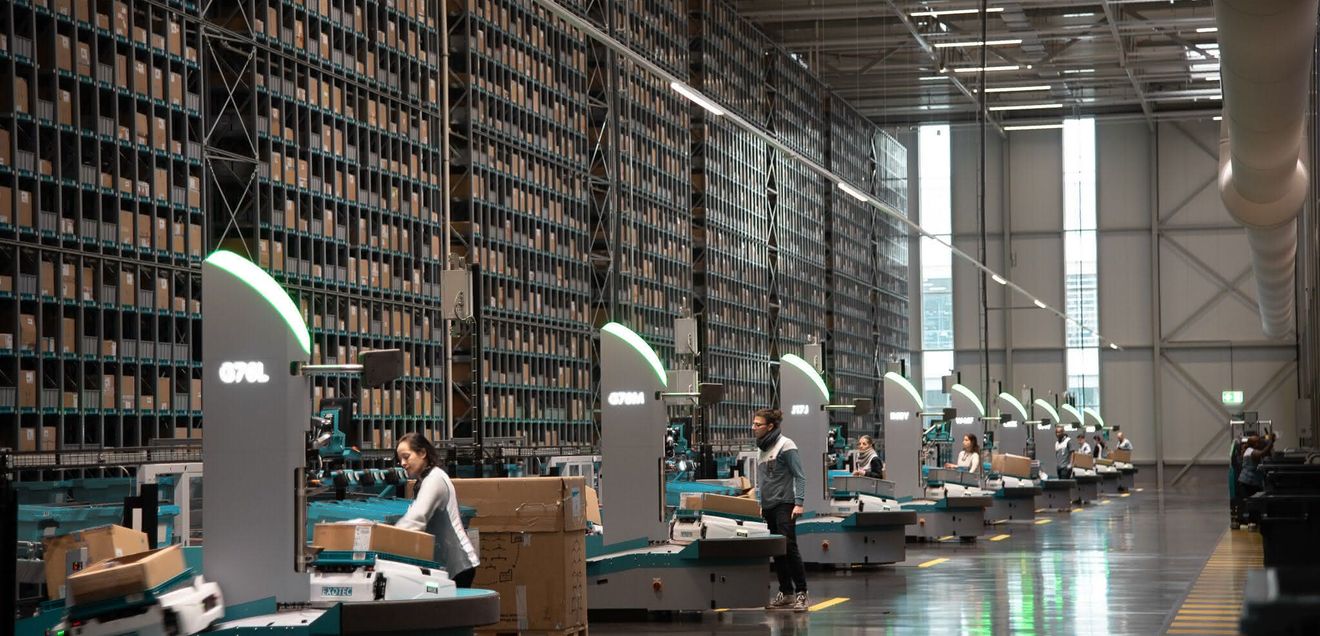
Automating store deliveries using single-item picking across multiple countries—that was the goal of sporting goods manufacturer Decathlon. More specifically, the project involved seven warehouse locations in England, France, Germany, Italy, and Portugal. After several years of growth in e-commerce and brick-and-mortar retail, a restructuring of the intralogistics operations was necessary. High-performance automation for all of these warehouses was intended to shorten the planning horizons for inventory forecasting. The goal was twofold: first, to implement efficient processes in the warehouses; and second, to reduce the required inventory levels in a standardized manner across all locations.
The Challenge: Standardized Automation
Looking back, whenever intralogistics specialists discussed the automation of a picking warehouse, it took only a few minutes before someone brought up the “major obstacle of customization” in the meeting: Everything had to be tailored to individual requirements and circumstances. That might have worked well, but it meant that the solution for Warehouse A couldn’t simply be transferred to Warehouse B. So how, under such conditions, could seven warehouses spread across Europe be brought under a standardized automation framework in less than three years? The answer was standardization. Exotec delivered this with its Skyfleet multi-site program.
The Decathlon solution is based on the modular Skypod system for storage and order fulfillment using autonomous robots. System components include, among other things, order-picking and packing stations, conveyor technology, and the Deepsky Warehouse Execution System (WES). Building on this, Exotec developed the Skyfleet program specifically for and in collaboration with Decathlon: a solution framework that was rolled out uniformly across the warehouses. The result is seven nearly identical automation systems, covering the entire process from goods receipt to goods issue. Exotec has integrated supplementary modules—which are not part of the basic Skypod system but are essential for a modern warehouse—into the overall design. These include depalletizers, carton openers, RFID tunnels, and palletizers, among others.
For Decathlon, the speed of implementation was the deciding factor in choosing to partner with Exotec. Jérôme Saillour, Head of Automation for Decathlon Logistics, offers an entirely positive assessment: "We were looking for someone to help us streamline our logistics network. We chose Exotec because this partner was able to roll out the solution across many locations in a short time and integrate scalable solutions that adapt to our changing requirements.” Exotec has also taken over operations and maintenance for the automation solution at the seven Decathlon warehouses.
High Availability Achieved
With the Skyfleet program, Decathlon has standardized store replenishment across the European continent. The distribution centers supply the stores, accelerate the flow of goods, and enable a reduction in inventory levels, resulting in significant savings in space, time, and costs. “The standardization provided by Exotec has enabled us to avoid inventory bottlenecks,” says Jérôme Saillour. And Siré Aw, a manager at Decathlon France Logistics, adds: “We’ve been able to demonstrate an availability rate of over 99 percent since the system was installed.”
Easy scalability
The standard configuration calls for 150 to 200 Skypod robots per warehouse. These are mobile units that move autonomously through the warehouse. Their number can be adjusted flexibly. The warehouses expand their Skypod fleets as needed—for example, during seasonal peak periods—and scale them back during slower periods. Decathlon also takes advantage of the ability to transfer robots between locations. This flexibility is demonstrated by the Ferrières location in France, where 13 additional robots were deployed on short notice without disrupting ongoing operations.
At the Northampton, England, location, the company also succeeded in reducing the space required for order preparation from 17,000 to 5,000 square meters. This had significant consequences for the workforce’s “walking distance”: The average daily walking distance per employee decreased from 10 to just 1 kilometer. Jérôme Saillour commented: “Our warehouse employees are benefiting from improved working conditions, as their tasks have become more varied and less physically demanding.”
Knowledge Transfer Between Portugal and Baden-Württemberg
One of the major advantages of the Europe-wide standardized design of seven automated warehouses is the ability to learn from one another: Each system implementation benefited from the previous one. The most recent one took just nine months. Using standardized dashboards in the Deepsky warehouse execution software, Decathlon monitors the performance of all locations and optimizes operations across the entire network.
The locations also share their experiences in day-to-day operations, as Diego Fernández, Warehouse Director at Decathlon Schwetzingen (Baden-Württemberg), clearly explains: "Up until now, each warehouse had its own unique characteristics: its own structures, its own processes, and its own inventory management. Thanks to Exotec, we now have a highly standardized system that allows us to implement improvements we achieve in Portugal here quickly and easily. And, of course, the same applies in the other direction.”


You might also be interested in
Arvato implements shuttle system for H&M in Poland
H&M will be able to handle its logistics in Central and Eastern Europe faster and more agile in future: Arvato has expanded its e-commerce distribution center in Stryków, Poland, and installed an automated shuttle warehouse with a capacity of up...
 read more...
Automation using shuttle technology and SAP
GC Corporation develops, produces and distributes dental products. In order to make the European subsidiary, GC Europe, fit for the future to meet increasing logistical requirements, the company expanded its storage and picking capacities at the...
read more...Intralogistics for steel wholesalers
Lemvigh-Müller relies on Knapp
Lemvigh-Müller is making its largest investment in logistics to date and centralizing two warehouses in Odense and Kolding, both in Denmark, into one distribution center in Kolding. This will ensure that Lemvigh-Müller can handle larger volumes of...
read more...New shuttle warehouse for BSH Hausgeräte in Dillingen
The ground-breaking ceremony for a shuttle warehouse for household appliance specialist BSH Hausgeräte recently took place in Dillingen, Bavaria. TGW Logistics will build a highly automated small parts warehouse there by spring 2027.
read more...Combined storage solution with transshipment and pallet warehouse
With the newly founded Faurecia Clarion Electronics (Fengcheng), Faurecia aims to become a global leader in electronics technology for vehicle cockpits. When it comes to intralogistics, the company relies on a combined warehouse solution from...
read more...Storage and order picking technology
SSI Schaefer automates for the market leader in ready-to-eat salads
Fresh Servant maximizes its performance through automation at its logistics center in Edsevö, Finland. The company relies on a complete system from SSI Schaefer, consisting of an SSI Cuby shuttle warehouse, pick-by-light picking and the WAMAS...
read more...30 million spare parts shipped annually
The manufacturer and supplier of automotive spare parts DRiV has put a new automated distribution center for Europe into operation. An automation solution from Knapp forms the heart of the system.
read more...Production and assembly flexibly supplied
Automotive supplier Magna manufactures exterior mirrors at its Assamstadt site in Germany. Magna relies on an automation solution from Knapp to cope with the changes in logistics and to be able to operate flexibly with a high level of vertical...
read more...Novaltia builds new distribution center with Knapp
The Spanish pharmaceutical wholesaler Novaltia is once again relying on a complete solution from Knapp: In the new distribution center at its headquarters in Zaragoza, logistics processes are to be streamlined and sequences made more precise by...
read more...