
Interview with Daifuku Europe
From a fixed sorter to a mobile robotic system
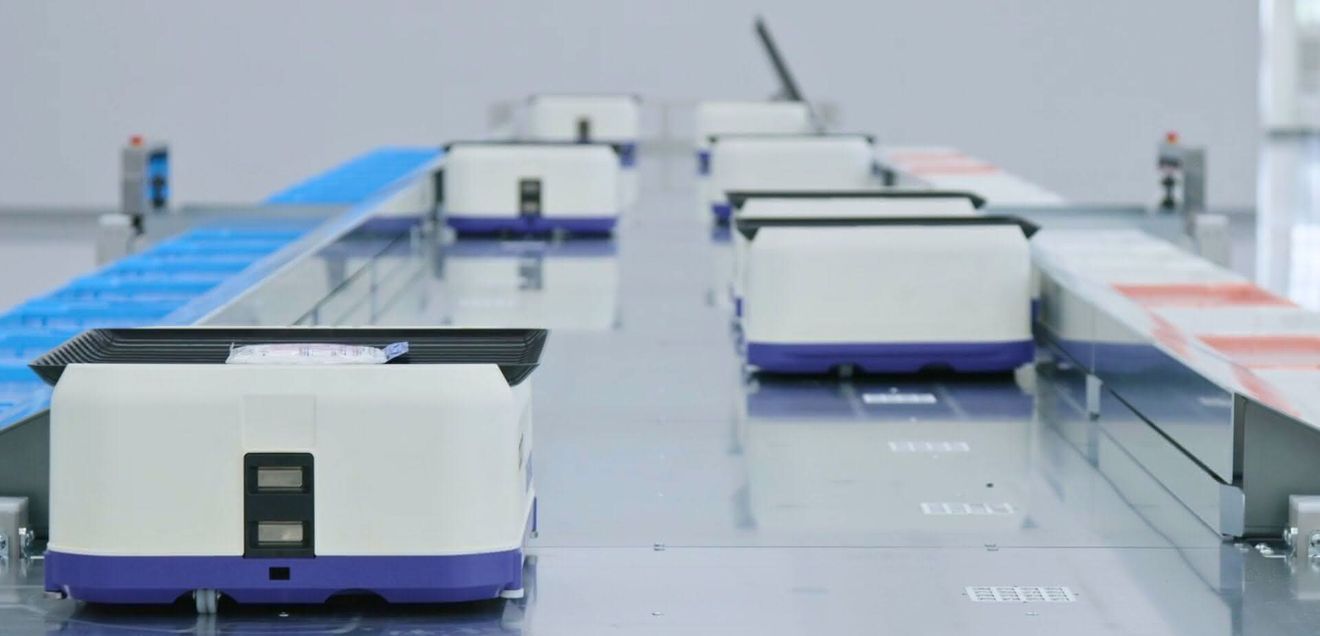
Goods-to-Person, rather than Put-to-Light, is shaping the next generation of sorting technology. While traditional sorting systems rely on fixed structures, mobile, robot-assisted concepts are rapidly gaining importance. With the SOTR-S, Daifuku Europe is pursuing an approach in which the goods come to the operator, rather than the other way around. In this interview, Russell Hutchinson, Head of Business Development at Daifuku Europe, explains the requirements that led to the development of the SOTR-S and the benefits this approach offers to operators and employees.
materialfluss: What was the main catalyst for the development of the
SOTR-S?

Russell Hutchinson: The development of the SOTR-S essentially stemmed from two parallel trends that we have observed very clearly in recent years. On the one hand, we are seeing increasingly volatile demand among our customers; on the other hand, the variety of goods to be handled is growing significantly. This poses challenges for traditional sorting systems: they must deliver high throughput while also being able to respond flexibly to different items. In addition, the growing labor shortage is significantly increasing the need for automation solutions.
With this in mind, we have developed the SOTR-S, a mobile, robot-assisted solution specifically designed for flexibility and scalability. It enables dynamic responses—without the limitations of traditional, highly manual processes. At the same time, we clearly see a trend toward systems that offer greater operational flexibility than traditional stationary sorting solutions.
mfl: Does the SOTR-S fundamentally change the material flow compared to traditional systems?
Hutchinson: The material flow remains essentially the same—the major change lies in the interaction between people and the system. In conventional “put-to-light” systems, operators move between different stations to pick items. This involves travel time, coordination efforts, and a certain degree of ergonomic strain. With the SOTR-S, we consistently follow the “goods-to-person” approach. This means the goods come to the operator—not the other way around. The robots bring the sorting units directly to the workstation. This significantly reduces travel time, and the operator can focus entirely on the sorting task.
mfl: A critical issue with robotic systems is traffic coordination. How do you prevent traffic jams within the fleet?
Hutchinson: That is indeed a key aspect. First, we use a two-tier system design. The robots move in a continuous loop in one direction, with traffic traveling in both directions on separate levels. This virtually eliminates oncoming traffic, which significantly reduces the risk of traffic congestion. Second, we use our Robot Traffic Controller, the RTC. This system handles the dynamic assignment of tasks and routes. Although the individual vehicles operate autonomously, the system is centrally coordinated and continuously optimizes traffic flows in the background—depending on current load and system status.
mfl: You've already mentioned the two-stage system. What exactly is the advantage over a single-stage solution?
Hutchinson: The main advantage lies in the decoupling of traffic flows. In single-level systems, interactions between vehicles are inevitable—resulting in evasive maneuvers, wait times, and, in the worst-case scenario, traffic jams. By distributing traffic across two levels, we can significantly reduce these interactions. This results in a more stable and efficient overall process. Another advantage is the more compact design: We can use narrower lanes, which improves space utilization in the warehouse. At the same time, operators also benefit, as their walking distances within the system environment can be reduced.
mfl: What advantages do you generally see in mobile, robot-assisted sorting systems compared to traditional solutions such as cross-belt or tray sorters?
Hutchinson: A key advantage is reliability. In traditional systems such as tray, slide-shoe, or cross-belt sorters, a single malfunction can bring the entire system to a standstill. With the SOTR-S, we have a distributed system architecture: If one robot fails, all the others continue to operate. This significantly increases system availability—especially during peak times. Maintenance work can also be performed while the system is running. Another key benefit is energy efficiency. Traditional sorters keep the entire system in constant motion. With the SOTR-S, however, only the components that are currently needed are activated—that is, individual robots, chutes, or conveyor segments. This selective operation noticeably reduces energy consumption.
mfl: How flexible is the system in terms of scalability?
Hutchinson: The design is modular from the outset. This means that the system can be adapted in terms of both capacity and structure. If higher throughput is required, the simplest and most common approach is to add additional robots. In addition, further sorting lanes or chutes can be integrated. This allows the system to adapt very well to growing demands—without requiring any major modifications.
mfl: Can you describe a typical system size?
Hutchinson: The specific design always depends on the required throughput. In one specific project, for example, we processed around 10,000 items at a rate of about 4,000 pieces per hour. This was achieved using approximately 100 robots and 250 chutes. This scale clearly demonstrates how scalable the system is.
mfl: Many operators face the challenge of integrating new technologies into existing systems. What should be kept in mind with the SOTR-S?
Hutchinson: From a mechanical standpoint, integration is relatively straightforward, as no direct physical connection to upstream or downstream systems is required. Items are loaded onto the vehicles manually. The real challenge lies more at the process level. It is crucial to clearly define the entire workflow—that is, item preparation before the system and further processing after sorting. Control systems also play a central role in this. Integration into existing WMS or WCS environments must be well thought out to ensure a seamless material flow.
mfl: And what specific benefits does this offer operators?
Hutchinson: The difference is very noticeable to the operators. In traditional scenarios, they move around a lot between different workstations—which is both time-consuming and physically demanding. With the SOTR-S, the operator remains at his workstation. The robots come to them, stop precisely, and allow them to easily place the items. This significantly reduces the amount of movement required. Additionally, there is no longer a need to place items on a continuously moving system—which requires a high level of concentration with traditional sorters. Overall, both physical strain and stress are reduced, and working conditions improve significantly.


You might also be interested in
Geberit Relys on Automated Intralogistics
At the Geberit plant in Bromölla, a new fleet of driverless transport vehicles is handling key logistics tasks. Still’s automated solution manages the flow of materials and connects systems, vehicles, and employees.
 read more...
Autonomous Forklift in the ABB Robotics Portfolio
With the new Flexley Stack F712 autonomous forklift, ABB Robotics is expanding its portfolio of mobile robots. The system is designed to automate material flow and intralogistics processes more efficiently and flexibly using AI-powered Visual SLAM...
read more...KUKA Automates Material Handling at a TV Manufacturer
At TPV Displays Polska, 22 autonomous mobile robots from KUKA handle internal material transport. The solution is designed to stabilize production, reduce the workload on employees, and make the material flow more efficient.
read more...Standardized in design, flexible in use
Automated guided vehicles are increasingly in demand in production and logistics as they automate processes efficiently - but in addition to the vehicle, the right peripherals are also crucial for safe operation. A new solution consisting of a...
read more...Toyota MH introduces SSAB Zero steel for LHM230 hand pallet trucks
Toyota Material Handling Europe has reduced the CO₂ emissions of its Toyota LHM230 hand pallet truck "from the cradle to the factory gate" by 18 percent. This was made possible by using SSAB Zero steel for the forks and frame.
read more...Kion significantly increases order intake
Kion holds its own in a difficult environment in 2025, increases order intake significantly and looks ahead to profitable growth in 2026 with a new segment name and efficiency gains.
read more...Shelving technology - these are the trends
The most frequently mentioned trends in intralogistics at the moment are artificial intelligence, robots and automation. However, every efficient warehouse solution is still based on the right racking technology. Giovanni Cataldi from heavy-duty...
read more...Industrial trucks for luxury cars
Optimized logistics for super sports cars
Automobili Lamborghini manufactures exclusive luxury and super sports cars. Founded in 1963 by Ferruccio Lamborghini, the company is still based at its traditional headquarters in Sant'Agata Bolognese.
read more...TwinFleet shows what industrial trucks really do
What are industrial trucks doing on the factory floor all day? Leadec TwinFleet answers this question: the solution creates transparency and shows starting points for optimizing the fleet and warehouse.
read more...