
Loading Docks
Efficiently Modernizing Loading Stations
Redesigning loading stations is a challenging task. Variations in pit dimensions and conditions complicate the replacement of loading bridges. Time-consuming and costly custom solutions are often required. With the new Series 3, Hörmann has developed a comprehensive concept designed to address these challenges systematically and cost-effectively.
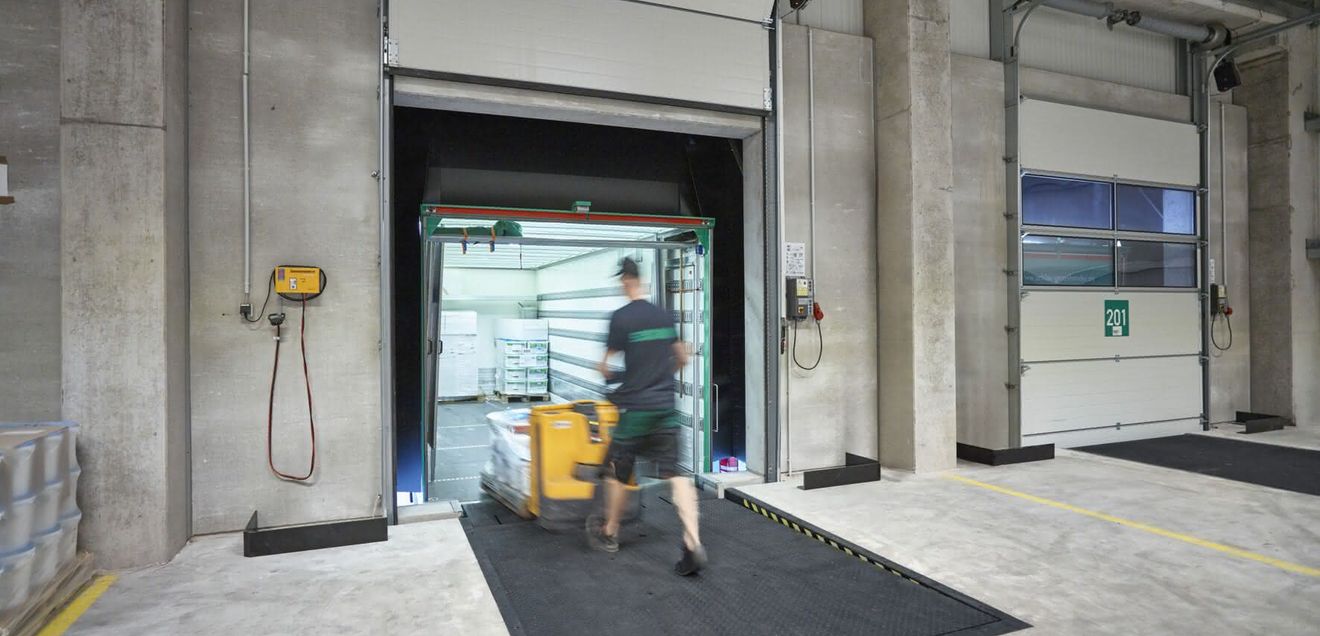
Whether it’s a renovation or a change of use: Replacing a loading dock is a lot of work and not much fun. Depending on the condition of the building structure, the process requires comprehensive planning, takes time and money, and often involves the construction of complex custom components with long lead times. With its Series 3 loading docks, Hörmann is now introducing a product family that makes replacement significantly easier. It includes sliding dock levelers (HTL3) and folding wedge dock levelers (HLS3) and offers a suitable solution for numerous installation scenarios, regardless of the manufacturer of the old system. At the heart of the system: Hörmann uses standard components that can be customized for the respective installation situations. According to the manufacturer, this allows renovations to be carried out much more quickly and cost-effectively.
Standardized Solutions for Complex Requirements
Depending on the structural conditions of the existing building, Hörmann assumes three different scenarios. Scenario 1: The existing pit meets standard requirements in terms of width and design. In this case, the new, compact Pit Model P in standard size can be installed. A length adapter is used to adjust the length.
In Scenario 2, the existing pit is too wide and/or too long for a standard size, or there is not enough steel in the correct location to connect the crossbeam. In such a situation, the newly developed Renovation Model R—which is optionally available with a length adapter—is used. The sides are designed so that the loading bridge can be easily adapted to fit the existing pit as needed, since the ordering system automatically configures the width adjustment.
Scenario 3: The pit is severely damaged. In this case as well, a standard design can be used: A pour joint is created by chiseling out the concrete, and a standard-size FR frame model is then cast into place. This eliminates the need for expensive custom designs—even when replacing old loading bridges that were not manufactured by Hörmann.
Steel quality reduces material usage
According to the manufacturer, a key feature of the new generation is the optimized steel quality. For the HTL3, Hörmann uses S355 steel with a thickness of 7/9 mm as the platform’s checker plate. For the HLS 3, this steel grade is available as an option. The advantage of this material is that it offers a higher load-bearing capacity than conventional S235 steel at 8/10 mm. The decisive factor here is not the material thickness alone, but the steel’s yield strength, which significantly determines its load-bearing capacity. The design of Series 3 takes this aspect into account and ensures high stability while reducing material usage. This not only minimizes the formation of ruts but also conserves resources and reduces carbon dioxide emissions by approximately 10% compared to the previous generation. Sustainability product passports, which Hörmann provides for all solutions in the series, verify the data and simplify the documentation process for sustainable construction projects.
Focus on Installation and Service
According to the company, the Series 3 is designed for easy installation and serviceability. Alignment aids allow for straightforward mounting in the pit frame, and the required positions of the weld seams are clearly marked. Standardized components and optimized accessibility reduce installation times and simplify maintenance work.
Today, the modernization of existing loading docks can be carried out systematically and cost-effectively. This makes it possible to accommodate a wide variety of structural conditions without the need for special designs.


You might also be interested in
Visual Guidance for More Efficient Picking
Kardex announces the launch of the Intuitive Picking Assistant for the Kardex Shuttle. The new solution supports operators with intuitive visual guidance and is designed to make order picking even easier. The solution was unveiled for the first time...
 read more...
Productivity guaranteed all day long
Rugged tablets for a wide range of applications
With the new 8-inch ZX80W and ZX80W-EX tablets, Getac is launching two rugged Windows 11 devices based on ARM architecture. The tablets are designed for mobile use in logistics, warehousing, and transportation.
read more...Unitechnik modernizes Hela logistics
Retrofit and new build closely linked
Hela Gewürzwerk Hermann Laue has laid the foundations for further growth at its Ahrensburg site by comprehensively modernizing its logistics. Together with Unitechnik Systems, a logistics center was created that combines new and existing structures.
read more...Movu Robotics at the Logimat 2026
Transformation to a 4-way pallet shuttle system
Movu Robotics, a member of the stow Group, will be demonstrating at Logimat how it is driving the large-scale transformation of automated storage and retrieval systems (ASRS) to 4-way pallet shuttle technology.
read more...Shelving technology - these are the trends
The most frequently mentioned trends in intralogistics at the moment are artificial intelligence, robots and automation. However, every efficient warehouse solution is still based on the right racking technology. Giovanni Cataldi from heavy-duty...
read more...Highly automated in all product ranges
Richard Kearns knows how his supply chain and his new warehouse in Hernando (Mississippi, USA) are doing because he receives feedback every day.
read more...PepsiCo Polska relies on Mecalux
PepsiCo Polska is working with Mecalux to drive forward the automation of its logistics and is planning an intelligent warehouse.
read more...Sixth AutoStore project for New Wave
Element Logic is implementing its sixth joint project with the New Wave Group: a future-proof AutoStore system for the logistics center in Geiselwind.
read more...Arvato further expands customs logistics in Turkey
With a new type A customs warehouse in Istanbul-Tuzla and additional capacity, Arvato is strengthening its cross-border logistics expertise and positioning Turkey as a strategic hub between Europe and Asia.
read more...