
Logistics real estate
Logistics real estate seismograph Q2 2016: Moderate new construction momentum
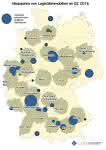
Munich, 26.07.16 - With over 561,970 sqm of newly built logistics space, the second quarter saw significant growth compared to the first quarter with just 454,850 sqm. Compared to the same period of the previous year, however, total new construction activity declined in the first half of 2016: While ground was broken for 1.23 million sqm of space in 2015, 1.07 million sqm of new logistics space was built a year later. The industrial sector remains the largest user group: at currently 44%, the proportion of industrial companies is similar to the previous quarter (58%). This is shown by the current logistics real estate seismograph, which is published quarterly by Munich-based logistics real estate consultant Logivest and the Fraunhofer Working Group for Supply Chain Services.
The top region of Hanover in particular benefited from the rising volume of new construction, with 92,500 sqm, making it the most dynamic region in the second quarter. It was followed by the top region of Rhine-Neckar, which recorded a total of 83,000 sqm of newly built logistics space. In Q2, the eastern Ruhr region was unable to match the high level of new construction activity seen in the first quarter, but remains the most dynamic top logistics region in Germany in the first half of the year. As far as the development of the top logistics regions as a whole is concerned, the proportion of new builds fell from 85% in Q1 to currently 62% within the established logistics locations. The top regions of the Lower Rhine, Rhine-Main, Swabia, Danube and Upper Rhine, which were all still at the top last year, are now showing less momentum in terms of new construction and have so far fallen short of their high figures from the previous year.
New logistics property construction: industry is the strongest user
In terms of the current user structure, the industrial sector currently has an above-average share of 44% compared to 31% in 2015. This shift is primarily at the expense of the retail sector, which currently has a share of 29%. In the second quarter of 2015, this figure was 45%. Logistics service providers remain at a relatively constant level and currently take up 26% of new space compared to 23% in 2015. "The increase in logistics space usage by industrial companies is currently being driven primarily by car manufacturers and suppliers. Around 250,000 sqm of logistics space was created in 2016 for production supply, handling the spare parts business and export logistics," says Kuno Neumeier, Managing Director of Logivest GmbH. red


You might also be interested in
Automation Is Driving Up Demand for Logistics Space
Warehouse automation is growing significantly in Europe. According to a study by Prologis, 50 percent of modern logistics space is expected to be automated by 2035.
 read more...
Prologis starts first construction phase
Major project in Dortmund
Prologis has started construction of the Dortmund DC4WARD logistics, commercial and light industrial park. Around 130,000 square meters of modern space with a focus on sustainability and energy-efficient operation will be built on the former...
read more...Logistics real estate: Logivest brokers in Bielefeld to Qtrado
In Bielefeld, logistics real estate consultant Logivest has brokered around 6,000 square meters of warehouse space for rent to Qtrado. The property belongs to the Fixemer Real Estate Group, an international real estate company.
read more...Dachser strengthens logistics location...
Investment worth millions in the Allgäu
Dachser is investing around EUR 30 million in the expansion of its Allgäu logistics center in Memmingen. A new facility for industrial and consumer goods with additional handling, storage and office space will be built by spring 2027.
read more...MLP Group plans second city logistics property in Vienna
The MLP Group is further expanding its Austrian portfolio with a second project in the capital city of Vienna. With the acquisition of a site near Vienna Central Station, the developer is pursuing the goal of consolidating its role in an expanding...
read more...Arvato further expands customs logistics in Turkey
With a new type A customs warehouse in Istanbul-Tuzla and additional capacity, Arvato is strengthening its cross-border logistics expertise and positioning Turkey as a strategic hub between Europe and Asia.
read more...Gebhardt expands into France
The Gebhardt Intralogistics Group is expanding into France and opening its first location in Paris. This strengthens the company's presence in one of Europe's most important logistics markets.
read more...11,000 square meters of logistics space for Magnera
In Gaggenau, Baden-Württemberg, the logistics real estate consultant Logivest has brokered a logistics location for Magnera for long-term rental.
read more...Arvato expands AutoStore system in the UK
Arvato and AutoStore have expanded the automated warehouse system at the Hams Hall site near Birmingham by over 30 percent in just three months. The aim is to support the growth of international customers in the UK market more quickly and flexibly.
read more...