
Growth 2019
Increased throughput in the Port of Hamburg
Seaborne cargo throughput rose to 136.6 million tons in 2019, while container throughput of 9.3 million TEU ensured strong growth of 6.1%. However, rail transport achieved a record result.
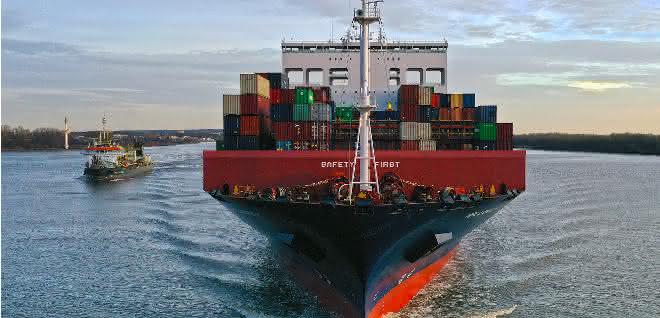
Germany's largest universal port reported a good result for 2019 with seaborne cargo throughput of 136.6 million tons (+1.1 percent) despite a slowdown in global trade and existing trade sanctions. "With a significant increase in container throughput, growth in seaborne cargo throughput and the disproportionate increase in environmentally friendly hinterland transport by rail, it is clear that the Port of Hamburg is on the right track," said Senator Michael Westhagemann.
Container transport in seaport-hinterland traffic increases
In seaport-hinterland traffic, which is so important for the Port of Hamburg, environmentally friendly container transport by rail in particular saw double-digit growth. In 2019, a total of 2.7 million TEU were transported by rail between the terminals in the Port of Hamburg and terminals inland. This is an increase of 10.4 percent and another record result for the Hamburg port railroad. Around 62,000 freight trains with around 1.7 million freight wagons ran on its network in 2019. A total volume of 48.2 million tons of goods was transported (+3 percent).
In 2019, a total of 5.8 million TEU (+7.8 percent) and 97.5 million tons (+0.8 percent) were handled in landside seaport-hinterland transport by rail, truck and inland waterway vessel. In 2019, rail accounted for 46.3% of landside hinterland traffic in Hamburg in terms of container transport and 49.4% (+1.0%) in terms of tonnage transported. The truck share is 41.4 percent and inland waterway vessels have a share of 9.2 percent.
More than 100 liner services connect Hamburg with the majority of the world's more than 1,000 seaports. "In addition to the launch of four new transatlantic liner services, which brought us strong growth in container traffic with the USA and Mexico, a new Asia service, an India service and two multi-purpose services also provided additional cargo. We are taking this upswing with us into 2020," explains Axel Mattern, Port of Hamburg Marketing Director.
In seaborne container traffic with China, Hamburg's most important trading partner, a total of 2.6 million TEU (+1.7 percent) were handled in Hamburg in 2019. "The impact of the coronavirus on foreign trade volumes with China cannot yet be precisely determined. However, depending on the length of the restrictions in the Chinese economy, there is likely to be a significant decline, which will then also be reflected in the handling of Chinese cargo in Hamburg with a time lag. We will not be able to assess this until the end of the first quarter at the earliest," estimates Mattern.
The HHM Executive Board assumes that this will also lead to a decline in rail transportation between China and Hamburg. In addition to the daily seaborne connections with China, more than 200 connections per week are now offered from Hamburg via the landside New Silk Road by rail.
For 2020, the Port of Hamburg's marketing organization expects a stable result in container traffic and a slight increase in bulk cargo handling.


You might also be interested in
Maersk and Hapag-Lloyd agree on joint operational cooperation
Hapag-Lloyd and Maersk have signed an agreement for a new, long-term operational cooperation called "Gemini Cooperation", which will start in February 2025. The aim is to create a flexible and interconnected service network in maritime...
 read more...
Successful 2023 - subdued prospects for 2024 in Bremen
As part of the 11th Project Logistics Forum, BHV-Bremische Hafen- und Logistikvertretung presented the initial results of its survey for the current "BHV Project Logistics Monitor".
read more...New rail transshipment facility in Bremen
Rhenus Weserport Bremen is building a fully automated new rail transshipment facility for loading aluminum hydroxide and aluminum oxide at Terminal 4 of Bremen's industrial port.
read more...Rising demand for nearshoring
The trend towards nearshoring is continuing even after the coronavirus pandemic, according to Munich-based international freight forwarder Robert Kukla. The intermodal service provider is seeing continued growth in transport from Turkey and the...
read more...Doubled storage space in Allermöhe
Nagel-Group is launching an extensive expansion and modernization project at its Hamburg site. Germany's largest food logistics company will completely restructure the site in the Allermöhe industrial estate.
read more...Port of Hamburg handles 58.2 million tons
Both the tense economic situation in Europe, and in Germany in particular, and the geopolitical conditions continue to have an impact on handling in the Port of Hamburg.
read more...Port of Hamburg suffers from loss of Russian business
The difficult economic development of the global economy is affecting the handling figures of the Port of Hamburg. As in other ports in Northern Europe, seaborne cargo throughput in Hamburg is declining, although individual trade lanes are...
read more...Green logistics facility for Mercedes-Benz
The largest photovoltaic system on an industrial building in Germany to date is the hallmark of the new "C3 Bremen" logistics center in the Freight Village of the Free Hanseatic City.
read more...Challenging year - positive outlook
Hamburger Hafen und Logistik AG (HHLA) performed successfully in the 2022 financial year despite challenging conditions.
read more...