
Kiel upgrades
Shore power system inaugurated at Norwegenkai
Ceremonial inauguration of the first shore-side power plant in Kiel's commercial port: On May 9, Schleswig-Holstein's Minister President Daniel Günther, the Federal Government's Coordinator for the Maritime Economy Norbert Brackmann, Kiel's Lord Mayor Dr. Ulf Kämpfer, together with Kiel Seaport Managing Director Dr. Dirk Claus and Color Line CEO Trond Kleivdal, officially put the plant into operation at Norwegenkai.
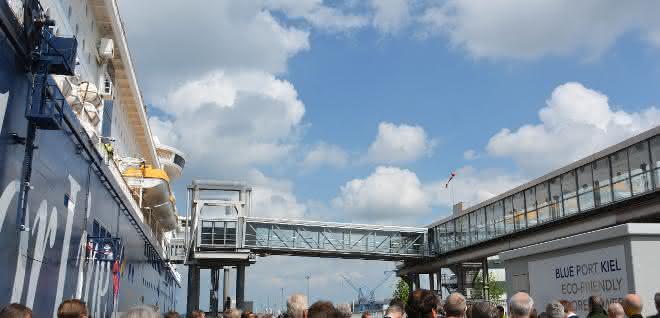
From now on, Color Line's large cruise ferries in Kiel can be supplied with emission-free shore power. Minister President Günther: "Together we are making an important contribution to keeping the air clean. By using shore power, we are reducing both pollutant emissions and greenhouse gas emissions to zero while the ships are in port. Schleswig-Holstein is supporting this pioneering project and will promote further systems of this kind." After the Norwegenkai, the Schwedenkai and the cruise terminal at the Ostseekai are also set to become shore power-capable in the coming year. Dirk Claus: "In future, we want to cover 60 % of the energy requirements of the ships calling at Kiel with shore power. This will make us one of the most environmentally friendly ports in Europe."
The Port of Kiel is the client of the shore power system, which was built by Siemens AG. The investment amounts to 1.2 million euros and is being subsidized by the state of Schleswig-Holstein with 400,000 euros. Lord Mayor Ulf Kämpfer: "As a climate protection city, Kiel wants to become climate-neutral by 2050. We can only achieve this ambitious goal if everyone helps. The new state-of-the-art shore-side power plant will help to significantly reduce CO2 emissions in the port. I am very pleased that Color Line is leading the way in this matter - and I would like to see other shipping companies follow suit." The ships of the Norwegian Color Line, the "Color Fantasy" and the "Color Magic", connect Kiel with Oslo every day. Arrival at the Norwegenkai is at 10.00 a.m. with departure at 2.00 p.m. The annual electricity requirement during the port laytime is around 4 million kilowatt hours. Trond Kleivdal, CEO of Color Line: "Our ships are equipped to draw electricity from shore and have been plugged into the port socket in Oslo since 2011 and in all four Norwegian ports since 2017. With Kiel, another port is now providing the necessary infrastructure to further advance and support our strategy to protect the environment. Now it is up to the German government to reduce the EEG levy on shore-side electricity in order to create an improved economic framework."
Norbert Brackmann commented on the occasion of the inauguration of the shore-side power system in Kiel: "Shore-side power is a good way to make a significant contribution to cleaner air in port and seaport cities. It is therefore definitely a good thing to have a shore power system. However, it is even better if it is also used by the ships. We will therefore pave the way at federal level to make shore-side power competitive. As the federal government's coordinator for the maritime industry, I am committed to this."
The shore power system from Siemens for the Norwegenkai in Kiel is precisely tailored to the needs of the shipping company and the port. It has a maximum connected load of 4.5 megawatts (MW) at an electrical voltage of 10 kilovolts (KV) and a grid frequency of 50 hertz (Hz). Dirk Claus: "The considerable performance data and daily operation will result in a high environmental benefit. The new plant supplies the largest amount of shore-side electricity in the whole of Germany." The heart of the system is the air-insulated, metal-encapsulated Siemens medium-voltage switchgear. The PLUG shore-to-ship transfer station (PLUG) is from the French manufacturer NG3. It is equipped with a programmable logic controller (PLC) that communicates with the switchgear in the shore station. All the necessary switching operations transmitted from the ship via the interface are carried out fully automatically. Before the power is transferred from shore to the ship, the system checks the correct plug and cable connections. Once this has been done, the shore power connection is switched on. The ship synchronizes with the shore power system, which takes over the on-board power supply.


You might also be interested in
Karsten Dirks becomes operational managing director
As of today, the 53-year-old will take over the operational management of BLG AutoTerminal Bremerhaven. In future, he will be responsible for the site together with Commercial Managing Director Jan Bellendorf.
 read more...
Port of Hamburg suffers from loss of Russian business
The difficult economic development of the global economy is affecting the handling figures of the Port of Hamburg. As in other ports in Northern Europe, seaborne cargo throughput in Hamburg is declining, although individual trade lanes are...
read more...Kiel seaport receives connection to Verona via Hanover/Lehrte
In rail freight transport, Kiel's seaport is gaining additional capacity and faster connections. Since the beginning of September, five new train pairs have been running weekly from Kiel to Verona in northern Italy via the Lehrte mega hub.
read more...First direct train from China reaches JadeWeserPort Wilhelmshaven
On July 13, the first direct train from the Chinese city of Hefei in Anhui province arrived at the JadeWeserPort Wilhelmshaven freight village. The train departed from Hefei on 25 June with a volume of around 100 TEU, mainly household appliances,...
read more...Normalization expected in late spring
Port of Kiel can almost maintain cargo throughput at 6.92 million tons
A total of 6.92 million tons of freight crossed the quayside at Kiel's seaport in 2020. This corresponds to only a slight decrease of 1.2 % compared to the same period last year.
read more...New shipping service gives breakbulk a boost in Rotterdam
In contrast to the neighboring seaports, the port of Rotterdam recorded growth in the volume of bulk goods in 2019.
read more...Covid-19 task force: Port of Antwerp works 100 percent
A Covid-19 task force met at the port of Antwerp for the first time on March 20. One thing is certain: the port of Antwerp remains 100 percent operational.
read more...Hamburger Hafen und Logistik AG
HHLA CEO: Stable operations at the port guaranteed
The supply of the population and companies with goods via the terminal facilities of Hamburger Hafen und Logistik AG (HHLA) is ensured regardless of the measures taken to protect against the spread of the coronavirus, says the head of HHLA.
read more...Container traffic between the Czech Republic and the Port of Hamburg develops positively
Every year, around three million tons of goods are transported to and from the Czech Republic via the port of Hamburg.
read more...