
Normalization expected in late spring
Port of Kiel can almost maintain cargo throughput at 6.92 million tons
A total of 6.92 million tons of freight crossed the quayside at Kiel's seaport in 2020. This corresponds to only a slight decrease of 1.2 % compared to the same period last year. Declines in Scheerhafen and Norwegenkai were offset by growth in Ostuferhafen and Schwedenkai. Dr. Dirk Claus, Managing Director of Seehafen Kiel GmbH & Co KG: "The economic impact of the Covid pandemic has presented the maritime industry with major challenges. In this situation, the Port of Kiel has succeeded in almost maintaining its handling result and helping to secure supply chains." Ferry services to Sweden and Lithuania have proven to be particularly stable, with a slight increase in the volume of goods transported. In contrast, Kiel recorded a slump in the area of maritime tourism. In 2020, only a good 517,500 passengers boarded or disembarked via the various terminals due to coronavirus, which is 78% fewer travelers. Dirk Claus: "This year, we expect the situation to normalize, especially from late spring and summer."
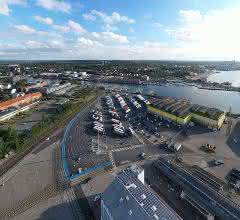
The Port of Kiel invested around EUR 17 million in the port facilities last year and was thus able to complete important projects. For example, the new apron of the Ostuferhafen was opened in late summer and the new terminal at Ostseekai, berth 28, was put into operation. Dirk Claus: "We are now in the advantageous position of having completed the major medium-term investments." The largest single measure, with an investment volume of EUR 15 million, was the construction of the shore-side power plant at the Ostseekai, which can also supply the Stena Line ferries at Schwedenkai with 100% emission-free green electricity. Dirk Claus: "All inner-city terminals now have a shore power connection. This means that we can already cover 50 % of the energy requirements of the ships calling at Kiel emission-free and - thanks to the reduction in the EEG levy - at competitive prices." The Port of Kiel is now turning its attention back to the Ostuferhafen, where a shore power connection and another RoRo ramp are also planned.
Record result in combined transport and digitization push
In ferry traffic, which accounts for 85 % of the Port of Kiel's handling performance, a total of almost 240,000 cargo units were loaded and unloaded last year. This corresponds to an increase of 2.3 %, whereby the increase in unaccompanied trailers was disproportionately high. At the same time, a record result was achieved in environmentally friendly hinterland transport by rail. For the first time, 32,957 cargo units (up 38.2 %) were loaded onto wagons in Kiel. The establishment of a block train connection to and from Bettembourg (Luxembourg), which is operated three times a week, contributed significantly to this result. Digitalization at the Port of Kiel also received a major boost in 2020. For example, the automated Gate Information & Operation System (Agios), which works across all customers for the ferry services and the forest products terminal, was put into operation in the Ostuferhafen. Agios optimizes and accelerates gate processes by automatically comparing electronic bookings with the license plates of incoming trucks. Once the data is complete, the previous counter check-in for truck drivers is no longer necessary.


You might also be interested in
Karsten Dirks becomes operational managing director
As of today, the 53-year-old will take over the operational management of BLG AutoTerminal Bremerhaven. In future, he will be responsible for the site together with Commercial Managing Director Jan Bellendorf.
 read more...
Port of Hamburg suffers from loss of Russian business
The difficult economic development of the global economy is affecting the handling figures of the Port of Hamburg. As in other ports in Northern Europe, seaborne cargo throughput in Hamburg is declining, although individual trade lanes are...
read more...Kiel seaport receives connection to Verona via Hanover/Lehrte
In rail freight transport, Kiel's seaport is gaining additional capacity and faster connections. Since the beginning of September, five new train pairs have been running weekly from Kiel to Verona in northern Italy via the Lehrte mega hub.
read more...First direct train from China reaches JadeWeserPort Wilhelmshaven
On July 13, the first direct train from the Chinese city of Hefei in Anhui province arrived at the JadeWeserPort Wilhelmshaven freight village. The train departed from Hefei on 25 June with a volume of around 100 TEU, mainly household appliances,...
read more...New shipping service gives breakbulk a boost in Rotterdam
In contrast to the neighboring seaports, the port of Rotterdam recorded growth in the volume of bulk goods in 2019.
read more...Covid-19 task force: Port of Antwerp works 100 percent
A Covid-19 task force met at the port of Antwerp for the first time on March 20. One thing is certain: the port of Antwerp remains 100 percent operational.
read more...Hamburger Hafen und Logistik AG
HHLA CEO: Stable operations at the port guaranteed
The supply of the population and companies with goods via the terminal facilities of Hamburger Hafen und Logistik AG (HHLA) is ensured regardless of the measures taken to protect against the spread of the coronavirus, says the head of HHLA.
read more...Container traffic between the Czech Republic and the Port of Hamburg develops positively
Every year, around three million tons of goods are transported to and from the Czech Republic via the port of Hamburg.
read more...New election and repositioning
Harm Sievers manages GETO
The Group of European TransEurasia Operators and Forwarders (GETO) will in future be headed by Harm Sievers. The Annual General Meeting elected the former GETO Board member to the new position.
read more...