
Decline in seaborne cargo handling
Corona pandemic slows down the port of Hamburg
The negative effects of the coronavirus pandemic, which are being felt worldwide, are also having an impact on the handling performance of Germany's largest universal port. In the first six months of the year, only 61.2 million tons of seaborne goods were loaded or unloaded at the terminals in the Port of Hamburg.
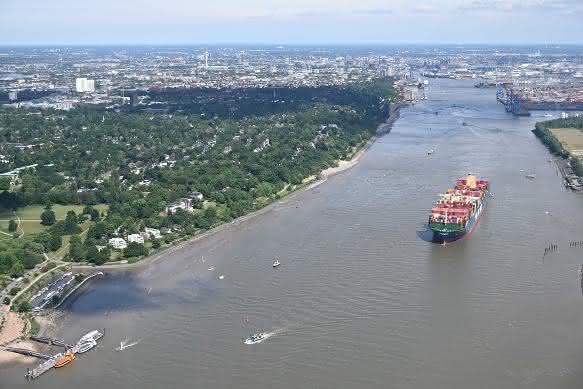
This is a decrease of 12.0%. Both main handling segments were affected. General cargo throughput of 42.5 million tons (-12.2 percent) and bulk cargo throughput of 18.7 million tons (-11.7 percent) were both significantly below the previous year's good result. In the container handling segment, a total of 4.1 million TEU (20-foot standard containers) were lifted over the quayside in Hamburg in the first half of the year. This represents a year-on-year decline of 12.4 percent.
"Of course, we are not pleased with this development, but the pandemic-related decline in throughput in the first half of the year has hit all ports in Northern Europe hard. As expected, it was more severe in the second quarter than in the first three months due to the weak global economy and the fact that global supply chains were partially suspended or only running with a very long delay," says Axel Mattern, CEO of Port of Hamburg Marketing e.V.
However, it is important that the port continues to provide its handling and logistics services 24/7. The reliable supply of goods and raw materials to the population and the economy is running smoothly, even under the difficult global economic conditions, emphasizes Mattern. "The port is fully operational with its handling terminals, logistics and service operations as well as the transport connections with the inland. Our customers appreciate this and it gives our employees security," says Mattern.
The biggest drop in volume compared to the same period last year was in imports. At 33.7 million tons (-16.3%), imports in the first six months were significantly weaker than exports, which at 27.5 million tons (-6.1%) were only
(-6.1 percent), which only recorded a single-digit decline. On the import side, the drop in steel production in particular led to less handling of ore and coal. In the grab cargo and liquid cargo sub-segments, overall declines of 24.0% and 10.5% respectively were recorded. In contrast, agribulk handling in the suction cargo segment developed positively in the first half of the year, reaching a volume of 4.1 million tons (+30.8%). Significantly more exports of grain and fertilizers are the main reason for the very good handling performance in the first half of the year.
The development of container throughput with the Port of Hamburg's ten most important trading partners in terms of volume varied greatly in the first six months. With the exception of Denmark, six countries recorded significant double-digit declines. In particular, the slump in seaborne container throughput with China (-16.4 percent), Hamburg's most important trading partner by far, could not be offset by positive developments in other countries. In addition to China, Russia (-14.9 percent), Sweden (-13.3 percent), South Korea (-14.4 percent), Denmark (-2.7 percent) and Poland (-10.5 percent) also recorded declines in seaborne container throughput. "The shutdown of the Chinese economy and the resulting suspension of liner services - blank sailings in shipping - led to lower handling volumes. These effects were reflected in the result for the first half of the year with a time lag," explains Mattern, who has, however, noticed an initial recovery in Chinese traffic on the import and export side since July.
In addition to the USA (+1.7 percent), trading partners with growth include Singapore (+5.5 percent), the United Kingdom (+39.0 percent) and Malaysia (+1.7 percent). The USA, which follows in second place in the ranking of container partners, recorded growth of 1.7% in the first half of the year with a total of 288,000 TEU. "This strikingly positive development is due to four transatlantic services launched in Hamburg at the beginning of 2019, which have now developed very well and are ensuring larger handling volumes, especially in container traffic with the USA," says Mattern. Singapore, in third place, also achieved an increase of 5.5 percent with 212,000 TEU in the first six months. According to Mattern, transhipment traffic with countries in the region routed via Singapore accounted for a significant share of this growth. Empty container equipment for German industry in particular is delivered from the UK.
For the coming months, Axel Mattern and his fellow Executive Board member Ingo Egloff assume that the Port of Hamburg can initially expect a continuation of the blank sailings and a rather slow recovery in overall throughput. "In the last two months, the slow economic recovery in China and Europe has stabilized ship departures. I am confident that we have now reached the bottom of the pandemic-related decline in seaborne cargo throughput and that we will see the first noticeable recovery and improvement in the economy by the end of the year," explains Ingo Egloff. Production in the manufacturing industry rose by 8.9 percent in June compared to the previous month, but is almost 12 percent lower than in the previous year. According to Egloff, this shows the dramatic nature of the economic development. The slump in economic output has never been so severe since the Federal Republic of Germany was founded. "Even if the export industry reports growth, it will take time to get back to pre-crisis levels. And we haven't even taken into account trade wars, sanctions and coronavirus outbreaks in other parts of the world. On top of this, Germans are holding back on consumption to the tune of EUR 130 billion. Of course, this is also putting pressure on imports of consumer goods such as textiles." The Port of Hamburg's marketing organization therefore assumes that a very good handling result like last year's will no longer be achievable this year.


You might also be interested in
Roman Fürtig is Port of Hamburg Marketing Representative Germany East
At the turn of the year, Roman Fürtig took over the management of the HHM Representative Office Germany East of the Port of Hamburg.
 read more...
Port of Hamburg handles 58.2 million tons
Both the tense economic situation in Europe, and in Germany in particular, and the geopolitical conditions continue to have an impact on handling in the Port of Hamburg.
read more...Sustainable across the Rhine
The "GAS 95", another innovative ship design from the HGK Shipping Design Center, has been sailing on the Rhine since 8 February: low-emission thanks to diesel-electric propulsion, future-oriented thanks to its "future-fuel-ready" design and...
read more...Germany's first center for remote-controlled ships opened
Seafar, a Belgian technology and service provider for remote-controlled and crew-reduced inland navigation, has set up the first so-called Remote Operations Center in Germany together with its project partners HGK Shipping and Reederei Deymann.
read more...Ole Trumpfheller new Head of Northern Europe at Maersk
Effective May 1, 2024, Ole Trumpfheller will assume the role of Vice President and Managing Director of Maersk's North Europe Continent (NEC) Area, based in Hamburg.
read more...NWL and DBR Hamburg cooperate in container handling
Norddeutsche Wasserweg Logistik (NWL) and Deutsche Binnenreederei (DBR) Hamburg declare their official merger in the container business.
read more...LHG holds its own in a difficult environment
Total throughput decreases moderately by 4.8 percent
read more...Maersk and Hapag-Lloyd agree on joint operational cooperation
Hapag-Lloyd and Maersk have signed an agreement for a new, long-term operational cooperation called "Gemini Cooperation", which will start in February 2025. The aim is to create a flexible and interconnected service network in maritime...
read more...Port of Hamburg: Zapp becomes EMP
The Zapp IT platform - the comprehensive and mandatory IT system for the customs export process in the Port of Hamburg - is being relaunched and renamed.
read more...