
Practical phase starts
VanAssist builds the autonomous delivery vehicle of the future
An ever-increasing volume of orders, a growing shortage of skilled workers and ever-increasing traffic density mean that the so-called last mile of parcel delivery, the handover to the recipient, is becoming more challenging. The VanAssist funding project has therefore set itself the goal of developing a locally emission-free, fully autonomous electric delivery vehicle.
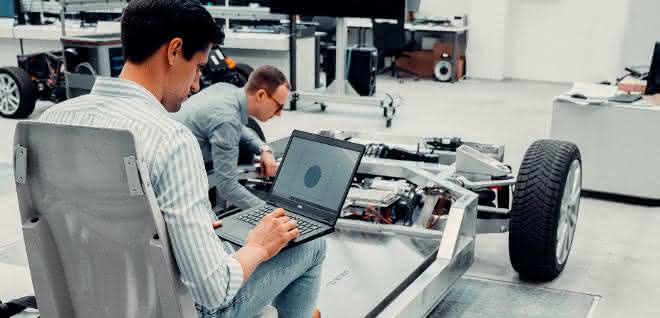
In addition to the international parcel and express service DPD, the scientific project partners behind VanAssist are the Lower Saxony Research Center for Automotive Engineering NFF at TU Braunschweig, TU Clausthal, Offenburg University of Applied Sciences and the University of Mannheim as well as BridgingIT GmbH, IAV GmbH, Ibeo Automotive Systems GmbH and Zentec GmbH. The autonomous parcel transporter is designed to optimize the delivery process and effectively relieve parcel carriers. The project, which is funded by the Federal Ministry of Transport and Digital Infrastructure (BMVI), is now entering the practical phase with the installation of sensors and control technology in the basic structure of the autonomous electric vehicle.
As an interactive, intelligent system for autonomous, remotely monitored vans in parcel logistics, the VanAssist project includes the autonomously driving motion board as well as a complete software solution for calculating optimal delivery routes and flexible control of the vehicle. As a result of the project, a so-called "demonstrator" is being created, which realistically depicts the functionality of future series-produced vehicles and can serve as the basis for series development.
In practice, deliveries are to be made in rendezvous mode in future. The vehicle will be able to cover the route from the depot to the delivery area autonomously, with the delivery driver only joining the vehicle at a defined meeting point. At a stopping point previously defined via route optimization, the delivery person picks up the parcels that they can deliver on foot in the immediate vicinity. While the delivery person is delivering several parcels in an area that is not accessible or can only be accessed via a detour, for example, the vehicle moves independently to the next stopping point and waits there for the delivery person. In the meantime, the delivery person can use an indoor navigation system from BridgingIT GmbH to guide them on the best route through an office building to the next meeting point with the vehicle.
Because the delivery driver and vehicle are always in contact via a secure communication unit, the vehicle can be flexibly directed to a different stop to the one originally specified at any time. Furthermore, the vehicle is in continuous contact with a control center so that problems can be responded to without the intervention of the delivery person. As a result, unnecessary routes and walking distances for the delivery driver should be reduced, meaning that more parcels can be reliably delivered in less time and the delivery driver's workload effectively reduced.
Following the development phase, VanAssist is now starting to implement the project: the demonstrator is being assembled on the TU Braunschweig campus, where the test track for demonstrating the functions of the fully autonomous delivery vehicle is also located. This will be based on the motion board supplied by Hanseatische Fahrzeug Manufaktur GmbH. Ibeo is equipping it with its 4D LiDAR solid state technology for a 360° all-round view and a safety system to monitor autonomous driving. The vehicle should be fully operational by the end of the year, with the final presentation scheduled for summer 2021.
After an intensive planning phase, we are very pleased to now be able to start the concrete implementation of the project together with our partners from science and industry," says Gerd Seber, Group Manager City Logistics & Sustainability at DPD Germany. "We see autonomous vehicle technology primarily as support for the human delivery driver. With a fully autonomous delivery vehicle, the delivery process can be even more efficient in future - and the human workforce can concentrate even more on the actual parcel delivery."
"The VanAssist project gives us the opportunity to develop a completely new modular, electrified vehicle that is capable of autonomous driving. In addition to the further development of existing automated driving functionalities, the parcel delivery use case gives us the opportunity to test these in a new traffic environment," explains Prof. Roman Henze, Head of the "Intelligent Vehicle and Connected Driving" research field at the Lower Saxony Research Center for Vehicle Technology (NFF). "The further development of HMI concepts through the interaction between the automated vehicle and the user, i.e. the delivery person, is also an exciting research question."
"This project is particularly exciting for us: we can further develop our research findings in the field of autonomous vehicle safety and test them in a real-life environment. Through our on-board monitoring and the connection to a central control station, we can demonstrably and substantially increase the safety of such systems. This means that the introduction of autonomous vehicles can be realized much faster," says Prof. Dr. Andreas Rausch, Director of the Institute for Software & Systems Engineering (ISSE) at Clausthal University of Technology and member of the board of the Lower Saxony Research Center for Vehicle Technology (NFF).
The project, which has a total budget of 4.3 million euros, is being funded by the Federal Ministry of Transport and Digital Infrastructure. As part of the "Automated and Connected Driving" funding program, the project will receive a total of 2.7 million euros in funding. DPD Deutschland GmbH is the consortium leader and is supported by ZENTEC GmbH in the administration of the project.
The project partners at a glance
BridgingIT GmbH
DPD Germany GmbH
Offenburg University of Applied Sciences - Institute for Reliable Embedded Systems and Communication Electronics
IAV GmbH - Ingenieurgesellschaft Auto und Verkehr
Ibeo Automotive Systems GmbH
NFF Technical University of Braunschweig - Institute for Automotive Engineering
NFF, Clausthal University of Technology - Institute for Software and Systems Engineering
University of Mannheim - Institute for Enterprise Systems
Project coordinator: ZENTEC Center for Technology, Start-ups and Cooperation GmbH


You might also be interested in
DPD Germany optimizes parcel delivery with Zebra Technologies
DPD Germany's delivery drivers scan up to 1,000 parcels a day with the help of mobile devices from Zebra Technologies. The logistics specialist uses the TC77 all-in-one mobile computer for all data scans in local transport, enabling it to keep pace...
 read more...
GLS and DPD cooperate on out-of-home parcel delivery
The parcel specialists GLS and DPD want to remain competitors, but see advantages in joint out-of-home delivery. They are planning a partner network of around 20,000 contact points by 2027.
read more...Emission-free heavy goods transport: Gruber Logistics, Iveco and AIT start practical test
As part of the Empower research project, a six-month test phase with a battery-electric, zero-emission truck prototype from Iveco for heavy commercial vehicles will start in mid-June 2026. In collaboration with Gruber Logistics, the prototype based...
read more...IKEA launches all-electric heavy-duty logistics project
Together with Mercedes-Benz Trucks and LC3 Trasporti, the Inter IKEA Group is focusing on battery-electric trucks and driving forward the decarbonization of road freight transport in Italy.
read more...Commitment to greater sustainability
Contargo strengthens e-truck fleet with 33 tractor units
Contargo puts 33 new battery-electric DAF XD Electric trucks into operation and reaches a milestone in the decarbonization of its fleet with now 90 e-trucks.
read more...Schuon relies on a sustainable fleet
In 2025, the Alfred Schuon company will integrate 68 new trucks, including trailers and semi-trailers, into its fleet at the Haiterbach and Veszprém (Hungary) sites. Among the new acquisitions: Mercedes-Benz Actros L with aerodynamically optimized...
read more...Automated trucks: live tests in Hamburg city traffic
As part of the EU MODI project, two successful practical tests on the automation of heavy goods traffic were carried out this spring - both in the inner city area of Hamburg and on the highway. The project partners tested two important use cases in...
read more...TST initiates depot charging network for e-trucks
The TST Group wants to usher in a new era of truck electrification with a cooperative-oriented depot charging network. TST is building an ecosystem for charging heavy commercial vehicles and delivery fleets that covers all relevant aspects: from...
read more...Daimler Truck celebrates the start of series production of the Mercedes-Benz eActros 600 for long-distance transport in Wörth
Karin Rådström, CEO of Daimler Truck, and Daniela Schmitt, Minister for Economic Affairs, Transport, Agriculture and Viticulture of Rhineland-Palatinate, give the go-ahead for series production of the new model.
read more...