
What the new Actros can do
The digital grab bag
Daimler has trimmed its best-selling Actros model for the future. Camera exterior mirrors, a digital cockpit, electro-hydraulic steering and the first semi-autonomous driving mode in a heavy truck make the flagship fit for the future. Can analog drivers still keep up?
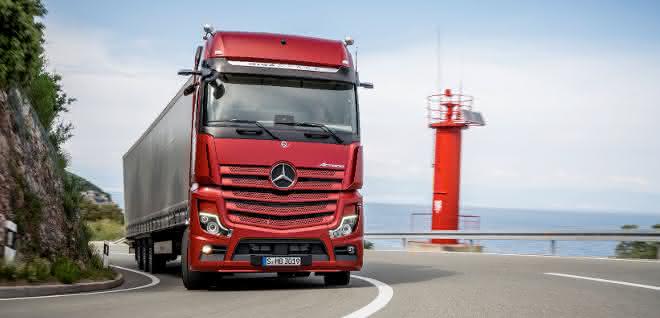
World premiere of the new Actros" is on the agenda at the prestigious Potsdamer Platz in the business heart of the German capital. "All talk, one does" is the self-confidently cheeky slogan for the launch of the IAA star. But when Mercedes-Benz Trucks boss Stefan Buchner lifts the veil on the new flagship, you have to look twice before you recognize the technological change in the world market leader's most important model. Because at first glance, there is nothing to see: no visual facelift, no new name and - above all - no more main mirrors on the side doors. So there stands the new Actros, with the elegant character head of a bull elephant whose ears have been pinned back. Apart from the elimination of the mirrors and a new daytime running light strip in the headlights, it's just like the old one - or so you think. Until truck boss Stefan Buchner talks about the inner values of his latest offspring. Because the Actros wears its high-tech mink on the inside.
Cameras to replace mirrors
The Mercedes makers have quietly ignited a digital firework display of more than 60 innovations under the largely untouched Actros exterior - from the first semi-autonomous driving mode in a heavy truck to digital instruments and switches. The most eye-catching innovation, which immediately sparked heated internet debates among drivers, is the camera replacement for the two massive mirror packages on the driver's doors. The rear view is now provided by compact cameras in slightly less compact housings above the door cut-outs. Because they are digital, the properly weather-protected lenses can do considerably more than a mirror-coated glass plate. They transmit the rear view to two 15-inch displays in the classic exterior mirror format, which are permanently mounted on the A-pillars in the interior.
The slightly lower position compared to the higher-positioned classic exterior mirrors is a matter of getting used to, while the limited access to the handrail when exiting the four-step-high Actros is rather impractical. On the other hand, the camera display technology shines with a whole package of goodies. For example, various line markers can be set in the display to mark the exact end of the trailer, enabling a sensitive approach to the ramp. Another highlight when looking back in digital: when cornering, the camera view inside the bend always follows the bending end of the trailer. This means that the critical last axles are always in view when maneuvering or negotiating tight bends such as traffic circles. When maneuvering in reverse, the camera switches to wide angle in the upper field of view of the display, thus offering optimum reverse driving protection.
Improved overview
Another point in favor of the digital displays, which are now fitted as standard, is the completely unobstructed view to the right and left through the side windows. Even though the Actros with its slim A-pillars and specially shaped mirror housings was well in the running here, this is a real gain in visibility. This can also be maintained at night in the event of suspicious noises in the vehicle. A switch in the dashboard or on the bed can be used to activate the mirror system for two minutes in night vision mode and spot light-shy figures on the trailer. Of course, all the good things about the Actros mirror system come with a downside: the two clumsy ramp mirror folding ears and the front mirror for monitoring the front of the vehicle remain in the new Actros. A suitable place for the additional display has not yet been found, is the half-baked excuse from the Swabian engineers. This is difficult to understand, as a few days later at the IAA, component developer Stoneridge was able to brilliantly solve precisely this problem with a wide-angle camera covering 270 degrees and additional displays on the inside above the driver's door. It is to be hoped that this solution will soon follow at Daimler, then there will be nothing more to criticize about the new mirror system, even if many old drivers are always critical of it at first. Daimler's decision to go into series production with this system deserves respect and once again demonstrates the seriousness with which the company in Stuttgart is getting rid of old habits.
This is demonstrated by the new display concept in the Actros driver's cab. Instead of the familiar dashboard rosettes in square salami design, there are now two digital displays from the luxury car class that take over the display job. The primary display of the "multimedia cockpit" provides the driving-relevant information that previously had to make do with a pointer and round display. Around the digital speedometer with rev counter, there is a display field that can be freely configured according to personal preferences, on which various information about the operating status of the drive through to traffic sign recognition can be displayed. The high-resolution display is pleasingly glare-free, clear and easy to read. A 10-inch display comes as standard, the larger 12-inch display costs extra.
Touchscreen instead of toggle switch
As stylish as the digital user interface looks, the secondary display to the right is likely to divide drivers' minds for the time being. Where there used to be solid toggle switches, quick swiping and typing skills are now required on a tablet surface. Most of the switch functions and a number of extra options are controlled by the driver's finger on the touchscreen. Apps take over additional information services and the truck is constantly connected to its home base or the service company via the data cloud. The quick march through the various user interfaces can be a test of patience for inexperienced drivers. On the other hand, not every truck driver is likely to have access to the fast, intuitive changeover as in a luxury car. Even on the mini control panel on the steering wheel, you can now not only press or scroll, but also swipe. What is not clear to the frightened cell phone user: Why are you allowed - or better yet, required - to delve into the depths of a display screen while driving when even reaching for your cell phone is strictly punishable by a fine? This is where the logic of the legislation gets lost in the depths of the new digital display world.
Start at the touch of a button
And what happens if you leave a discreet trace of oil on the display with dirty fingers after changing the saddle or charging? A few shortcut keys for lights, heating, air conditioning or the telephone are the last beacons for analog fingers in this digital wonderland. Even the passionate and pleasurable turn of the ignition key is electrified by Daimler. Fortunately, the key stays in the ignition thanks to wireless technology or "Keyless Go". One push of a button is enough to start the engine. The same applies to the parking brake: there is no need to reach for the compressed-air hissing that is so common on holiday evenings. An electrified parking brake takes over this job at the touch of a button with silent perfection. It also releases automatically when you start driving. And even a stretch-brake-like trailer braking system is celebrating a happy birthday in the new Actros as a trailer stabilization system. Once you get going with the Actros's obviously ineradicable starting jerk, you notice the creamy-smooth operation of the new electro-hydraulic Servotwin steering system, which retires the bumpy steering system of its predecessor. Precise and accurate, a clean jolt can be conjured up on the road, if the Actros doesn't suddenly want to play along. Because as an optional extra goodie, the latest Actros now drives through the world of transportation semi-autonomously from a standing start.
The intelligent combination of lateral guidance assistant, cruise control and distance keeping system comes together in the interplay that Daimler has christened Active Drive Assist and works amazingly well from the very first few meters. The permanent camera and radar view to the front and side makes it possible to actually drive autonomously and feel safe straight away. The Actros drives through the countryside neither hesitantly nor jerkily. The system reliably detects the most common road situations. However, to ensure that the driver with Active Drive Assist does not become too comfortable in his or her driverless skin, the system requires a tangible hand on the steering wheel to ensure that the driver is immediately available in critical situations. This is also the case with the new love of autonomous driving: Nothing works without holding hands. On the other hand, the entrepreneur can rub his hands together. Thanks to improved aerodynamics due to the elimination of the mirror ears, the further optimized Predictive Powertrain Control GPS cruise control and the drive axle with a gear ratio of 2.412, the six-cylinder engine in the new Actros should consume an average of three - ideally up to five percent - less fuel.
Safely into the bend
The GPS cruise control now also comes into its own off the highway. The new PPC (Predictive Powertrain Control) ensures an optimum overview where there is still nothing for the driver to see. The automatic cruise control now draws on digital road maps that are supposed to know the course of bends and the nature of junctions and traffic circles. This means that the cruise control can also be used on country roads in an initially unusual way, while the GPS function always remains active. In practice, the Actros reduces the speed even before approaching invisible bends and shows the maximum speed for the upcoming bend on the display. However, the PPC cruise control still has problems recognizing when entering towns or very narrow traffic circles. All in all, the new functionality and the further improved ABA5 (Active Brake Assist) with pedestrian detection at speeds of up to 50 km/h are an important step forward. The turning assistant, which has been installed two years ago, does the rest to maximize the operational safety of the truck-trailer combination.
Good news in the brave new world of truck driving. However, Daimler could have given the new flagship a fresh coat of make-up to celebrate the flood of new products. Because, as I said, the innovations in the new Actros are not at all obvious at first glance. However, the Actros still looks so good, according to the top management, that such a facelift in the Swabian, economical style could be dispensed with. Not least because the new vehicle length regulations with their impact on truck cabs are practically on the driver's doorstep. Then the new Actros will not only have an ultra-modern interior, but also a new face.
About the author: The expert and specialist journalist Oliver Willms has been writing about the commercial vehicle sector for LT-manager since 2010.


You might also be interested in
New Actros rolls off the production line in Wörth
Mercedes-Benz launched series production of the new Actros at the assembly plant in Wörth with a sapphire blue Actros 1851 LS 4x2.
 read more...
Design innovations of the Mercedes-Benz Actros
The new Actros celebrated its trade fair premiere at the IAA Commercial Vehicles in September. The design of the new model has changed significantly.
read more...Daimler floats its truck division on the stock market
Daimler is planning a fundamental change to its corporate structure. The Supervisory Board and Board of Management have decided to evaluate a spin-off of the Truck & Bus business and to begin preparations for an independent stock market listing...
read more...500th Mercedes-Benz Actros SLT heavy-duty tractor unit handed over to TSB Transport-Service Beitinger
Heavy-duty tractor units such as the Mercedes-Benz Actros SLT are used to transport oversized and heavy components or machinery. The 500th Mercedes-Benz SLT tractor unit based on the current Actros was handed over to TSB Transport-Service Beitinger...
read more...Emission-free heavy goods transport: Gruber Logistics, Iveco and AIT start practical test
As part of the Empower research project, a six-month test phase with a battery-electric, zero-emission truck prototype from Iveco for heavy commercial vehicles will start in mid-June 2026. In collaboration with Gruber Logistics, the prototype based...
read more...IKEA launches all-electric heavy-duty logistics project
Together with Mercedes-Benz Trucks and LC3 Trasporti, the Inter IKEA Group is focusing on battery-electric trucks and driving forward the decarbonization of road freight transport in Italy.
read more...Commitment to greater sustainability
Contargo strengthens e-truck fleet with 33 tractor units
Contargo puts 33 new battery-electric DAF XD Electric trucks into operation and reaches a milestone in the decarbonization of its fleet with now 90 e-trucks.
read more...Schuon relies on a sustainable fleet
In 2025, the Alfred Schuon company will integrate 68 new trucks, including trailers and semi-trailers, into its fleet at the Haiterbach and Veszprém (Hungary) sites. Among the new acquisitions: Mercedes-Benz Actros L with aerodynamically optimized...
read more...Automated trucks: live tests in Hamburg city traffic
As part of the EU MODI project, two successful practical tests on the automation of heavy goods traffic were carried out this spring - both in the inner city area of Hamburg and on the highway. The project partners tested two important use cases in...
read more...