
Software
On the way to all-encompassing solutions
In the field of logistics software, materialfluss also wanted to know where the journey in this segment is heading in the coming year and provide an overview. We asked five companies. Smart data, big data, artificial intelligence, new algorithms - exciting things are happening on the way to even more efficient warehouse processes.
Daniel Wöhr, Head of Corporate Communications at software company CIM, sees three key developments in the market: "Firstly, we are seeing an increasing trend towards so-called suite solutions. More and more interested parties are looking for a competent partner who can provide them with an all-encompassing solution comprising hardware - such as IT infrastructure - and software - such as warehouse management, production or material flow control. With our Prolag-World Suite, we fulfill exactly this wish for our customers. Depending on the industry, size or type of warehouse, we can supply special product packages or individual products, such as our Prosend shipping system. In this way, we put together an individual and suitable "complete package" for each customer.
Wöhr sees users and their software as another key issue. Users today want to be able to operate their software from anywhere, at any time and with any end device. In addition, there will be increasingly different user groups in the future. As a result, the user interface and the end device itself will have to be increasingly adapted to the needs of the user. "In 2018, we will be launching completely redesigned interfaces for browsers and mobile devices. Key innovations will be the UX design and visual process guidance using icons and graphics to make day-to-day work easier and faster," says Wöhr.

"As a partner, we want to deliver all-encompassing solutions."Daniel Wöhr CIM Photo: CIM
The third topic is sensor technology in logistics, which is becoming increasingly important in the eyes of the CIM expert. In combination with the right software, intelligent sensors could make logistics processes more efficient and sustainable. However, the prerequisite for this is that the recorded data, such as temperature or humidity, can be used as a basis for making decisions to improve the system. At LogiMAT and CeMAT, CIM will therefore be presenting the "first sensing warehouse management system" as a special innovation.
Increase transparency in the warehouse

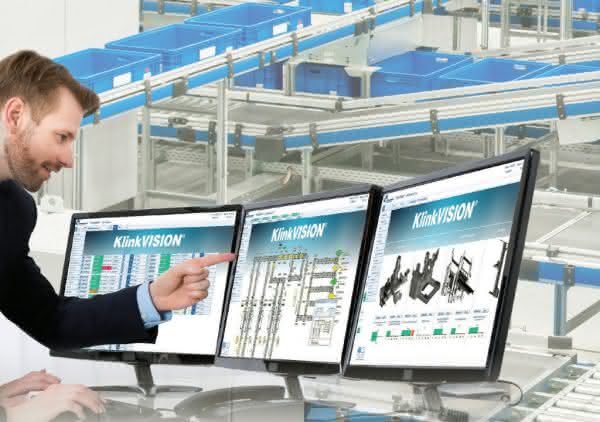
Patrick Diedrich, IT Consultant at Klinkhammer Förderanlagen, emphasizes that his company is constantly working on improving usability so that user interfaces are self-explanatory and intuitive, as well as optimized for mobile devices. Cockpit views with the most important functions ensure that the operator always has an optimum overview of his system. Thanks to networking and data evaluation with system visualization and remote maintenance tools, transparency in the warehouse is constantly improving. Smart data can be used to report potential failures even before a defect occurs. With its new maintenance tool, the KlinkVision system visualization software offers a maintenance display of the individual devices and system parts based on the duration of use and supports the operating and service personnel with predictive maintenance. The software not only logs operating data. Using a traffic light function and time bar, it visualizes the performance of individual components such as the travel and lifting gear of a storage and retrieval machine. The data supplied by sensors on the status of the systems is stored and analyzed and evaluated with the help of error messages and statistics. Predictive maintenance tools continuously collect data during operation, analyze it, learn from it and make it possible to interpret live data.

"It's only a matter of time before the WMS market gets to grips with artificial intelligence."Patrick Diedrich Klinkhammer Förderanlagen Photo: Klinkhammer
"Big data" is also one of the main topics at Klinkhammer. The use of complex algorithms makes it possible to master the flood of data. The KlinkWare WMS software will therefore be able to provide the control station with information about its own capacity utilization even more quickly and easily in the future. "In the WMS market, it will be a matter of time before the topic of artificial intelligence is addressed. In the future, the system could use the data and experience it collects to make decisions and take action independently. Thanks to continuous further development, the KlinkWare WMS software is also constantly being expanded with new functions," says Diedrich.
Framework forms common platform
Now let's hear what Dr. Giovanni Prestifilippo, Managing Director of PSI Logistics GmbH, thinks about new products and strategies. "The question of "strategies and products" can only be partially answered from a developer's perspective. PSI Logistics is in an excellent competitive position with the group-wide PSI Java Framework (PJF) and the development environment for the standard products of the PSI Logistics Suite, as evidenced by the recent Top 100 awards as one of the most innovative companies in the German SME sector. With the PJF, the company's strategic orientation was defined and finalized several years ago. The framework offers all companies in the PSI Group a common development platform that makes it possible to link innovative developments from the sister companies and the different functional scopes with each other as required and to integrate them into the various standard products or to network them consistently. In this way - and PSI Logistics sees this as a key strategy - users achieve competitive advantages.

"Reference projects demonstrate cost reduction potential in the double-digit percentage range "Dr. Giovanni Prestifilippo PSI Logistics Photo: PSI Logistics
For example, PSI Logistics was one of the first software companies to develop functions and algorithms for the combined analysis and optimization of production and logistics and concentrate them in a core module. Reference projects prove that, depending on the industry, size and structures, users are able to tap into additional cost reduction potential in the double-digit percentage range.
For PSI Logistics, a customer-oriented approach is the key strategic factor in the development and integration of innovative functions into standard products. In addition, the focus is on long-term investment security for customers. PSI Logistics covers this aspect on the one hand with the reliability of an economically sound company, and on the other hand with maximum integration and the consistent release and upgrade capability of its standard products," explains Prestifilippo.

"A WMS must communicate integratively with other systems."Markus Müllerschön viastore Software Photo: viastore Software
Holistic planning wins
Markus Müllerschön, Vice President Sales, viastore Software, goes into great detail and sees the following trends: "Globalization, worldwide networking, but also the need for greater cost-effectiveness and efficiency with small batch sizes, shorter delivery times and higher delivery quality". These would require that logistics processes in warehousing and production are no longer considered individually and in isolation from each other. Instead, all tasks between logistics and production, and therefore all information and goods flows, must be planned, managed and continuously improved as a whole. "A WMS must therefore communicate integratively with other higher-level, adjacent and lower-level systems, for example in production and assembly, and use this additional information to optimize the logistics processes in real time for the current requirements of the various areas and provide precise key figures for all processes. Another requirement is that the software makes life easier for all people with their very different tasks and requirements along the value chain - from installation to admin and control functions to picking and maintenance tasks on the store floor. This is achieved, among other things, through intuitive use: "Anyone who is able to operate a smartphone should also be able to use a WMS," says Müllerschön: "That is our claim, and we have already fulfilled it today with the standard viadat WMS. In addition, there is the simple and intuitive integration of wearables that help people to perform their tasks more easily - be it data glasses for order picking or smart watches that help to protect employees from overload, find optimal routes - or achieve individual fitness goals when working in the warehouse."

"Reinventing forecasting with new algorithms"Alexander Wanko Wanko Information Logistics Photo: Wanko
Improving and reinventing forecasts
Alexander Wanko and Alexander Fuchs from the software company Wanko Informationslogistik see an increasing demand for operational and strategic IT solutions in logistics, which will provide sufficient employment for a large number of IT companies in the coming years. In particular, controllers in companies are pushing for digitalization in logistics in order to gain an overview of logistics costs. For decades, logistics costs were allocated using an overhead cost key, but today logistics costs need to be allocated according to the source. The aim is to identify profitable customers. "The challenge of modern digitalization is the timely, optimal planning and control of connected logistics processes. With new algorithms in artificial neural networks, forecasts for goods orders and goods, route optimization and dealing with disruptions during transport should not only be improved, but reinvented. According to the experts, "learning systems should make suggestions to logistics specialists in the warehouse and in scheduling as to how they can handle their day-to-day business more easily, more quickly and with fewer errors. Conclusion: In logistics, it is important to further optimize the interlocking work processes using AI-supported software in order to maintain transparent logistics costs. This applies in particular to the growing same-day delivery of food.
Martin Schrüfer


You might also be interested in
PepsiCo Polska relies on Mecalux
PepsiCo Polska is working with Mecalux to drive forward the automation of its logistics and is planning an intelligent warehouse.
 read more...
System Logistics implements new high-bay warehouse at Asahi Poznań
With the construction of a modern, automated high-bay warehouse at Asahi Poznań, System Logistics wants to set an example for the future of intralogistics. The project, which is being implemented in close cooperation with a total of twelve...
read more...Metzger Autoteile cooperates with Kardex Mlog
Metzger Autoteile has commissioned Kardex Mlog as general contractor to build an automated five-aisle high-bay warehouse with around 6,000 pallet spaces and an AutoStore system with around 80,000 boxes.
read more...TGW Logistics expands headquarters in Marchtrenk
The ground-breaking ceremony for the expansion of the TGW headquarters in Marchtrenk took place on September 25. TGW Logistics will invest in a 25,000 m² production building and a highly automated warehouse system by summer 2026.
read more...Storage media leverage savings potential
Save energy in AKL with supercaps
More and more operators are equipping their storage and retrieval machines (SRMs) in automated small parts warehouses with energy-saving capacitors as a storage medium. For SRMs in refrigerated warehouses, capacitor storage pays for itself quickly,...
read more...New Quooker logistics center realized with Swisslog
The ground-breaking ceremony for a new, automated Swisslog logistics center for Quooker in Nieuw Reijerwaard, the Netherlands, has been held and was celebrated appropriately.
read more...MS Motorservice International relies on Kardex Mlog
MS Motorservice International, the sales organization for Rheinmetall's global aftermarket activities, has commissioned Kardex Mlog as general contractor to build a four-aisle high-bay warehouse at its Neuenstadt site. The high-bay warehouse will be...
read more...Dematic with doubled trade fair presence and AMR showcase
For the first time, Dematic will be exhibiting at two stands at Logimat. The automation technology provider wants to show how users can master the challenges of intralogistics with its material flow solutions.
read more...Single-mast storage and retrieval unit
Automation even for small warehouses
Westfalia Technologies will be exhibiting its latest bestseller for the first time at Logimat - a compact single-mast storage and retrieval machine.
read more...