
Sensors & control technology
Diagnosis from anywhere in the world
The new DDLS 500 optical data transmission photoelectric sensor from Leuze electronic not only impresses with its ease of use, but above all with the new option of location-independent remote diagnostics. All relevant data can be called up worldwide using the integrated web server.
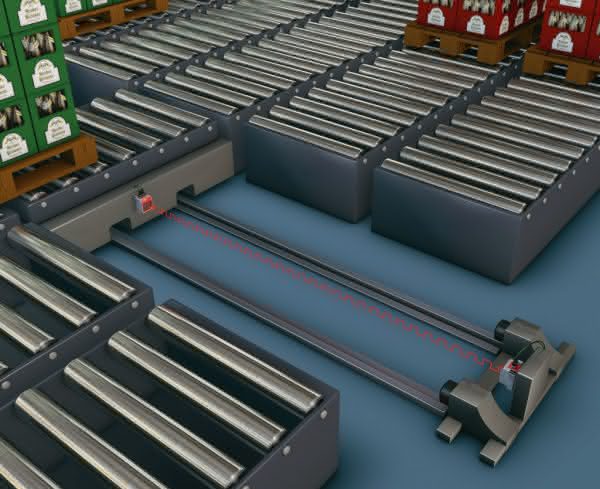
Optical data transmission photoelectric sensors make it possible to transmit data from industrial networks of moving system parts in conveyor technology such as storage and retrieval machines, gantry crane bridges or transfer cars wirelessly and thus without interference over long distances. The new DDLS 500 optical data transmission photoelectric sensor from Leuze electronic is easy to put into operation and offers the new option of location-independent remote diagnostics: thanks to the integrated web server, specialists can call up all the information required to analyze error messages from a machine or system from anywhere in the world, no matter where their desk is located. Specialists no longer have to travel long distances and carry out diagnostics in person on site to get them up and running again as quickly as possible, but can initiate maintenance work remotely and accompany and support the maintenance personnel accordingly. The option of remote diagnostics via a web server saves a great deal of time and money and makes the new DDLS 500 data transmission photoelectric sensor an economical, efficiency-enhancing central network component.
Early warning of failure
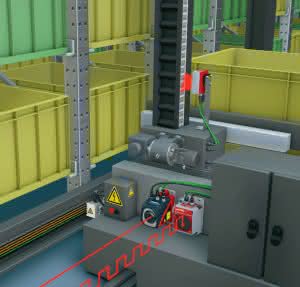
The reception level is constantly monitored to monitor availability and power reserves. This provides an early warning of impending failure, for example due to excessive soiling. In addition to the reception level LEDs on the control panel, the pre-failure message is also available as a signal. All warning messages that could indicate a suspension of transmission are displayed in good time and, in the DDLS 548i version, are actively transmitted to the controller as Profinet participants by means of process data. For quick and easy on-site diagnostics, the DDLS 500 has a highly visible status LED for displaying warnings and errors, which further simplifies maintenance and diagnostics.
Wear-free transmission by laser light
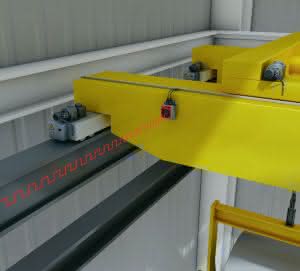
Wherever wired communication systems reach their limits, data transmission photoelectric sensors transmit data from industrial networks contactlessly and wear-free using invisible, infrared laser light. Two devices face each other, with one device usually mounted stationary and the opposite device traveling on a moving part of the system. The infrared laser communicates bidirectionally. In this way, distances of up to 200 meters can be bridged wirelessly. The new DDLS 500 links Ethernet networks using optical data transmission with a bandwidth of 100 Mbps. All common Ethernet protocols such as PROFINET, Ethernet IP, EtherCAT, Ethernet TCP/IP or Ethernet UDP are supported and transmitted in real time up to a distance of 200 meters. Typical areas of application are lifting and travel axes in storage and retrieval machines as well as transfer cars in conveyor technology, gantry bridges and overhead cranes.

"The new data transmission photoelectric sensors set a new standard worldwide. With additional functions, the DDLS 500 from Leuze electronic become much more than just 'optical cables'."Matthias Göhner, Product Marketing Manager, Leuze electronic
For any distance up to 200 meters
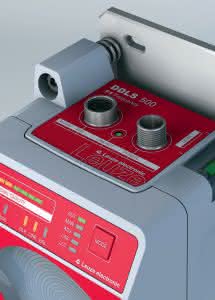
Thanks to the modular basic structure, the devices can be selected flexibly and according to requirements and combined with the basic model. The ability to adapt to applications begins with the choice of range: the DDLS 500 is available for distances from 0.1 to 200 meters. This means that the devices are not only ideally suited for short distances, but also for spatially extended systems. A laser alignment aid is available as an option, which is particularly suitable for longer distances. It projects four clearly visible laser points parallel to the optical axis downwards onto the floor, making horizontal alignment very simple and intuitive. Another functional module is an integrated appliance and windshield heater, which is always used when the product is used in deep-freeze warehouses or outdoors.
Easy installation by one person
The basic equipment of a DDLS 500 includes a pre-assembled mounting plate with spring-loaded wobble elements, with which the device can be easily mounted and aligned. Adjustment screws make horizontal and vertical alignment of the appliances to each other child's play. The installer simply turns an adjustment screw until the four flashing points are aligned at the same distance from the guide rail or system.

Intra says: brilliant!
I'd like my GP to be able to make the diagnosis remotely in future. That would save me the annoying wait in the waiting room. And if he then sees on his screen that I'm going to have a total breakdown in twelve days because I've forgotten to lubricate my little screws, er, brain convolutions, that would be very practical. The various wristbands that constantly measure blood pressure and pulse already exist. And my health insurance company will know right away. An RBG and I have more in common than you might think. I have to go and get the oil...
Vertical alignment is carried out using an integrated spirit level and also by turning a second adjustment screw. A laser spot then clearly marks the target point at which the opposite device is to be mounted. Thanks to the patented single-handed adjustment (SHA) process for one-man adjustment, the data light beam can be precisely aligned by a single person. Fine adjustment using the SHA method is supported by self-explanatory monitoring of the reception level in the control panel on the front of the housing. The convenient laser alignment aid described above is available for longer distances.
Matthias Göhner


You might also be interested in
PepsiCo Polska relies on Mecalux
PepsiCo Polska is working with Mecalux to drive forward the automation of its logistics and is planning an intelligent warehouse.
 read more...
System Logistics implements new high-bay warehouse at Asahi Poznań
With the construction of a modern, automated high-bay warehouse at Asahi Poznań, System Logistics wants to set an example for the future of intralogistics. The project, which is being implemented in close cooperation with a total of twelve...
read more...Metzger Autoteile cooperates with Kardex Mlog
Metzger Autoteile has commissioned Kardex Mlog as general contractor to build an automated five-aisle high-bay warehouse with around 6,000 pallet spaces and an AutoStore system with around 80,000 boxes.
read more...TGW Logistics expands headquarters in Marchtrenk
The ground-breaking ceremony for the expansion of the TGW headquarters in Marchtrenk took place on September 25. TGW Logistics will invest in a 25,000 m² production building and a highly automated warehouse system by summer 2026.
read more...Storage media leverage savings potential
Save energy in AKL with supercaps
More and more operators are equipping their storage and retrieval machines (SRMs) in automated small parts warehouses with energy-saving capacitors as a storage medium. For SRMs in refrigerated warehouses, capacitor storage pays for itself quickly,...
read more...New Quooker logistics center realized with Swisslog
The ground-breaking ceremony for a new, automated Swisslog logistics center for Quooker in Nieuw Reijerwaard, the Netherlands, has been held and was celebrated appropriately.
read more...MS Motorservice International relies on Kardex Mlog
MS Motorservice International, the sales organization for Rheinmetall's global aftermarket activities, has commissioned Kardex Mlog as general contractor to build a four-aisle high-bay warehouse at its Neuenstadt site. The high-bay warehouse will be...
read more...Dematic with doubled trade fair presence and AMR showcase
For the first time, Dematic will be exhibiting at two stands at Logimat. The automation technology provider wants to show how users can master the challenges of intralogistics with its material flow solutions.
read more...Single-mast storage and retrieval unit
Automation even for small warehouses
Westfalia Technologies will be exhibiting its latest bestseller for the first time at Logimat - a compact single-mast storage and retrieval machine.
read more...