
Shortsea fleet
Rhenus-Arkon-Shipinvest places order for four eco-ships
The shipping company Rhenus-Arkon-Shipinvest has launched the construction of its own eco-shortsea fleet. The first four environmentally friendly ships of the "Hanse Eco Short Sea Coaster" have been ordered. Construction will begin in February 2020 and delivery is scheduled for the second half of 2021.
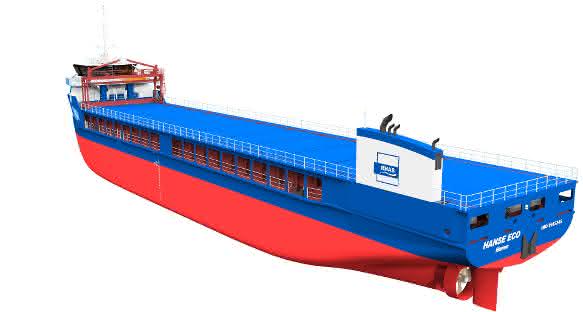
The Hanse-Eco fleet is the result of an initiative by Torsten Westphal, founding member of Arkon Shipping. Together with its partner Rhenus, the development of a sustainable shortsea fleet is a sustainable solution for shipbuilding.
Rhenus-Arkon-Shipinvest has developed its own ship standard for European short-sea traffic. The Hanse-Eco ship will be around 90 meters long and have a carrying capacity of 4,200 tons. The cargo hold volume will be over 5,500 cubic meters.
"Our Hanse-Eco fleet shows a way of doing justice to climate protection and at the same time making sensible use of the digitalization megatrend. We are therefore setting a high standard for European shipping 2.0 from the planning stage through to commissioning," says Torsten Westphal, Managing Shareholder of Rhenus-Arkon-Shipinvest.
The Hanse-Eco ships are characterized by a number of optimizations compared to the conventional design: The forward arrangement of the bridge offers a clear view even with deck cargoes and the innovative hull shape reduces fuel consumption. In addition, an increased cargo hold length is suitable for project cargoes as well as classic bulk and breakbulk cargoes. This type of ship is characterized by its continuous deck for bulky and bulky goods and is able to serve new cargo segments thanks to its open-top capability.
In addition to the water treatment systems required from 2020, the eco-ships will be equipped with a hybrid ship propulsion system with a bio-catalytic converter, electric motor support and exhaust gas aftertreatment. This will not only meet the requirements of the future IMO Tier III emissions standard, but will also significantly reduce carbon dioxide emissions, particulate matter emissions and fuel consumption. The main engine can also burn biofuel.
"An integrated automation system and the use of state-of-the-art camera technology simplify the operational processes on the ship and in the ports and reduce the captains' administrative work," adds Ralf Uebachs, Managing Director of Rhenus-Arkon-Shipinvest.


You might also be interested in
Sustainable across the Rhine
The "GAS 95", another innovative ship design from the HGK Shipping Design Center, has been sailing on the Rhine since 8 February: low-emission thanks to diesel-electric propulsion, future-oriented thanks to its "future-fuel-ready" design and...
 read more...
Germany's first center for remote-controlled ships opened
Seafar, a Belgian technology and service provider for remote-controlled and crew-reduced inland navigation, has set up the first so-called Remote Operations Center in Germany together with its project partners HGK Shipping and Reederei Deymann.
read more...Ole Trumpfheller new Head of Northern Europe at Maersk
Effective May 1, 2024, Ole Trumpfheller will assume the role of Vice President and Managing Director of Maersk's North Europe Continent (NEC) Area, based in Hamburg.
read more...NWL and DBR Hamburg cooperate in container handling
Norddeutsche Wasserweg Logistik (NWL) and Deutsche Binnenreederei (DBR) Hamburg declare their official merger in the container business.
read more...LHG holds its own in a difficult environment
Total throughput decreases moderately by 4.8 percent
read more...Maersk and Hapag-Lloyd agree on joint operational cooperation
Hapag-Lloyd and Maersk have signed an agreement for a new, long-term operational cooperation called "Gemini Cooperation", which will start in February 2025. The aim is to create a flexible and interconnected service network in maritime...
read more...Port of Hamburg: Zapp becomes EMP
The Zapp IT platform - the comprehensive and mandatory IT system for the customs export process in the Port of Hamburg - is being relaunched and renamed.
read more...New rail transshipment facility in Bremen
Rhenus Weserport Bremen is building a fully automated new rail transshipment facility for loading aluminum hydroxide and aluminum oxide at Terminal 4 of Bremen's industrial port.
read more...Identification technology and RFID
Networked container terminals: 5G campus networks for Eurogate
Deutsche Telekom is equipping port terminals in Hamburg, Bremerhaven and Wilhelmshaven with local 5G networks by spring 2024.
read more...