
Heavy lift logistics
Gustav Seeland makes Hamburg's S-Bahn fit
Gustav Seeland played a key role in the replacement of the railroad bridge over the Bille at Bullerdeich during a major project to renew Hamburg's S-Bahn.
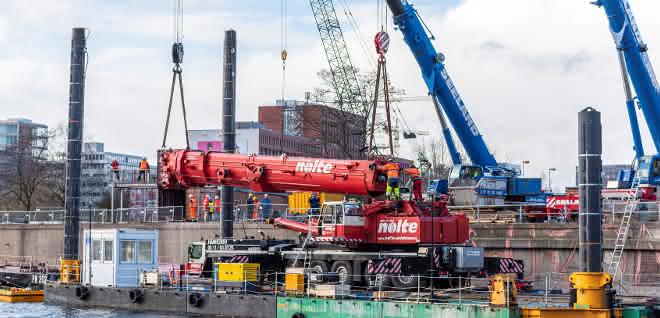
The over 100-year-old steel structure between the Rothenburgsort and Billwerder-Moorfleet S-Bahn stations had to be dismantled and rebuilt in a very short space of time: In order to minimize disruption to passengers on the S2 and S21 lines, the reconstruction was carried out in just two weeks. Gustav Seeland had set aside three days just for dismantling the bridge.
The dismantling and removal of the old bridge presented the specialists with challenges. The bridge overpass was dismantled from both the land and the water side.
To ensure quick dismantling, the bridge, which was built in 1902, was first divided into three parts. The three elements were lifted onto floating pontoons on the water side by crane and transported away. The particular difficulty of the job, however, was the dismantling and removal of the middle section of the bridge. A 500-ton crane anchored on a pontoon had to lift and load the 40-ton bridge element. Hydraulic support pillars were used to secure the loads and support the pontoon. This prevented the floating crane pontoon from swaying under load and tipping over.
After loading, the old bridge sections were towed on floating pontoons to the port of Hamburg for scrapping. Gustav Seeland planned to use two special cranes, each with a lifting capacity of around 220 tons, and a 60-ton brake truck with a pulling force of 80 tons for this major project. The lifting mast for the 500-ton crane was assembled on the crane pontoon from the land side. Gustav Seeland deployed 12 heavy lift and assembly specialists with the relevant expertise to handle the order.
"The planning and implementation of this extensive project requires the utmost precision. This is no easy task, even for the specialists at Gustav Seeland. With the tight time frame, the heavy loads and the installation from the water, there is a lot to consider. In particular, safety must not be neglected in such a complex task," says Johann Evers, Managing Director of Gustav Seeland.


You might also be interested in
Sustainable across the Rhine
The "GAS 95", another innovative ship design from the HGK Shipping Design Center, has been sailing on the Rhine since 8 February: low-emission thanks to diesel-electric propulsion, future-oriented thanks to its "future-fuel-ready" design and...
 read more...
Germany's first center for remote-controlled ships opened
Seafar, a Belgian technology and service provider for remote-controlled and crew-reduced inland navigation, has set up the first so-called Remote Operations Center in Germany together with its project partners HGK Shipping and Reederei Deymann.
read more...Ole Trumpfheller new Head of Northern Europe at Maersk
Effective May 1, 2024, Ole Trumpfheller will assume the role of Vice President and Managing Director of Maersk's North Europe Continent (NEC) Area, based in Hamburg.
read more...NWL and DBR Hamburg cooperate in container handling
Norddeutsche Wasserweg Logistik (NWL) and Deutsche Binnenreederei (DBR) Hamburg declare their official merger in the container business.
read more...LHG holds its own in a difficult environment
Total throughput decreases moderately by 4.8 percent
read more...Maersk and Hapag-Lloyd agree on joint operational cooperation
Hapag-Lloyd and Maersk have signed an agreement for a new, long-term operational cooperation called "Gemini Cooperation", which will start in February 2025. The aim is to create a flexible and interconnected service network in maritime...
read more...Port of Hamburg: Zapp becomes EMP
The Zapp IT platform - the comprehensive and mandatory IT system for the customs export process in the Port of Hamburg - is being relaunched and renamed.
read more...New rail transshipment facility in Bremen
Rhenus Weserport Bremen is building a fully automated new rail transshipment facility for loading aluminum hydroxide and aluminum oxide at Terminal 4 of Bremen's industrial port.
read more...Identification technology and RFID
Networked container terminals: 5G campus networks for Eurogate
Deutsche Telekom is equipping port terminals in Hamburg, Bremerhaven and Wilhelmshaven with local 5G networks by spring 2024.
read more...