
Container tracking
Freight flows at a glance
A shipment of goods with sea freight containers can involve more than 200 interactions. The tire manufacturer Michelin wanted to ensure accurate information about its stock at all times. The company now relies on a tracking solution from Sigfox.
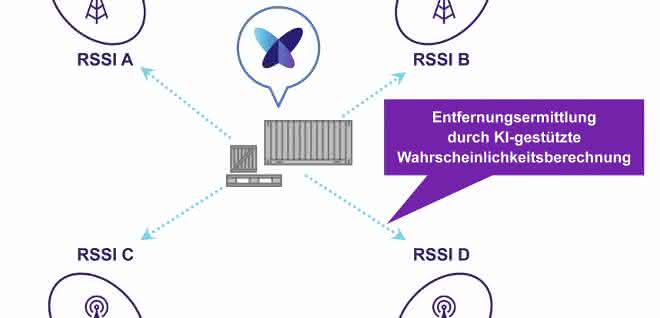
If a sea freight container misses its loading date, it has to wait for the next available cargo ship. This can quickly lead to delivery delays of more than a week. However, if a delivery deadline is not met, this can lead to considerable financial losses for Michelin's customers. Delays must therefore be recognized and managed immediately. Due to administrative guidelines, some sea freighters only report delays with a delay, which means that reliable monitoring cannot be guaranteed. Michelin was therefore looking for a cost-effective and sustainable tracking solution for its intercontinental goods traffic. Continuous transparency was required so that customers are always informed of the current whereabouts of important consignments in particular and the estimated time of arrival can be predicted as accurately as possible.
Expensive delays
A late delivery to a car manufacturer can lead to high financial losses if production comes to a standstill. The breakdown of a mining truck simply because a spare tire is not on site can also quickly cause damage amounting to several million euros. Existing tracking solutions based on GSM 3G or 4G technology were not an option for Michelin, however, as they cost around 100 US dollars per container shipment: with more than 150,000 containers shipped per year, the total costs of around 15 million euros were simply not affordable. In addition, the existing tracking solutions only had a short battery life and also had problems transmitting their signals from the containers. A solution with lower costs, long battery life and reliable signal transmission was therefore needed.
Cost-efficient trackers and a global network
Michelin therefore worked with Argon Consulting - a consulting firm specializing in operational transformation projects - to find a suitable tracking technology and solution platform that they could also further develop and optimize if necessary. For Michelin, quality and location accuracy were the most important factors when selecting the technology to be used.
IoT service provider Sigfox was the only provider of an international low-power network that could offer Michelin both the tracker and the 0G network with high-quality connectivity in all the countries in which the company operates. However, some adjustments were still required. For example, the three companies jointly developed an algorithm that allows the trackers to detect physical movements so that the tracking solution can also capture specific actions such as loading and unloading and monitor and report critical parameters such as temperature, humidity and shocks.
Michelin's tests have shown that this real-time tracking has saved up to ten percent of goods in transit by sea and improved the accuracy of estimated time of arrival predictions by up to 40 percent. The flow of goods interrupted by exceptional events such as storms has also been reduced by up to 75 percent.
The Sigfox 0G network also scored highly in terms of network coverage and transmission reliability, which are crucial for comprehensive geolocalization. Michelin and its customers benefited from the reliability even in remote locations. The transmitted real-time data can be called up from the Sigfox cloud via a secure web interface so that the status of the shipments can be tracked at any time and critical event messages can be sent.
After around one and a half years of collaboration, Sigfox, Argon Consulting and Michelin have jointly founded the company SafeCube, which will market the solution and open and scale it up for other companies. According to the company, one of the key advantages of the tracking solution is its cost efficiency. As the trackers only transmit data when important events occur, they require little energy. This means that comparatively small batteries with a long service life can be used.
With the new tracking solution from SafeCube, not only can shipments be localized, but the environmental conditions such as brightness, temperature and humidity of the shipment can also be monitored and an immediate response can be made to unplanned container openings or other negative influences on the transported goods.
The tracking solution is also scalable and can be quickly adapted to different business cases and requirements. The tracking devices are not designed for one-time use, but can be used for at least four years, which has a positive impact on the environmental footprint.
Optimizing the intercontinental flow of goods
By developing this cost-effective, customer-centric asset tracking solution, Michelin and its partners are helping to bring the supply chain & logistics industry into the digital age. With over 100 million container shipments per year and a total turnover of five billion euros, the digital transformation of the supply chain is essential to ensure that the container logistics industry keeps pace with the businesses it serves. Michelin, together with Argon and Sigfox, will further diversify the data that can be transmitted. Ultimately, it should also be possible to make the data obtained available to a wide range of companies as well as port and border authorities, customs and maritime institutions


You might also be interested in
Driving ahead puts digitalization in the transport sector on the agenda
Tire manufacturer Goodyear heralded the next round of the expert talk "Driving Ahead". The latest panel discussion took place as part of a future forum on the digital service offerings of Goodyear Proactive Solutions.
 read more...
BFGoodrich exhibits at the IAA Commercial Vehicles for the first time
BFGoodrich will be represented at the IAA Commercial Vehicles in Hanover for the first time. The company will be presenting its range of tires for trucks and city buses.
read more...Michelin man for truck roofs is back
Munich, 28.08.2017 - The Michelin Man is returning to the cab roof. The tire manufacturer has now launched a new edition of the popular brand symbol. The new Michelin man is around 40 centimeters tall and has been specially...
read more...New CEO and President for Bridgestone EMEA
Zaventem/Belgium, 25.07.2016 - Tire manufacturer Bridgestone EMEA has appointed Paolo Ferrari as its new President and Chief Executive Officer (CEO). He will be responsible for the business of the world's leading tire and rubber company in...
read more...Sustainable across the Rhine
The "GAS 95", another innovative ship design from the HGK Shipping Design Center, has been sailing on the Rhine since 8 February: low-emission thanks to diesel-electric propulsion, future-oriented thanks to its "future-fuel-ready" design and...
read more...Germany's first center for remote-controlled ships opened
Seafar, a Belgian technology and service provider for remote-controlled and crew-reduced inland navigation, has set up the first so-called Remote Operations Center in Germany together with its project partners HGK Shipping and Reederei Deymann.
read more...Ole Trumpfheller new Head of Northern Europe at Maersk
Effective May 1, 2024, Ole Trumpfheller will assume the role of Vice President and Managing Director of Maersk's North Europe Continent (NEC) Area, based in Hamburg.
read more...NWL and DBR Hamburg cooperate in container handling
Norddeutsche Wasserweg Logistik (NWL) and Deutsche Binnenreederei (DBR) Hamburg declare their official merger in the container business.
read more...