
From materialfluss 4/2020
Forklift battery system: refueling during the lunch break
Hermes Fulfilment relies on the Toyota battery system with lithium-ion technology for longer truck operating times at the Ohrdruf logistics center.
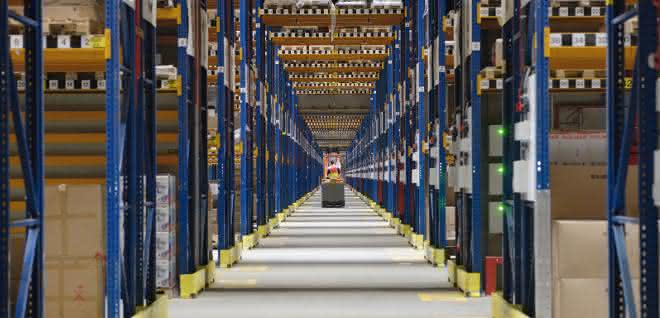
The company's subsidiary Hermes Fulfilment stores and picks goods from 14 European countries for Otto at its logistics center in Ohrdruf, Thuringia. To ensure that this runs smoothly over several shifts, the company uses Li-ion technology for the industrial trucks from Toyota Material Handling. At this site, 350 permanent employees ensure that the intralogistics process chain runs smoothly. Various goods are delivered here, stored, picked and handed over to Hermes Germany for delivery. The range includes items from the small and very small electronics sector, such as smartphones, but also large items weighing up to 31.5 kilograms. These include, for example, smaller furniture or home accessories. Returned goods are unloaded and assessed in the returns department. If necessary, they are repaired in the company's own workshop.
New energy technology for longer operating times
"All processes at the site have to be coordinated - otherwise it's difficult for us to cover peak times like before Christmas," says Ronald Ganther, Head of Inbound at Hermes Fulfilment. The site has been adapting to ever shorter delivery times for two years: "We offer Next Day Delivery. Since then, we have been working in two shifts in order picking," adds Ganther. This change in the logistics concept requires longer vehicle deployment times. "We were faced with the question that almost every logistics company asks itself: How can I use my industrial trucks as efficiently as possible?" explains Ganther.
Being able to use an industrial truck over two shifts with as little downtime as possible is not feasible with lead-acid batteries. "Our reach trucks run for around seven hours at a time. It takes just as long to charge the lead-acid batteries for use the following day," says Ganther, explaining the initial situation. However, the devices are needed flexibly, especially during seasonal order peaks. A new type of energy therefore had to be found. Initially, the use of exchangeable batteries was tested - but this did not prove successful because battery handling is time-consuming and cumbersome. The additional space required also proved to be a disadvantage. In cooperation with Toyota Material Handling, Hermes was able to convince itself of the potential of another energy source - Li-ion batteries.
Lower electricity costs thanks to charging management
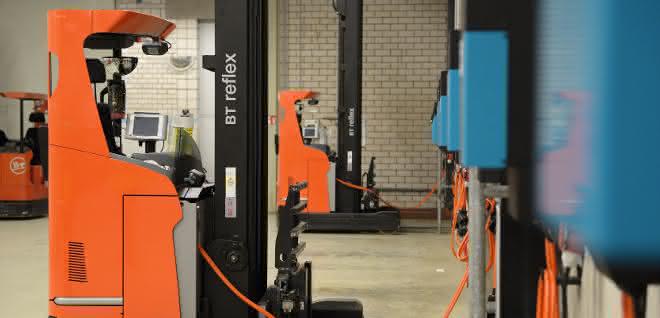
This technology enables the batteries to be charged quickly, for example during the lunch break. Charging time is always when the appliance is not needed, even for a short time. Battery changes are therefore a thing of the past - and there is no need for time-consuming water refills. The most important factor for increasing the efficiency of the fleet with lithium technology is adherence to the charging cycles: "Toyota calculated the charging cycles according to our needs. The employees have been trained on when to charge. This enables us to ensure that the operating times of the devices can be completed without any problems according to our shifts," explains Ronald Ganther.
Faster charging requires higher charging currents. "Dynamic Power Limitation (DPL)" ensures that a group of chargers does not exceed the specified current consumption. This avoids current peaks that can occur during simultaneous charging. "The use of charge management is very important to us - especially in terms of saving costs due to power peaks," explains Ronald Ganther. There is no additional work involved in setting up DPL. The existing chargers communicate with each other wirelessly, so no additional cabling is required. The current battery status of all devices can be viewed at any time in the fleet management system.
Greater occupational safety through fleet management
Hermes Fulfilment uses the I_Site fleet management system to ensure a consistent overview. Information on battery charge levels, collisions and device access is clearly listed in the web-based application. For the logistics center in Ohrdruf, it is a tool for optimization: for example, users can see where collisions may occur and can initiate preventive measures. In addition, thanks to Smart Access, only authorized employees have access to the vehicles. Each operator receives an individual chip to log on to the device. There are plans to further expand the use of the system in order to make employees more aware of the need to handle the devices with care.
You can find out more about the battery charging system at:


You might also be interested in
Industrial trucks for luxury cars
Optimized logistics for super sports cars
Automobili Lamborghini manufactures exclusive luxury and super sports cars. Founded in 1963 by Ferruccio Lamborghini, the company is still based at its traditional headquarters in Sant'Agata Bolognese.
 read more...
Explosion-proof forklift trucks for production and warehouses
Sherwin-Williams (legal entity Inver) from Dresden produces industrial coatings for various industries. In order to create a safe working environment, the company has purchased a fleet of Linde explosion-proof forklift trucks. The industrial trucks...
read more...High-voltage forklift trucks for all weather conditions
EP Equipment presented the EFL 10T high-voltage forklift truck at the IFOY Award 2025 Test Camp in Dortmund. The EFL-HV series, including the EFL 10T, is designed to combine the performance of traditional combustion engine equipment with the modern...
read more...Hub for spare parts: KION Regional Distribution Center Central Europe opened
In order to further shorten delivery times and ensure delivery availability of almost 100 percent in the future, Linde Material Handling has built a new, larger spare parts distribution center equipped with modern technology at its existing site in...
read more...Spare parts efficiently brought to the track
The distribution center and spare parts warehouse of an automotive manufacturer in Wallersdorf, which opened in 2016, covers an area of around 235,000 square meters. Customers all over the world are supplied with spare parts and accessories from...
read more...Flexible for indoors and outdoors: New Toyota MH series
Toyota Material Handling has launched the latest generation of its electric counterbalance trucks - the Toyota Traigo48 series. This is intended to impress in terms of performance and design as well as with a comprehensive package of functions.
read more...Hubtex Group takes over Genkinger GmbH
The Hubtex Group has acquired 100 percent of the shares in Genkinger GmbH, based in Münsingen. The aim of this acquisition is to further strengthen the individual brands internationally and to utilize synergies across locations.
read more...Still invests in Hamburg headquarters: 50 million euros for new mechatronics center
On February 19, intralogistics expert Still and Mercurius Industrial Properties officially broke ground for the Still "Centre of Competence Mechatronics" in Hamburg. Still has also announced further site developments in the Hanseatic city: The...
read more...Lift trucks, stackers and order pickers from a single source
Colorbaby distributes toys, outdoor leisure products and household goods from its warehouse in Ibi, Alicante, Spain. The company previously used a fleet of industrial trucks from various manufacturers. After more than five years of good experience...
read more...