
From materialfluss 5/2020
Double-deep stacking with sensor support
With hydraulic telescopic forks, palletized goods can be stacked double-deep on the opposite side of a truck, wagon or in a rack. No more time-consuming maneuvering.
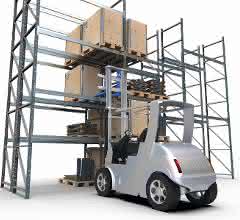
Trucks or railcars only need to be opened on one side. This results in faster loading options and a higher loading speed, safety is increased and transport damage is efficiently minimized. However, anyone who has ever driven a forklift truck with telescopic forks knows the challenge of handling different goods. It is particularly difficult at great heights or when visibility of the load is restricted. The new T180CT series telescopic forks with depth sensing from Aschaffenburg-based Kaup are designed to make handling more effective and convenient. A sensor in the attachment constantly monitors the current fork length, even when visibility is restricted. Gerald Schmitt, Marketing Manager at Kaup: "The forklift driver is now in a comfortable position: a color touch display in the cockpit shows the current fork length to the millimeter and much more, allowing him to navigate the forklift optimally."
Lively interior
The telescopic fork weighs hardly any more than a standard fork. Equipped with hydraulic forced synchronization, the fork shoes can be extended and retracted steplessly. The attachment unit is supplied with oil from the forklift hydraulics via an additional hydraulic function on the industrial truck. Easily accessible hydraulic connections on the back of the forks simplify the assembly and disassembly of the telescopic forks. How does this depth sensing function work? In each of the two forks, two square tubes move against each other. The position sensor continuously records the relative positions of the two square tubes to each other and reports them to the display. The particular challenge: the lateral offset and the play between the two tubes. Producing precise measurement results under these difficult conditions is a particular challenge and requires a customized solution. The incremental, magnetically coded BMLS2C position measuring system from sensor specialist and automation solutions provider Balluff is used. According to the company, it is robust, fast and precise, and also allows large reading distances and greater mechanical tolerances. Furthermore, with dimensions of 10 x 25 x 35 mm, the system also fits into tight installation spaces such as forks, as the electronics are integrated into the sensor housing.
Precise non-contact detection of positions
It consists of a sensor head and a magnetically coded measuring body, a plastic band with alternating magnetic north and south poles made of synthetically bonded ferritic material. In the telescopic fork from Kaup, the measuring body is located on the outside of the inner square tube, while the counterpart, the sensor head, is mounted opposite on the inside of the outer square tube.
If the telescopic fork is now actuated, the sensor head slides contact-free over the measuring body at a distance of at least five mm after moving to the reference position. By counting the magnetic periods, which are output as a digital square-wave signal, a precise statement can be made about the distance traveled in both directions. The resolution is freely configurable and ranges from 10 to 2,500 µm at a permitted travel speed of up to 10 m/s, which far exceeds the practical requirements of the telescopic fork. The results of the measurement are available on the touch display without delay, i.e. in real time.
As the measuring system works magnetically, it is relatively insensitive to contamination, for example from oil or dust, and is therefore also suitable for use in harsh, dusty industrial environments. "Even if some dirt has accumulated during long-term operation, no incorrect measurements can be detected. The forks run without any complaints. This is the feedback from our customers," says Schmitt with satisfaction.
Telescoping with a view
The truck driver can choose between two operating modes. In the first mode, he sees the measurement results - i.e. the fork length - shown in millimetres on a color touch display. In the second mode, he can freely pre-program three fork lengths, for example 1400, 1600 or 1800 mm, and select them by touch. During telescoping, the color of the fork length display adapts to the preselected length. Two flashing arrows indicate the direction in which telescoping is required. Once the target fork length has been reached, the direction arrows change color from green to red to indicate that the target length has been reached and both arrows flash. The forklift driver benefits from this solution, says Schmitt: "Particularly when handling pallets at great heights or in poor visibility conditions, he no longer has to rely solely on his intuition and experience; he is shown the exact fork status and can navigate faster and more safely than before. Errors and mishaps can also be successfully minimized."
Another advantage of the Balluff solution comes into play when mounting the new telescopic forks. While other position measuring systems usually have to be ordered in the correct length for the corresponding application, the magnetic tape can be purchased on a roll and then assembled directly on site. "All our fitters have to do," says Gerald Schmitt, "is cut it to the right length, stick it onto the square tube of the telescopic fork and cover it with steel tape to protect it from damage. The magnet-coded displacement encoders from Balluff offer a great deal of flexibility here and also help to simplify warehousing."
Non-contact and therefore wear-free, the magnetically coded magnetic tape length measuring systems have an almost unlimited life expectancy according to the company. "If the system is not deliberately damaged," continues Schmitt, "it will last the life of a telescopic fork."


You might also be interested in
Industrial trucks for luxury cars
Optimized logistics for super sports cars
Automobili Lamborghini manufactures exclusive luxury and super sports cars. Founded in 1963 by Ferruccio Lamborghini, the company is still based at its traditional headquarters in Sant'Agata Bolognese.
 read more...
Explosion-proof forklift trucks for production and warehouses
Sherwin-Williams (legal entity Inver) from Dresden produces industrial coatings for various industries. In order to create a safe working environment, the company has purchased a fleet of Linde explosion-proof forklift trucks. The industrial trucks...
read more...High-voltage forklift trucks for all weather conditions
EP Equipment presented the EFL 10T high-voltage forklift truck at the IFOY Award 2025 Test Camp in Dortmund. The EFL-HV series, including the EFL 10T, is designed to combine the performance of traditional combustion engine equipment with the modern...
read more...Hub for spare parts: KION Regional Distribution Center Central Europe opened
In order to further shorten delivery times and ensure delivery availability of almost 100 percent in the future, Linde Material Handling has built a new, larger spare parts distribution center equipped with modern technology at its existing site in...
read more...Spare parts efficiently brought to the track
The distribution center and spare parts warehouse of an automotive manufacturer in Wallersdorf, which opened in 2016, covers an area of around 235,000 square meters. Customers all over the world are supplied with spare parts and accessories from...
read more...Flexible for indoors and outdoors: New Toyota MH series
Toyota Material Handling has launched the latest generation of its electric counterbalance trucks - the Toyota Traigo48 series. This is intended to impress in terms of performance and design as well as with a comprehensive package of functions.
read more...Hubtex Group takes over Genkinger GmbH
The Hubtex Group has acquired 100 percent of the shares in Genkinger GmbH, based in Münsingen. The aim of this acquisition is to further strengthen the individual brands internationally and to utilize synergies across locations.
read more...Still invests in Hamburg headquarters: 50 million euros for new mechatronics center
On February 19, intralogistics expert Still and Mercurius Industrial Properties officially broke ground for the Still "Centre of Competence Mechatronics" in Hamburg. Still has also announced further site developments in the Hanseatic city: The...
read more...Lift trucks, stackers and order pickers from a single source
Colorbaby distributes toys, outdoor leisure products and household goods from its warehouse in Ibi, Alicante, Spain. The company previously used a fleet of industrial trucks from various manufacturers. After more than five years of good experience...
read more...