
Timocom transport barometer
Transportation company down 12 percent
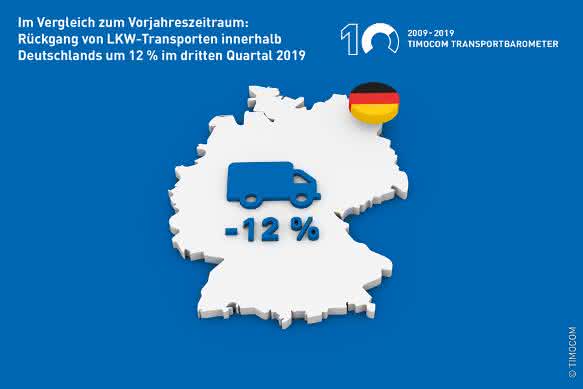
Germany's transport companies did less business in the third quarter of 2019 than in the previous year. From July to September, domestic truck transports in Germany fell by 12% compared to the same period last year. Nevertheless, the cyclical downward trend in demand for transport services in Europe's first Smart Logistics System, which was apparent until the middle of the year, has been halted. This was reported by IT company Timocom in its analysis of the third quarter of 2019 with regard to the transport barometer.
Timocom has been using the transport barometer to analyze the development of transport supply and demand for the freight and cargo space smart apps integrated in the Smart Logistics System since 2009. More than 130,000 users generate up to 750,000 international cargo and freight offers every day.
10 years of the transport barometer
In terms of developments in the UK, the TIMOCOM Transport Barometer reflects the great market uncertainty that prevails in the European economy in the wake of the Brexit debate. While the number of freight offers from EU countries to the UK slumped by 56% in the first two quarters of this year, more freight is currently being transported to the island again. Fecke: "In the third quarter, we are again seeing an increase in stock levels, which shows that companies with a location in the UK are currently preparing for the coming months."
A look at individual EU countries paints a different picture: the heavy rainfall in recent weeks in the Mediterranean region and eastern Andalusia has led to massive crop failures for fruit and vegetables, which have had an impact on truck exports from this region. "The significant growth in exports that Spain's farmers were able to record in the first two quarters of this year has slowed down," observes Fecke. "Added to this is the political blockade in Spain, which is still without a government. This panorama of uncertainty is also having a blocking effect on exports." As a result, vehicles heading back to southern Europe are lacking on the market. "We are therefore seeing a 14% increase in freight supply to Spain and a 12% increase to Portugal compared to the third quarter of 2018," continues Fecke.
"Compared to the previous year, demand for transportation in Germany is weakening," says Timocom's business analyst Tilman Fecke. Nevertheless, the number of all freight offers that have been placed on the freight exchange since January 2019 has stabilized over the course of this year. "The market is currently at 94 percent of the previous year's level," says Fecke.


You might also be interested in
Industry is once again facing material shortages more frequently
According to the ifo Institute, material shortages in the industrial sector worsened in June. The chemical, electronics, and electrical industries have been particularly hard hit.
 read more...
Port of Duisburg feels economic slowdown
The global economy is cooling noticeably, which is also reflected in duisport's half-year balance sheet: Duisburger Hafen AG's container throughput is down slightly compared to the previous year.
read more...Editorial materialfluss SPEKTRUM 2019
The great reflection
In the well-known Bavarian folk song "Sepp bleib do", slightly Germanized here for the sake of intercultural dialogue, it says so beautifully: "It can rain or snow, or the weather can stay fine". So what should he do, Sepp?
read more...Economic survey - The industry is confident despite political crises
Without exception, entrepreneurs are optimistic about 2017. Some are cautiously optimistic about the overall economic development in Germany, but for their own company, the thumbs are all pointing up. A stable...
read more...System Alliance Europe and Timocom cooperate
The companies System Alliance Europe eG (SAE) and Timocom have entered into a strategic partnership. The primary aim of the collaboration is to set up a closed freight exchange, which the freight tech company will establish for Europe's largest...
read more...Sirum connects TMS with Timocom freight exchange
The Hamburg-based software company Sirum has connected its Transport Management System (TMS) to Timocom's freight exchange. This allows logistics service providers to plan and manage their existing orders as well as search for new ones and post...
read more...Emission-free heavy goods transport: Gruber Logistics, Iveco and AIT start practical test
As part of the Empower research project, a six-month test phase with a battery-electric, zero-emission truck prototype from Iveco for heavy commercial vehicles will start in mid-June 2026. In collaboration with Gruber Logistics, the prototype based...
read more...IKEA launches all-electric heavy-duty logistics project
Together with Mercedes-Benz Trucks and LC3 Trasporti, the Inter IKEA Group is focusing on battery-electric trucks and driving forward the decarbonization of road freight transport in Italy.
read more...Commitment to greater sustainability
Contargo strengthens e-truck fleet with 33 tractor units
Contargo puts 33 new battery-electric DAF XD Electric trucks into operation and reaches a milestone in the decarbonization of its fleet with now 90 e-trucks.
read more...