
Fuel consumption reduced
The Actros relies on aerodynamics
The fuel consumption of the Actros has been further reduced in recent decades. Aerodynamics is one of the most important levers here.
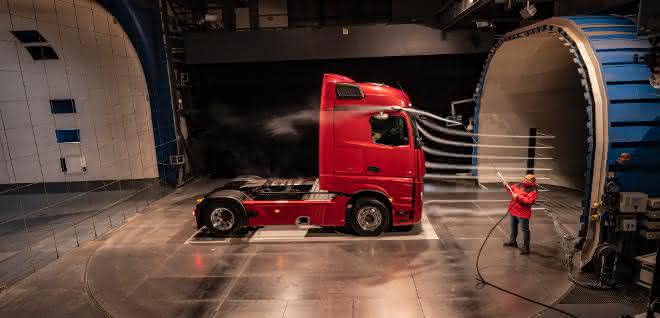
According to the company, savings of up to 15 percent were achieved in typical long-distance transport operations between 2011 and the introduction of the new Actros in 2019. Compared to its predecessor, the new Actros is up to three percent more economical on freeways and up to five percent more economical in interurban transport.
The importance of aerodynamics is made clear by one figure: in a current front-wheel-drive truck used for long-distance transport in Europe, around a third of the available mechanical energy is used to overcome air resistance. This is also reflected in the new Actros: the MirrorCam alone, which replaces the classic rear-view mirrors, contributes up to 1.5 percent to the overall fuel savings of the new Actros. The new, concave end edge flaps on the cab also make their contribution. These improvements are due not least to intensive tests in the Daimler AG wind tunnel in Untertürkheim. There, the engineers simulated the airflow conditions around the truck with the aim of optimizing the cd value, i.e. the wind slip, and thus the fuel consumption.
The optimized cruise control and transmission control Predictive Powertrain Control (PPC) as well as new rear axle ratios also contribute to this reduction in fuel consumption.


You might also be interested in
Daimler floats its truck division on the stock market
Daimler is planning a fundamental change to its corporate structure. The Supervisory Board and Board of Management have decided to evaluate a spin-off of the Truck & Bus business and to begin preparations for an independent stock market listing...
 read more...
500th Mercedes-Benz Actros SLT heavy-duty tractor unit handed over to TSB Transport-Service Beitinger
Heavy-duty tractor units such as the Mercedes-Benz Actros SLT are used to transport oversized and heavy components or machinery. The 500th Mercedes-Benz SLT tractor unit based on the current Actros was handed over to TSB Transport-Service Beitinger...
read more...Emission-free heavy goods transport: Gruber Logistics, Iveco and AIT start practical test
As part of the Empower research project, a six-month test phase with a battery-electric, zero-emission truck prototype from Iveco for heavy commercial vehicles will start in mid-June 2026. In collaboration with Gruber Logistics, the prototype based...
read more...IKEA launches all-electric heavy-duty logistics project
Together with Mercedes-Benz Trucks and LC3 Trasporti, the Inter IKEA Group is focusing on battery-electric trucks and driving forward the decarbonization of road freight transport in Italy.
read more...Commitment to greater sustainability
Contargo strengthens e-truck fleet with 33 tractor units
Contargo puts 33 new battery-electric DAF XD Electric trucks into operation and reaches a milestone in the decarbonization of its fleet with now 90 e-trucks.
read more...Schuon relies on a sustainable fleet
In 2025, the Alfred Schuon company will integrate 68 new trucks, including trailers and semi-trailers, into its fleet at the Haiterbach and Veszprém (Hungary) sites. Among the new acquisitions: Mercedes-Benz Actros L with aerodynamically optimized...
read more...Automated trucks: live tests in Hamburg city traffic
As part of the EU MODI project, two successful practical tests on the automation of heavy goods traffic were carried out this spring - both in the inner city area of Hamburg and on the highway. The project partners tested two important use cases in...
read more...TST initiates depot charging network for e-trucks
The TST Group wants to usher in a new era of truck electrification with a cooperative-oriented depot charging network. TST is building an ecosystem for charging heavy commercial vehicles and delivery fleets that covers all relevant aspects: from...
read more...Daimler Truck celebrates the start of series production of the Mercedes-Benz eActros 600 for long-distance transport in Wörth
Karin Rådström, CEO of Daimler Truck, and Daniela Schmitt, Minister for Economic Affairs, Transport, Agriculture and Viticulture of Rhineland-Palatinate, give the go-ahead for series production of the new model.
read more...