

Order-picking technology
Fully automatic picking: from minus 25 ˚C to plus 18 ˚C
The retail chain Coop Norge Handels SA has automated the logistics processes for all product ranges and temperatures at its central goods distribution center near Oslo, thereby achieving a significant increase in efficiency. On a peak day, up to 480,000 retail units are picked. The logistics center was planned and implemented by the general contractor Witron Logistik + Informatik GmbH from Parkstein.

The "Coop Logistikksenter Gardermoen (CLog)" covers 52,000 square meters and supplies around 1,200 stores throughout Norway with a good 17,000 different items. It is located in the immediate vicinity of Oslo Airport and has several important functions in Coop's logistics structure: On the one hand, it serves as a regional distribution center for the region around Oslo. In this region, CLog supplies the stores with goods from the full product range: dry (+18 °C), fruit & vegetables (+12 °C/+7 °C), fresh (+2 °C) and frozen (-25 °C). On the other hand, the CLog acts as a central distribution center for slow and medium-moving items from the dry and fresh ranges - and thus as a transshipment point for four other Coop regional warehouses in Norway.
The Norwegian trading company was planning to switch from purely manual warehouse and picking processes to a high degree of automation in all logistics areas. One of the main reasons for this was that manual processing was becoming increasingly problematic and expensive. In Norway, the unemployment rate is low and wages are high. Halvor Nassvik, Senior Manager for the Coop Logistics Center Gardermoen project, explains: "We believe that in future it will be difficult for us to find young people for this physically demanding and mostly monotonous work."
Goal: Ensure long-term competitiveness
Coop saw the construction of a new, modern logistics center as a great opportunity to ensure the company's long-term competitiveness. After all, the changeover has also made the company a little less dependent on the tight labor market situation. "That was a paradigm shift for us," says Nassvik. Around 95 percent of all items at Coop are now stored and picked automatically or semi-automatically. There were several reasons why Coop opted for the automated Witron solutions, says Nassvik: "First and foremost because of the low 'cost per picked unit' compared to the costs of manual processing." Other advantages for Coop - thanks to the automation - include error-free and store-specific picking, flexible implementation of individual store requirements - for example in terms of pallet heights, tightly packed load carriers and optimally loaded trucks. This means major savings in the transport area and in the stores. "Witron was also the only provider in the food retail sector that was able to show us a large number of highly automated logistics systems of the right size, throughput and availability, which had proven themselves successfully on the market for many years." Witron's range of products and services included the design and implementation of all material flow, IT, control, warehouse management and mechanical components. All conveyor technology and storage and retrieval machines were developed and manufactured by the Witron subsidiary FAS. A Witron on-site team is directly responsible for the complete service and maintenance of the system and ensures a permanently high availability of all logistics components during operation.
Fully automatic picking in all temperature ranges
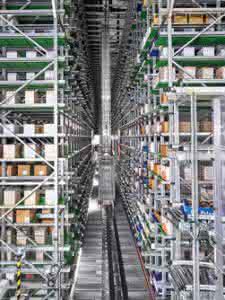
Coop stores and picks its entire product range in the logistics center. The standard "Order Picking Machinery (OPM)" system is used as a fully automated picking system for retail units in all temperature ranges. The "Dynamic Picking System (DPS)" for picking small-volume items is used in the dry goods and fresh food areas. The "Car Picking System (CPS)" is used to pick bulky goods in the dry goods area. An automated outgoing goods buffer optimizes the processes in the dispatch area. The material flows in all storage areas and temperature zones are intelligently designed and networked so that the number of remaining pallets can be reduced to a minimum and customer orders are consolidated and condensed to a maximum, regardless of the logistics area in which they are picked.
Small parts are picked directly into the shipping carton
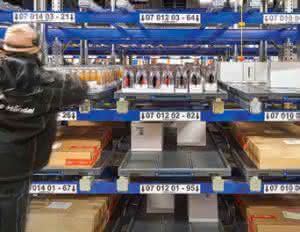
In the DPS, the highly dynamic and automated picking of small parts is supported by a pick-by-light system. DPS works according to the "goods-to-man"/"man-to-goods" principle. Depending on the order structure, the items are permanently or as required in the pick front, which is constantly optimized by automated storage and retrieval machines. DPS enables direct storage and picking in an automated small parts warehouse (AKL). In the DPS, Coop does not pick products from the dry and fresh range "classically" from container to container, but from container directly to shipping carton. The reason for this is again the long delivery routes. As the furthest store is around 1,700 kilometers away, it would not be economical to return the containers from the stores back to the distribution center. In addition, the shipping cartons picked in the DPS are fed directly to the OPM system, which ensures optimum order consolidation between the two systems.
Car picking system (CPS) for bulky and large-volume goods
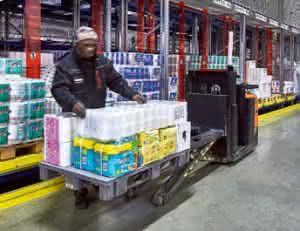
CPS is a manual picking system for route-optimized picking of large-volume and bulky retail units onto pallets or roll containers. Thanks to the intelligent control system, several orders can be picked in parallel by one picker in the CPS area. Replenishment to the pick front is fully automated by storage and retrieval machines. At Coop, orders are picked from pallets (medium and fast-moving items) or layer trays (slow-moving items) onto the order pallet using pick-by-voice. This technology is also used for promotional items and display pallets. Ergonomic layer trays developed in-house by Witron ensure that a large number of additional items can be stored in the pick front in an extremely space-saving manner. The use of layer trays reduces picking distances by around 60 percent.
Fully automatic outgoing goods buffer
Another technical highlight in the system is the fully automatic Witron outgoing goods buffer. At Coop, the temperature in the dispatch area is a constant +4 °C. "This enables us to buffer the picked orders from the various temperature zones centrally, consolidate them according to route and store and make them available in the correct sequence and just-in-time for delivery directly in front of the correct dispatch gate," explains Jack Kuypers, Vice President Witron North West Europe. "This is automated and system-controlled at the more cost-effective height instead of manually in the expensive area." This minimizes the required staging area. Coop also benefits from the very short walking distances for shipping employees when loading trucks. This reduces the loading time at the gates and the vehicles can make their way to the stores more quickly," says Kuypers.
Further expansion of the cooperation is planned
Everyone involved is completely satisfied with what has been achieved so far. "Our stores benefit from error-free deliveries, store-specific sorting of goods on pallets - adapted to the respective store layout - and higher product quality thanks to improved temperature controls. Coop also saves a lot of transportation costs," says Head of Logistics Halvor Nassvik, drawing a positive conclusion.
In addition, Coop Norway has achieved considerable cost savings, particularly in terms of personnel and maintenance. "As automation also enables a higher degree of centralization, considerable savings have also been made on inventory," adds Ove Bjorgum. As a result, the total cost and container savings are around 50 percent. And the joint journey is not over yet: Coop intends to use other Witron systems in the future. New projects are currently being considered.


You might also be interested in
Automated Pallet Inspection
In logistics, the quality of pallets is critical to safety, efficiency, and smooth operations. With an intelligent classification system from Breeze Innovations, pallet inspection can be performed automatically and objectively. The system detects...
 read more...
Circular load carriers for more sustainable supply chains
With the planned Industrial Accelerator Act, the European Union wants to accelerate the transformation of industry towards low-carbon production processes and resource-efficient supply chains. Logistics and transportation are also increasingly...
read more...Integration of a robotics solution
Lyreco modernizes logistics center in France
Lyreco is pressing ahead with the automation of its central site in Villaines-la-Juhel with an investment volume of over 25 million euros.
read more...Dragsbæk halves pallet area
By using automated pallet solutions from Palomat, Dragsbæk has halved the space required for pallets, optimized processes and sustainably improved working conditions.
read more...Pixels instead of paper
With the solutions from Logistikbude, Bekuplast, manufacturer of plastic containers, keeps an eye on its load carriers, saves costs and can work more efficiently with forwarding partners.
read more...Flexibility in saving space
Purus Plastics has developed a new retail range. The company operates a processing plant for plastics; recycling creates new products from secondary raw materials, including pallets.
read more...Solutions for the food industry
At Werit, the focus is on customer-specific solutions, sustainable recycling and pooling systems and products made from recyclate. The stand concept is divided into four areas: Products and innovations in the food sector, customer solutions,...
read more...Pallets with QR code
At the Epal Germany stand, visitors can gain an insight into the reusable system propagated by Epal, the life cycle of an Epal pallet and the newly developed QR pallet.
read more...The path of the Euro pallet into the IoT
With the introduction of the EPAL Euro Pallet QR in 2024, the European Pallet Association (EPAL) aims to set a new standard for the classic Euro pallet, which has been used successfully for over 60 years, and pave the way for ecologically...
read more...