
Commercial construction
Poco expands its commitment thanks to Brüninghoff
Poco, the furniture discounter, has built an impressive regional warehouse in the picturesque Lüneburg Heath. This large warehouse serves to supply the stores in the greater Hamburg, Schleswig-Holstein and Hanover areas and at the same time supports the company's flourishing online business. Poco once again relied on the proven expertise of Brüninghoff for the realization of this major project.
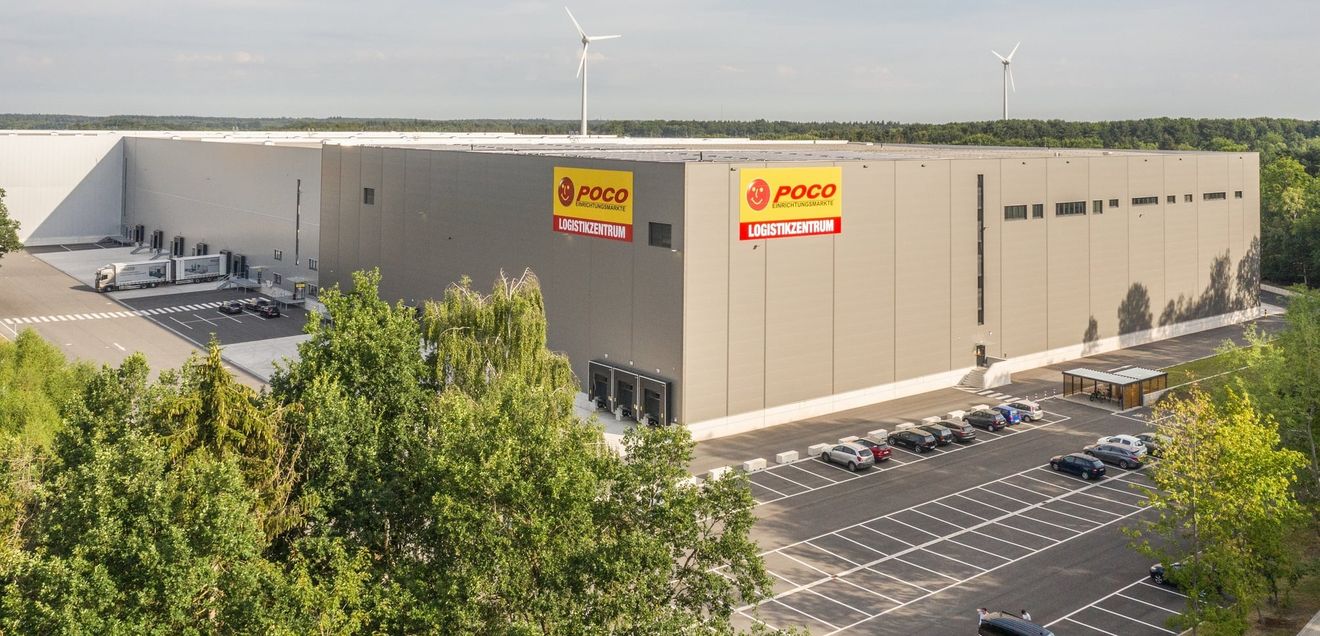
The halls were specially tailored to the storage and logistics requirements of the furniture discounter. Part of the project was designed as a two-storey building in order to make optimum use of the available space and minimize surface sealing.
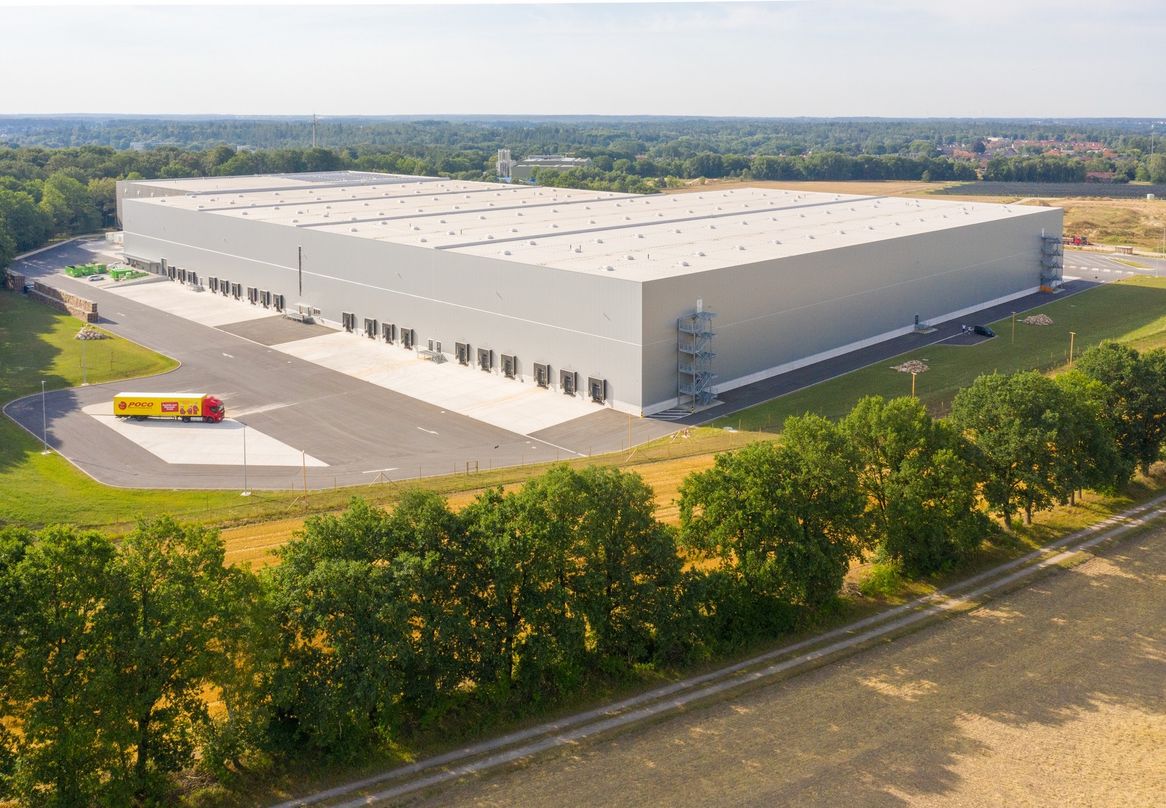
The growing online trade and increasing demands on the availability of goods require sophisticated logistics. Poco has risen to this challenge and invested in a new regional warehouse in Walsrode-Bomlitz, Lower Saxony. This location is centrally located between Hamburg and Hanover and is directly connected to the federal highways 7 and 27 via the Walsrode triangle. Five warehouses were built in three construction phases on a site measuring around 100,000 square meters.
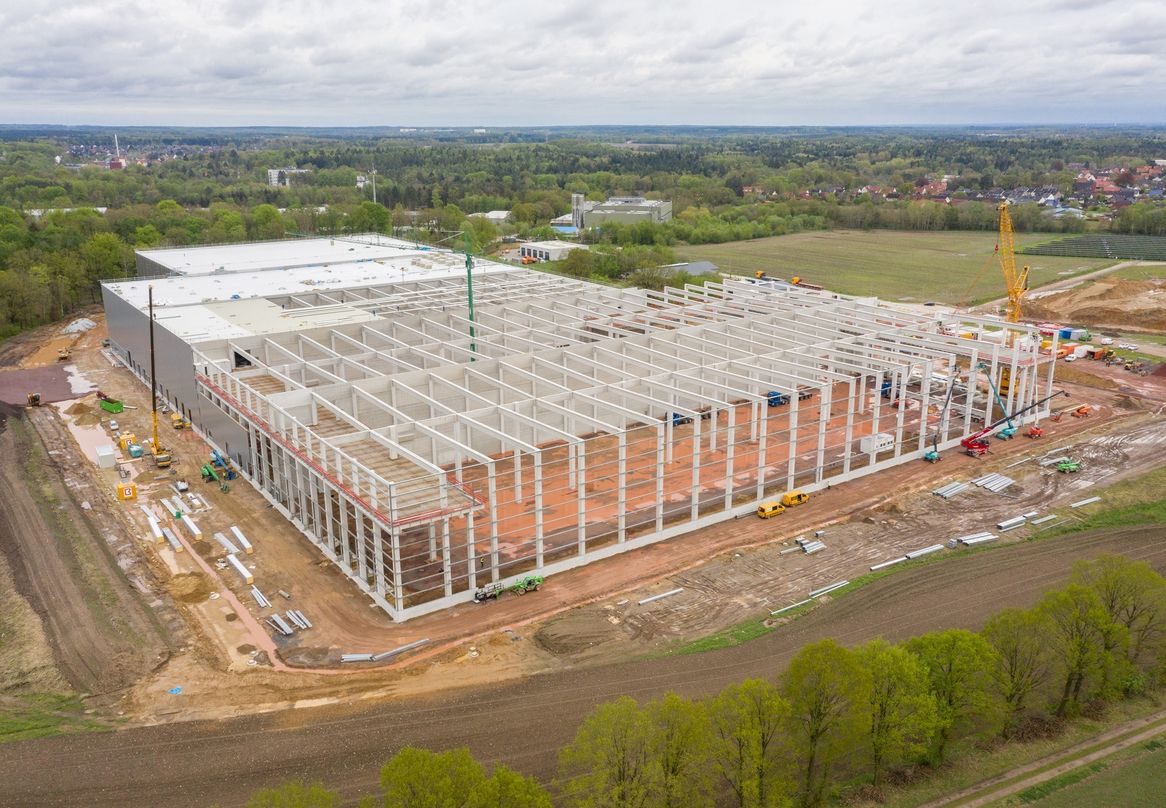
Based on positive experiences from previous projects, the furniture discounter once again decided to work in partnership with Brüninghoff. The project construction specialist from Heiden took over the general contractor services, with the exception of the technical building equipment (TGA), which was realized by the client itself. The architectural concept was designed by Inke Sabine Kloss from Theissen Architektur in Göttingen.

Optimization of storage space and logistics processes
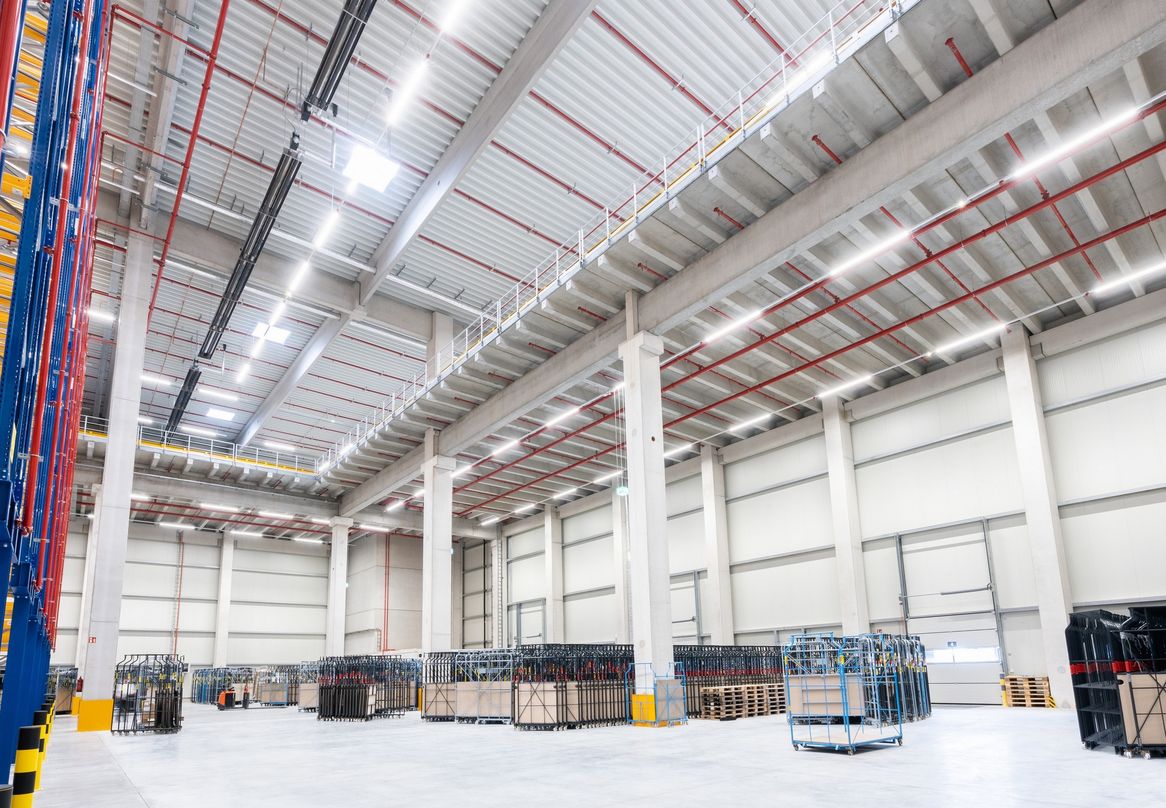
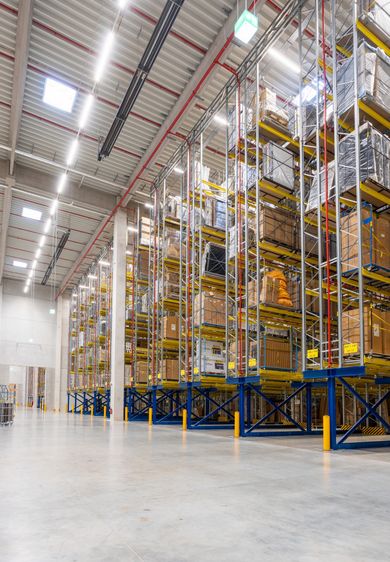
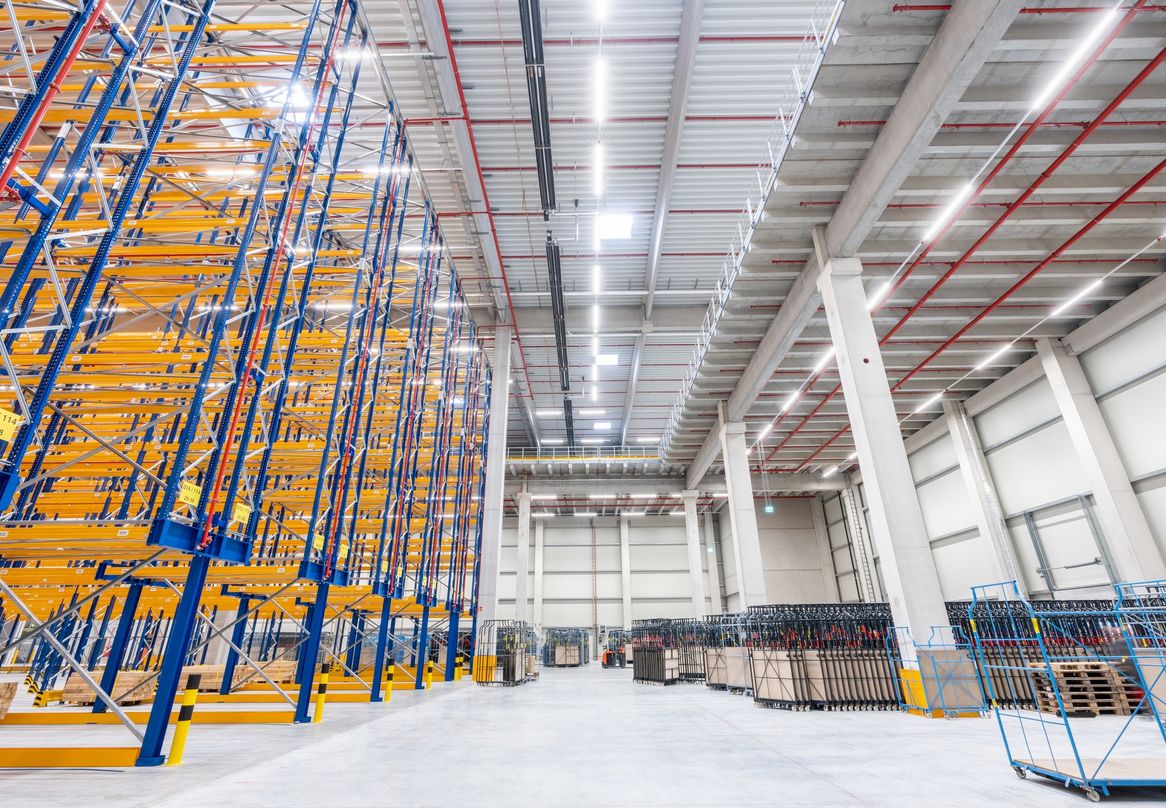
The logistics complex for Poco was designed to make the best possible use of the built-up area. A key challenge was to minimize the number of internal columns in order to increase the flexibility of the storage area. The building also had to enable efficient loading processes. For this reason, the entire building was raised 1.15 meters above ground level and has a total of 57 gates for the delivery and removal of goods.
Hall construction
A combination of reinforced concrete columns and beams with prestressed concrete trusses and PI ceilings was used to ensure an economical construction and at the same time meet the requirements for spans and fire protection. The PI ceilings enable high traffic loads and at the same time carry heavy loads. The beams span widths of up to 27 metres, which allows for flexible room design and optimized storage. For the façade, the decision was made to use sandwich panels as an economical solution.
Two-storey halls and mezzanines
The five halls reach a height of up to 22.5 meters and offer around 38,900 square meters of floor space on the first floor. One hall has a two-storey design, while the other halls have surrounding mezzanines. These mezzanines were added in order to use the space above the delivery gates for corlet storage and offer a total usable area of around 7,300 square meters. The upper floor of the two-storey hall with a usable area of 6,980 square meters is also used for Corlette storage.
Use of BIM
Brüninghoff relies on Building Information Modeling (BIM) as standard in the planning and implementation of projects. In Walsrode, the use of BIM data made day-to-day work on the construction site considerably easier.
BIM was used to control the logistics and timing of the individual trades. The data was prepared in such a way that the model provided important measuring points for a total station, which guided the users to the targets selected in the BIM model with millimeter precision. This proved to be extremely helpful during the foundation work, as time-consuming manual measurements on the construction site were avoided and dimensional tolerances were minimized.

In Walsrode, Brüninghoff has created an impressive logistics complex that impresses with its clever planning and implementation. This includes the generous spans and the minimal number of columns, as well as the two-storey design and the surrounding mezzanines. The project represents a process-optimized large construction site in which BIM played a decisive role.


You might also be interested in
Digitalization in the construction industry:
ABI - IOT tracking from Sensolus Logistics processes for customized precast concrete elements
Since 1950, Andernacher Bimswerk GmbH & Co. KG, ABI for short, has been creating value from concrete - for the German, family-run company in its third generation, sustainability and resource conservation are just as important as tradition and...
 read more...
Automation Is Driving Up Demand for Logistics Space
Warehouse automation is growing significantly in Europe. According to a study by Prologis, 50 percent of modern logistics space is expected to be automated by 2035.
read more...Prologis starts first construction phase
Major project in Dortmund
Prologis has started construction of the Dortmund DC4WARD logistics, commercial and light industrial park. Around 130,000 square meters of modern space with a focus on sustainability and energy-efficient operation will be built on the former...
read more...Logistics real estate: Logivest brokers in Bielefeld to Qtrado
In Bielefeld, logistics real estate consultant Logivest has brokered around 6,000 square meters of warehouse space for rent to Qtrado. The property belongs to the Fixemer Real Estate Group, an international real estate company.
read more...Dachser strengthens logistics location...
Investment worth millions in the Allgäu
Dachser is investing around EUR 30 million in the expansion of its Allgäu logistics center in Memmingen. A new facility for industrial and consumer goods with additional handling, storage and office space will be built by spring 2027.
read more...MLP Group plans second city logistics property in Vienna
The MLP Group is further expanding its Austrian portfolio with a second project in the capital city of Vienna. With the acquisition of a site near Vienna Central Station, the developer is pursuing the goal of consolidating its role in an expanding...
read more...Arvato further expands customs logistics in Turkey
With a new type A customs warehouse in Istanbul-Tuzla and additional capacity, Arvato is strengthening its cross-border logistics expertise and positioning Turkey as a strategic hub between Europe and Asia.
read more...Gebhardt expands into France
The Gebhardt Intralogistics Group is expanding into France and opening its first location in Paris. This strengthens the company's presence in one of Europe's most important logistics markets.
read more...11,000 square meters of logistics space for Magnera
In Gaggenau, Baden-Württemberg, the logistics real estate consultant Logivest has brokered a logistics location for Magnera for long-term rental.
read more...