
From materialfluss 8-9/2019
Mixed use over several floors
The design of Segro's inner-city properties in Germany takes into account both the current demand situation and the long-term challenges of urban logistics. The multi-level logistics project "Air²" near Paris is a good opportunity for international knowledge transfer.
Commerce logistics is strongly represented in the Berlin conurbation, big boxes in the Ruhr region, automotive logistics in the south - the German logistics sector, the third largest sector in Germany after the automotive industry and trade, has many important regions whose user groups differ according to the regional economic sectors. The situation is different in France, where political and economic centralism is deeply rooted. More than half of all logistics space is located in the Paris-Ile de France region. Against this backdrop, it is hardly surprising that competition for modern building plots for logistics properties close to the city is extremely fierce. Developers in the greater Paris area are currently securing building plots that are strategically located on waterways and railroads, thus enabling alternative delivery processes away from the busy roads. This is also relevant as the "Grand Paris" megaproject is planning a massive expansion of the infrastructure.
Segro pilot project in Gennevilliers
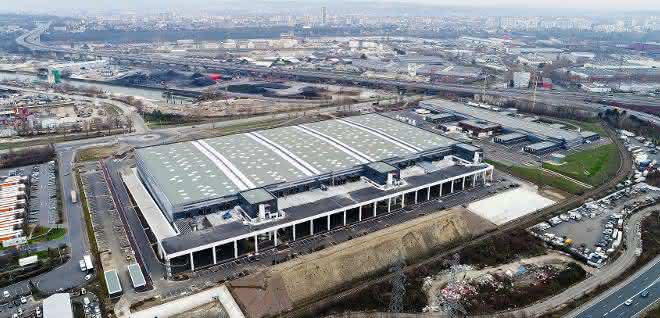
Centrally located building plots are limited in terms of space. With the "Paris Air² Logistique" real estate project in Gennevilliers near Paris, which Segro completed together with its subsidiary Vailog in January 2019, a structural step upwards was also taken in Paris. A total of 63,000 square meters of usable space was created on two floors, evenly distributed over both storeys. The lower floor is nine meters high, the upper seven meters. IKEA has rented around 50,000 square meters over both floors to supply the global metropolis, which is around 20 kilometers away, while the remaining space is largely used by DIY store and garden retailer Leroy Merlin. The building has a total of 48 double-sided loading ramps on the first floor and 24 single-sided loading ramps on the upper floor; even large trucks can be loaded and unloaded on the upper floor without any problems. A ten-meter-wide, separately accessible external ramp enables uninterrupted traffic in both directions. This allows the property to be operated by several users or user profiles; it can also be used by third parties.
Building even higher in the future
The property is used by IKEA as a pick-up center and central warehouse for the Paris stores. It has 300 parking spaces and is easily accessible by public transport. The immediate proximity to the port of Gennevilliers and the good connections to several highways and the rail network enable IKEA to implement a modern multimodal last-mile strategy by water, road and rail. All transports are to be handled with emission-neutral vehicles by 2020. For the furniture manufacturer's fleet of e-vehicles, 85 charging points were already integrated during the construction of the project. The property itself was also built with environmental sustainability in mind and received the top rating of "Excellent" from the international certification system BREEAM (Building Research Establishment Environmental Assessment Methodology).
Paris as a case study for Germany
In a city where delivery traffic can hardly reach the city center, the Seine is becoming increasingly important for a smooth flow of goods. For Segro as a player in many European markets, projects such as "Air²" in Paris provide an opportunity for international knowledge transfer. Although the traffic and space problems in German cities are not as pronounced as in Paris, inner cities in Germany are also becoming increasingly crowded. It is not only Berlin and Frankfurt am Main that are experiencing constant population growth. Numerous international players from the e-commerce sector are planning or completing their market entry in Germany. In addition, logistics real estate developments in city centers in particular are increasingly competing with new residential and office construction when it comes to the allocation of space. The design of Segro's inner-city properties in Germany takes into account not only the current demand situation, but also the long-term challenges of urban logistics. A two-storey property near Munich, which is used as a fresh food logistics location and for parcel delivery, was handed over ready for occupancy in 2018.
Are multi-level mixed uses coming?
In Germany, areas that fall into the building law category of "urban areas" are ideal for the development of new real estate concepts. Here, different noise levels and floor area ratios are permitted, as well as the mixing of several types of space. For example, two to five-storey mixed-use properties are conceivable in which the first floor is used for city logistics - including modern delivery methods such as e-bikes. The upper floors could be used for surgeries, offices or daycare centers. There are already models, such as free-standing supermarket projects with residential units built on top. Even the combination of logistics and housing is not categorically ruled out: At Segro Park Hayes near London, a former Nestlé factory is being revitalized as a mixed-use complex with apartments as well as production and logistics space.


You might also be interested in
Guest article logistics real estate
Ecologically sustainable and economically sensible
The logistics industry is facing major challenges and the demands on logistics properties are high. They must meet the applicable sustainability standards.
 read more...
Segro expands Airport Park Berlin
Segro is building a further 33,000 square meters for the commercial section of Segro Airport Park Berlin. Now that planning permission has been granted, construction will begin on the first section of around 15,000 square meters this year.
read more...Automation Is Driving Up Demand for Logistics Space
Warehouse automation is growing significantly in Europe. According to a study by Prologis, 50 percent of modern logistics space is expected to be automated by 2035.
read more...Prologis starts first construction phase
Major project in Dortmund
Prologis has started construction of the Dortmund DC4WARD logistics, commercial and light industrial park. Around 130,000 square meters of modern space with a focus on sustainability and energy-efficient operation will be built on the former...
read more...Logistics real estate: Logivest brokers in Bielefeld to Qtrado
In Bielefeld, logistics real estate consultant Logivest has brokered around 6,000 square meters of warehouse space for rent to Qtrado. The property belongs to the Fixemer Real Estate Group, an international real estate company.
read more...Dachser strengthens logistics location...
Investment worth millions in the Allgäu
Dachser is investing around EUR 30 million in the expansion of its Allgäu logistics center in Memmingen. A new facility for industrial and consumer goods with additional handling, storage and office space will be built by spring 2027.
read more...MLP Group plans second city logistics property in Vienna
The MLP Group is further expanding its Austrian portfolio with a second project in the capital city of Vienna. With the acquisition of a site near Vienna Central Station, the developer is pursuing the goal of consolidating its role in an expanding...
read more...Arvato further expands customs logistics in Turkey
With a new type A customs warehouse in Istanbul-Tuzla and additional capacity, Arvato is strengthening its cross-border logistics expertise and positioning Turkey as a strategic hub between Europe and Asia.
read more...Gebhardt expands into France
The Gebhardt Intralogistics Group is expanding into France and opening its first location in Paris. This strengthens the company's presence in one of Europe's most important logistics markets.
read more...