
Lighting/floor cleaning/fire protection
Fire protection: prevention is better than extinguishing
Today, fire protection in warehouses and factories is virtually synonymous with fire prevention. This is because the aim is to "turn off the air" to potential fires from the outset by drastically reducing the oxygen content. The fire prevention solutions, which are also used in deep-freeze high-bay warehouses, for example, are complex but pay off in many respects, especially as they act as an energy supplier.
Preferred Freezer Services' automated deep-freeze high-bay warehouse in Richland, Washington State, is the largest of its kind in the world. The 144-metre-long and 45-metre-high rack aisles offer 117,000 pallet spaces in which around 900,000 tons of frozen food, predominantly French fries, are stored and retrieved each year.
The gigantic warehouse is the first building in the USA to be protected with the active fire prevention system "OxyReduct" from Wagner. However, "warehouses of this size and height pose a particular challenge", as Wagner experts emphasize.
Fire protection for a gigantic deep-freeze high-bay warehouse

As a fire prevention solution, an OxyReduct Pressure Swing Absorption (PSA) system was installed that was individually adapted to the structural conditions. Its principle is based on lowering the oxygen content by means of a controlled oxygen supply. The specified residual oxygen content was determined on the basis of fire tests and takes into account the ignition limits of the stored goods packed in ready-to-ship cartons and the sub-zero temperatures (-23 degrees Celsius) in the warehouse.
The oxygen content has been reduced to 16% by volume so that a fire can no longer develop or spread. The PSA system uses activated carbon to generate nitrogen directly from the ambient air. This can then be fed directly into the protected area. The oxygen sensors of the OxyControl control system are used to monitor the air ratio in the protected area. These ensure that the nitrogen supply and the oxygen content in the protected area are optimally coordinated and that the oxygen concentration is continuously maintained at the specified level.
Fuel cells for fire prevention and energy supply
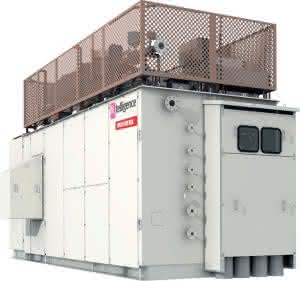
Minimax and Fuji N2telligence have successfully implemented the world's first project for simultaneous energy supply and fire prevention with fuel cell technology in a deep-freeze warehouse. It enables the customer Wolf ButterBack to produce energy- and cost-efficiently, avoid fires and, as a side effect, protect the environment. Since 2005, Minimax has been protecting the baked goods deep-freeze warehouse in Plant 2 of Wolf ButterBack KG in Fürth with an Oxeo Prevent fire prevention system.
There, the oxygen content is permanently reduced to 17% by volume through the supply of nitrogen produced on site, so that a fire cannot develop in the first place. Last year, the decision was made to replace the existing fire prevention system, partly for energy cost reasons.
A fuel cell supplies 100 kilowatts of electrical energy continuously and without interruption and can therefore cover part of the basic energy load in production. At the same time, it produces low-oxygen air without interruption, which can be fed into the deep-freeze warehouse as required. Users such as Wolf ButterBack thus benefit from significantly reduced operating costs and can even expect a return on investment in the medium term. This is unique in the fire protection sector. In addition, there is a state subsidy for sustainable electricity and heat production.
Economically positive side effects
In December 2016, a "QuattroGeneration" fuel cell powered by natural gas was installed within just two weeks and integrated into the control and piping system of the existing fire prevention system. Minimax cooperated with Fuji N2telligence on this project. By using the fuel cell, the deep-freeze warehouse is supplied with electricity and protected against fire at the same time. Fuel cells generate electricity and heat simultaneously according to the principle of combined heat and power generation and, as a by-product, clean and nitrogen-rich exhaust air; this can be ideally used to operate an oxygen reduction system for fire prevention.
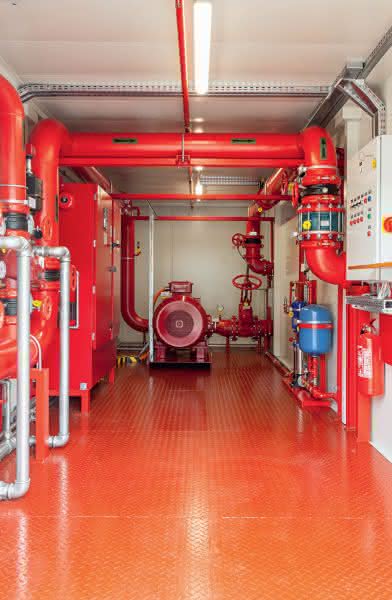
Calanbau, a company of the Fire Protection Solutions Group, has developed mobile container solutions for the pump control center of sprinkler systems for customers with special requirements. With the "All-inPumpUnit", installation time is reduced, the container solution is space-saving and mobile, inexpensive to purchase and contains all the system components of a classic sprinkler control panel.
All equipment features such as the electrical systems, monitoring and sprinkler system controls are integrated into the container.
Versatile mobile sprinkler control panel
The container solution of the mobile sprinkler control center complies with the standard requirements (EN, NFPA, FM, VdS) and limits the installation time for the pump device on the building to one to two days instead of several weeks for the construction of a new building section.
The device is standardized and at the same time universal, which allows it to be used under different conditions and for different types and object sizes. It requires significantly less space than a traditional pump device. It is also mobile, as the container can be moved to another location if necessary and can therefore also be used to protect another object. Furthermore, the mobile sprinkler control center allows the construction of any number of pumps and is cheaper to purchase than a traditional pump station.
The TPI container pump center is delivered completely finished. Thanks to its small dimensions, the container can be easily transported to the construction site, where it is placed on a foundation. Then all that remains to be done is to connect the electrical wiring and the suction and discharge lines as well as the monitoring system.
The equipment of a mobile sprinkler control center includes the sprinkler pump with diesel or electric motor, the sample line with flow meter, as well as exhaust air valves, heating and lighting. In addition, a double-walled fuel tank, the necessary piping, including the connection to the water supply tank and the electrical systems with main switch-off system are installed; finally, the control systems and sprinkler protection are installed in the container.
Calanbau recently delivered two mobile container centers to customers of IBS Industrie-, Brandschutz und Sicherheit GmbH in Limburg and Schwalmtal. Reinhard Irrgang
www.calanbau.dewww.minimax.com www.wagnergroup.com


You might also be interested in
Automated Pallet Inspection
In logistics, the quality of pallets is critical to safety, efficiency, and smooth operations. With an intelligent classification system from Breeze Innovations, pallet inspection can be performed automatically and objectively. The system detects...
 read more...
Circular load carriers for more sustainable supply chains
With the planned Industrial Accelerator Act, the European Union wants to accelerate the transformation of industry towards low-carbon production processes and resource-efficient supply chains. Logistics and transportation are also increasingly...
read more...Integration of a robotics solution
Lyreco modernizes logistics center in France
Lyreco is pressing ahead with the automation of its central site in Villaines-la-Juhel with an investment volume of over 25 million euros.
read more...Dragsbæk halves pallet area
By using automated pallet solutions from Palomat, Dragsbæk has halved the space required for pallets, optimized processes and sustainably improved working conditions.
read more...Pixels instead of paper
With the solutions from Logistikbude, Bekuplast, manufacturer of plastic containers, keeps an eye on its load carriers, saves costs and can work more efficiently with forwarding partners.
read more...Flexibility in saving space
Purus Plastics has developed a new retail range. The company operates a processing plant for plastics; recycling creates new products from secondary raw materials, including pallets.
read more...Solutions for the food industry
At Werit, the focus is on customer-specific solutions, sustainable recycling and pooling systems and products made from recyclate. The stand concept is divided into four areas: Products and innovations in the food sector, customer solutions,...
read more...Pallets with QR code
At the Epal Germany stand, visitors can gain an insight into the reusable system propagated by Epal, the life cycle of an Epal pallet and the newly developed QR pallet.
read more...The path of the Euro pallet into the IoT
With the introduction of the EPAL Euro Pallet QR in 2024, the European Pallet Association (EPAL) aims to set a new standard for the classic Euro pallet, which has been used successfully for over 60 years, and pave the way for ecologically...
read more...