Conveyor technology & components
Secondary wiper Y-Type from Flexco for high cleaning performance
Material carryback is one of the main causes of problems with conveyor belt systems. In contrast, operators use head scrapers for coarse material and secondary scrapers for fine cleaning.

In many cases, more than 90 percent of the carryback can be removed in this way. With the new Y-Type, Flexco has a flexible secondary scraper in its range that can be equipped with different polyurethane and carbide blades.
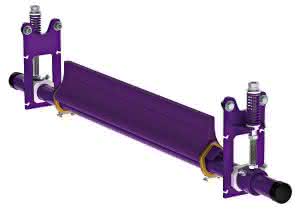
For operators conveying large quantities of dry food, Flexco also offers the Y-Type secondary cleaner with a chemical-resistant and food-approved polyurethane blade. No matter what application the Y-Type is used for, it improves belt cleaning and reduces routine maintenance. Flexco offers this flexible solution for normal and heavy-duty applications. It is therefore available with a maximum belt speed of three and 3.8 meters per second. A spring tensioning device ensures constant pressure of the blade on the belt at all times, thus ensuring thorough fine cleaning. The 75 millimeter wide blade segments also adapt to worn or damaged belts.
About Flexco
Flexible Steel Lacing Company (Flexco), headquartered in Downers Grove, Illinois, USA, specializes in mechanical conveyor belt splicing systems, belt cleaners, belt centering stations, impact beds and pulley lagging for light and heavy-duty conveyor belts. The solutions enable users to reduce downtimes and increase their productivity. Flexco Europe GmbH is the German subsidiary of Flexco, based in Rosenfeld, Swabia, where the group of companies currently employs around 60 people.
The quick-release axle has a diameter of 60 millimetres for normal applications and 72 millimetres for heavy-duty applications. Depending on the application, the Y-type is suitable for belt widths from 450 to 1,200 millimetres (normal) and from 900 to 1,800 millimetres for belts subject to heavy loads. It can be used at temperatures from minus 35 to 82 degrees Celsius. Clearly visible wear markings indicate whether they need to be replaced. The service employee can remove and replace the segments individually or all at the same time as a complete cassette.


You might also be interested in
Conveyor and lifting technology
Flexco: Secondary wipers for high cleaning performance
Material carryback is one of the main causes of potential problems with conveyor belt systems. To prevent this from happening in the first place, operators use head scrapers for coarse material and secondary scrapers for fine cleaning. In many...
 read more...
Conveyor technology without control cabinet
New materials, more efficient components and digital control concepts are increasingly changing traditional conveyor technology. The focus of many developments is primarily on one goal: reducing overall costs. Considerable expenses are often...
read more...mk expands conveyor technology portfolio
Intelligent intralogistics from the modular system
The mk Technology Group is expanding its intralogistics portfolio with the new RBF 2000 roller conveyor system. The fully modular system combines flexible conveyor technology with intelligent control architecture and is suitable for transport,...
read more...Pocket sorter: goods transported autonomously to their destination
TGW Logistics installs a SmartPocket system for the mail order company Personalshop in Polling, Tyrol.
read more...100+ installations worldwide: Trust through practice
Automation must function reliably, every day, at all times. With more than 100 adapter-based sorting systems from Dürkopp Fördertechnik (DFT) installed worldwide, the technology has proven itself in continuous industrial operation.
read more...Bonfiglioli focuses on modularity and automation
Bonfiglioli had two stands at Logimat: in Hall 9 with forklift trucks and warehouse machines and in Hall 3 for materials handling technology and industrial automation. In the area of industrial trucks, the company presented complete drive solutions,...
read more...Experience Zero-Touch live
Schönenberger Systeme will be presenting a live intralogistics system that demonstrates the zero-touch approach from goods receipt to goods issue. The focus will be on the combined transportation of hanging and flat goods, the handling of batch size...
read more...Transitic opens new branch in Spain
Transitic, system integrator for networked intralogistics systems, is expanding by opening a subsidiary in Spain. A first order with the retail giant El Corte Inglés, the largest department store group in Europe, is already in the works.
read more...DHL Express Germany relies on sorter solution from Vanderlande
Vanderlande has been commissioned to support DHL Express Germany with an automation solution for the new site project in Cologne. The system will be equipped with the new Spox sorter type. The agreement was signed on October 21 at Parcel+Post Expo...
read more...