
Loading ramp receives upgrade
Efficient warehouse logistics thanks to fully automated conveyor line
Six storage areas on three levels, two vertical conveyors and a converted, 140-meter-long truck loading ramp - these are the cornerstones of the new pallet conveyor system at Raiffeisen Kraftfutterwerke (RKW) in Kehl.
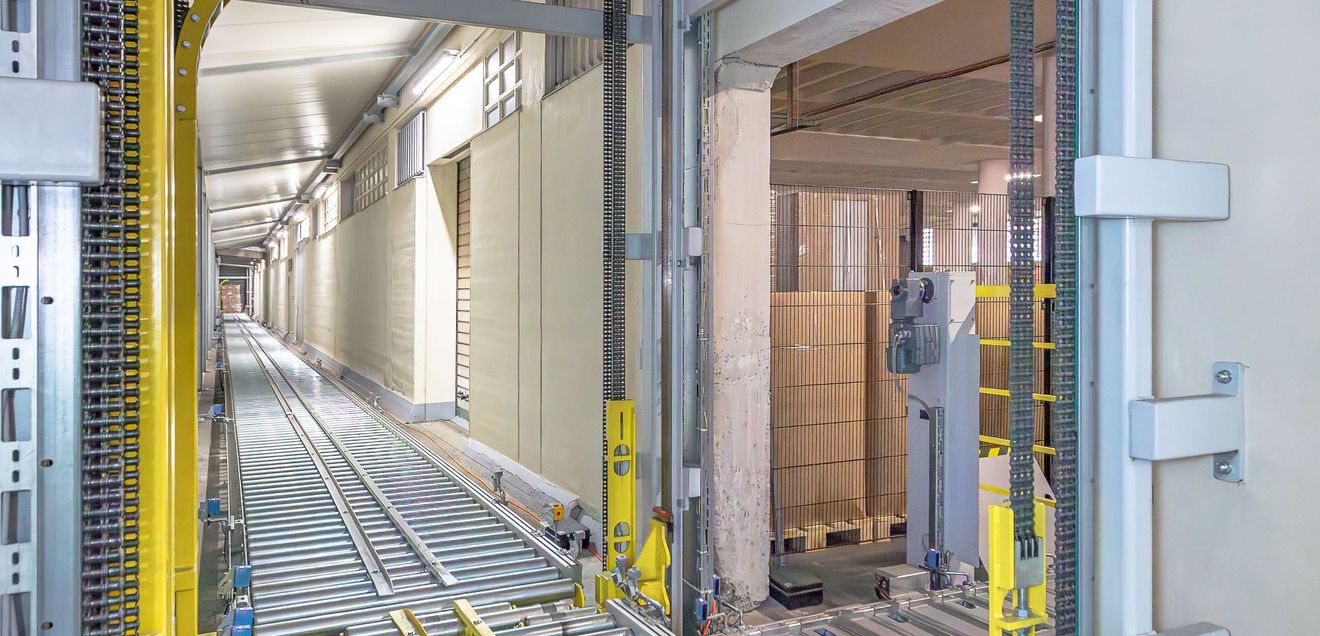
Conveniently located at the port, the site offers optimal conditions for the supply of raw materials by ship, rail and for up to 20 trucks, which are handled daily at the loading ramp - and the trend is rising. RKW Kehl, founded in 1963 and a Raiffeisen subsidiary, has been producing compound feed for livestock at the Kehl site for more than 60 years. Since 1987, the company has also specialized in the production of high-quality dry pet food products.
Due to the permanent increase in the production volume of packaged products and in order to meet the changing logistics requirements of customers, new solutions had to be created for the storage and delivery logistics of the packaged products. The company, which produces entirely without green genetic engineering and relies exclusively on European raw material origins, also sought and found a sustainable solution in the area of logistics. A building from the 1960s in the immediate vicinity was put back to good use for this purpose.
The goal for the conveyor technology manufacturer HaRo from Rüthen in the Sauerland region was clearly defined. The confusing forklift traffic was to be minimized and the truck loading ramp located in front of the warehouses was to be integrated into the conveyor system concept. In addition to the automated storage and retrieval of all six storage areas, additional pallet buffer spaces were to be created on the 141-metre-long roller conveyor.
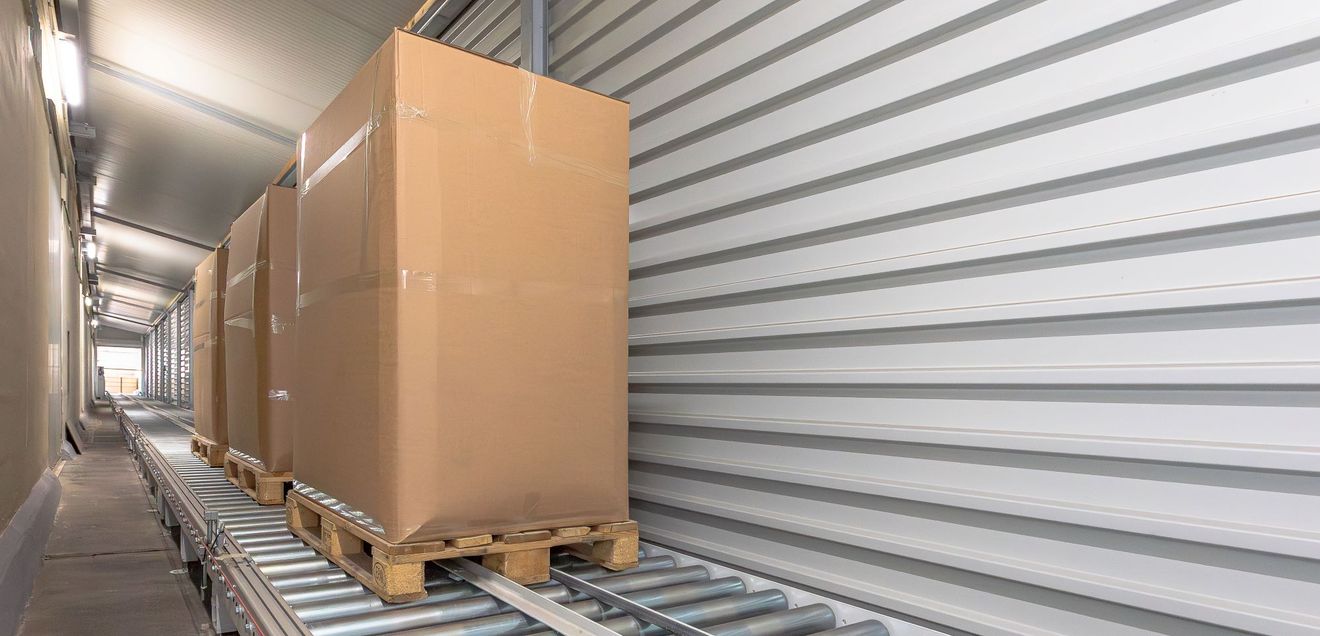
The concept of outsourced conveyor technology is nothing new for HaRo, be it in a tunnel that connects production buildings underground or on a bridge that crosses a main road. At RKW in Kehl, the challenge was to integrate an existing 1.2 meter high truck loading ramp into the conveyor technology concept in such a way as to ensure long-lasting and reliable operation. The exposed location at the port and the flanking arrangement along the outside of the building therefore required a weather-protected enclosure for the entire conveyor system, including the two vertical conveyors.
The task of this conveyor system is to quickly, efficiently and reliably distribute the flow of goods arriving by truck in the form of big bags, buckets and bagged goods on different types of pallets to the six storage areas on three levels. The employee selects the destination for the current pallet at a control panel and places the goods on the galvanized roller conveyor in the incoming goods area. Flat bars mounted in the set-down area support the depositing and positioning process.
Incoming pallet inspection for a reliable material flow
"With a system of this size, extensive inspection processes are essential before the goods are fed into the goods cycle to avoid faults," explains Markus Löseke, Head of Design. After being fed into the incoming goods department, the conveyed goods first undergo a contour and skid check in order to detect any safety-relevant damage to the pallets.
The next step is the legally required overload detection with a mechanical scale underneath the roller conveyor. This ensures that the maximum load of the vertical conveyor is not exceeded. If the result of one of the tests is negative, the pallet moves back. If the response is positive, the pallet is released for onward transportation.
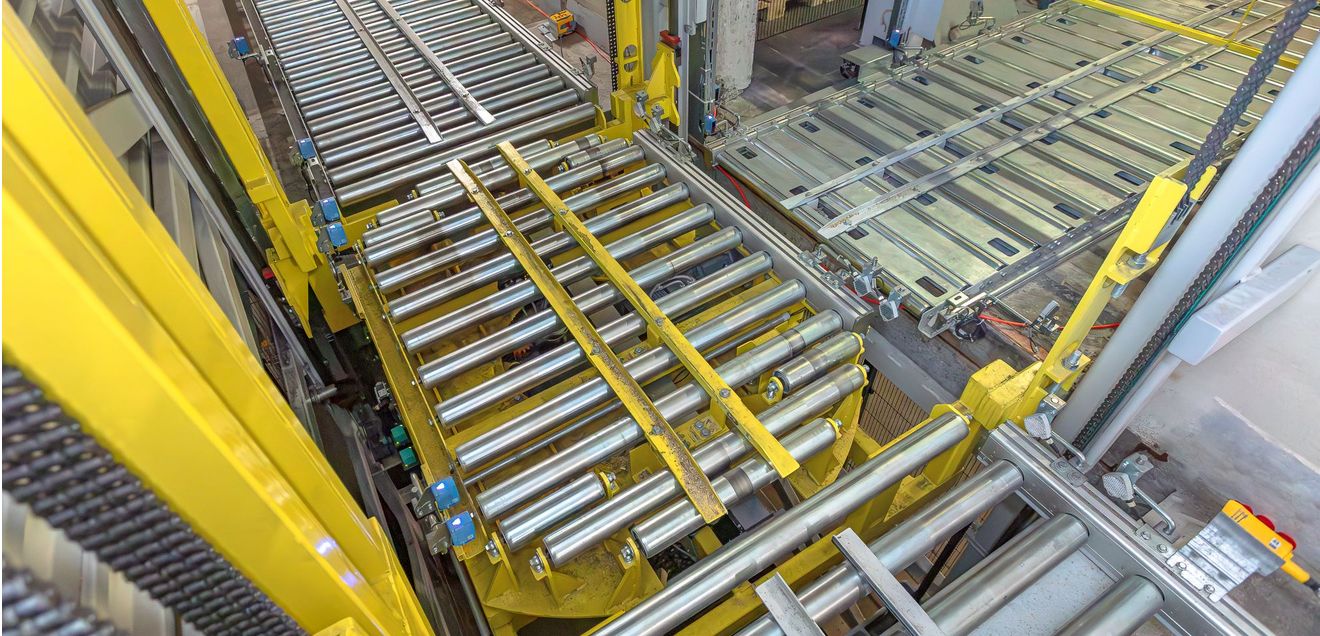
The driven roller conveyor transports the goods fully automatically to the preselected storage level in the desired building section and floor.
Pallet transport on the roller conveyor
In addition to automated transport, the entire roller conveyor section can also be used as a short-term pallet buffer. Here, the conveyor system works according to the block accumulation principle. A block of up to three pallets is formed on the first roller conveyor segment, which is then transported in one piece to the furthest free roller conveyor. This process prevents gaps from forming on the roller conveyor and ensures the highest possible buffer capacity, meaning that the section up to the first vertical conveyor can accommodate a complete truck load of 36 pallets. On the driven roller conveyors between the two vertical conveyors, the PLC control system also stores the destination addresses of the conveyed goods and tracks them along the conveyor line to their destination.
To ensure trouble-free operation, additional guide rails were integrated along the roller conveyors as a passive safety component. This central guide ensures that the different pallet formats reach their destination in a straight line on the conveyor section, which can be up to 70 meters long. This prevents the pallets from "getting lost" due to different runners and dimensions.
Facts, figures and data
The conveyor system installed by HaRo has a total length of 141 meters and is divided into two sections of 68 and 70 meters plus the vertical conveyors that can be driven through. The total sections were divided into 22 segments of 6,000 millimeters each. Only one drive unit per roller conveyor segment is required to transport the goods, which weigh up to 4.5 tons in total. This reduces investment costs and saves energy in the long term. Roller conveyors with a low overall height were used on the individual storage levels. At just 80 millimetres in the storage levels, these roller conveyors enable easy removal of the incoming pallets using a pallet truck. To increase the vertical conveyor's cycle times, several buffer spaces were created on the storage levels for the incoming and outgoing goods. In this way, the vertical conveyor can unload its load at any time and pick up new goods on the adjacent floor. Empty runs of the car are minimized in this way.
The roller conveyors were installed on the existing truck loading ramp; only the vertical conveyors had to be placed on a lower foundation due to their own weight of six tons and a height of 14 meters.
The customer's specifications stipulated an output of 60 pallets per hour with a maximum lifting height of 8.6 meters. In order to achieve these values, the vertical conveyors were each equipped with a drive power of eleven kW. This power enables a vertical travel speed of up to 37 meters per minute with a maximum load capacity of 2,000 kilograms.
Special feature: Vertical conveyor with integrated turning station
The special feature of the vertical conveyors used is the T-shaped arrangement of the adjacent roller conveyors. Given that the pallets can only be transported lengthways on a roller conveyor, the pallets are already rotated by 90 degrees in the vertical conveyor. A specially integrated turning station in the car enables the pallets to be correctly aligned so that they can be removed smoothly by the employees on the storage levels.
The demand for complete systems on this scale is constantly increasing. Project coordination requires the utmost attention. "Close cooperation with the customer, but also with other trades, is essential, especially when extending existing buildings," says HaRo Head of Design Markus Löseke.


You might also be interested in
Next-Generation Cold Storage Facility
Lineage Relying on Automation from TGW Logistics in Texas
Lineage is relying on TGW Logistics’ automation expertise to build one of the world’s largest temperature-controlled distribution centers in Texas. The highly automated cold storage and frozen food warehouse is scheduled to begin operations in late...
 read more...
mk expands conveyor technology portfolio
Intelligent intralogistics from the modular system
The mk Technology Group is expanding its intralogistics portfolio with the new RBF 2000 roller conveyor system. The fully modular system combines flexible conveyor technology with intelligent control architecture and is suitable for transport,...
read more...Experience Zero-Touch live
Schönenberger Systeme will be presenting a live intralogistics system that demonstrates the zero-touch approach from goods receipt to goods issue. The focus will be on the combined transportation of hanging and flat goods, the handling of batch size...
read more...Ennen takes over New Business at Kardex Mlog
On January 1, Heinz Ennen took over the position of Head of New Business at Kardex Mlog. He succeeds Winnie Ahrens, who moved to the management board of the intralogistics specialist at the turn of the year.
read more...The finalists for the IFOY Award 2026 have been announced
The IFOY Award 2026 is entering the decisive phase: 17 devices and solutions from eight nations and four start-ups have made it to the final. The finalists will face the IFOY audit at the Test Camp Intralogistics in Dortmund in April.
read more...Transitic opens new branch in Spain
Transitic, system integrator for networked intralogistics systems, is expanding by opening a subsidiary in Spain. A first order with the retail giant El Corte Inglés, the largest department store group in Europe, is already in the works.
read more...DHL Express Germany relies on sorter solution from Vanderlande
Vanderlande has been commissioned to support DHL Express Germany with an automation solution for the new site project in Cologne. The system will be equipped with the new Spox sorter type. The agreement was signed on October 21 at Parcel+Post Expo...
read more...Four floors efficiently connected
Anyone entering this part of the warehouse and production facilities at cosmetics manufacturer Dr. Kurt Wolff in Bielefeld does not expect to see conveyor technology: every space is used, characterized by normal walkways, flanked by production and...
read more...Kardex Mlog implements fully automated logistics center for NÖM
The Austrian dairy NÖM AG has commissioned Kardex Mlog to build a fully automated dispatch warehouse and conveyor system. The new building will offer space for up to 26,000 pallets. As general contractor, Kardex Mlog is also coordinating the steel...
read more...