
Improve performance and energy consumption
Conveyor technology: Turning old into new
MTA motorized rollers breathe new life into ageing conveyor technology - with new technology, extensive performance improvements and optimized energy consumption.
For many years, old accumulating roller conveyors have been doing their job in conveyor systems for cartons and containers all over the world. During implementation, manufacturers relied on technology such as clutch-brake systems or pneumatic accumulation conveyors. From today's perspective, these conventional technologies are generally neither efficient nor sustainable. They are noisy, consume a lot of energy and require costly stocking of spare parts and maintenance. In many cases, the availability of spare parts is also constantly decreasing.
The challenge: conversion without long downtimes
If the operator now wants to use new technologies, the conversion usually involves massive intervention in the existing control systems. Long downtimes and considerable costs are usually pre-programmed. An intervention in the PLC can also result in modified interfaces to a material flow computer or even to the WMS. In contrast, many operators have already replaced self-contained system areas, such as storage and retrieval machines. However, the conveyor system remains at the same level as the outdated technology. This increases the risk of the entire system failing.
Conversion without changing the control unit
MTA has now developed a solution for these systems by converting the cost-intensive accumulation roller conveyors to efficient motorized roller technology. The conversion does not require any changes to the existing control systems: The logistical functionalities of the sensor technology are either adopted or simply relocated in the MTA motor controllers. All interfaces to the higher-level control system are retained. The inefficient asynchronous motors, which are connected to the driven rollers of the conveyor system via belt technology, are eliminated. Likewise, there are no longer any active parts in the conveyor system after the retrofit. The signal transmitter structure, on the other hand, is retained.
"In particular, the operator gains considerable advantages when replacing pneumatic accumulation roller technology," says MTA Sales Manager Uwe Neumann. "On the one hand, the provision of pneumatic energy is very cost-intensive due to leakage losses and extensive compressor operation, and on the other hand, there are no longer any noise emissions typical of pneumatics," he continues.
Energy efficiency through sleep and wake mode
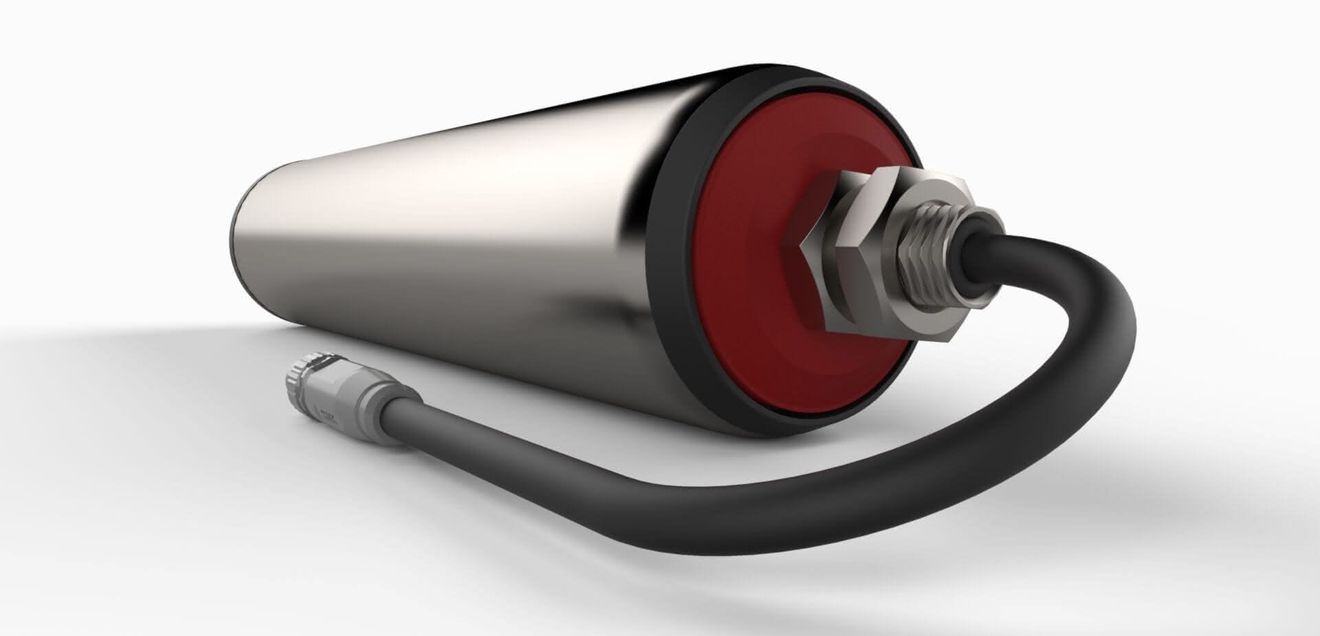
The energy saving results from the fact that in an accumulation section with motorized rollers, only the segment on which the goods to be conveyed are located is driven. The MTA motor controller includes a sleep and wake mode as standard. The gearless MTA motorized roller MRA50 is used in conjunction with the MTA motor controller. Both are also used in new conveyor systems as a proven combination. The motorized roller has a 24 V or 48 V standard and an output of up to 35 W. Conveying speeds of up to 1.2 m/s can be achieved. Installation is carried out in the existing conveyor profiles using the existing non-driven idlers, neither of which need to be replaced. A suitable drive unit (Poly-V, O-rings) is combined with the motorized roller by MTA according to requirements. The power supply is provided by a power supply unit that supplies up to ten motorized rollers with operating voltage. This results in a plug & play installation that can be carried out either by MTA partner companies or by existing maintenance personnel. As there are no changes to the control systems, the conversion can be carried out section by section without significant interruptions to operation.
Increased system availability
According to MTA, successfully implemented projects show that the availability of the systems is significantly improved. At the same time, energy consumption is reduced by around 70 to 75% and maintenance costs fall by around 80%. Neumann comments: "The retrofitted systems show that the return on investment (ROI) is less than three years, taking into account an eight-year depreciation period. In addition, it has been proven that the conversion in a medium-sized system with 250 to 300 converted stowage spacessaves over 90,000 kWh of electricity and therefore around 300 tons ofCO2 . The MTA concept also works independently of the manufacturer.


You might also be interested in
Next-Generation Cold Storage Facility
Lineage Relying on Automation from TGW Logistics in Texas
Lineage is relying on TGW Logistics’ automation expertise to build one of the world’s largest temperature-controlled distribution centers in Texas. The highly automated cold storage and frozen food warehouse is scheduled to begin operations in late...
 read more...
mk expands conveyor technology portfolio
Intelligent intralogistics from the modular system
The mk Technology Group is expanding its intralogistics portfolio with the new RBF 2000 roller conveyor system. The fully modular system combines flexible conveyor technology with intelligent control architecture and is suitable for transport,...
read more...Experience Zero-Touch live
Schönenberger Systeme will be presenting a live intralogistics system that demonstrates the zero-touch approach from goods receipt to goods issue. The focus will be on the combined transportation of hanging and flat goods, the handling of batch size...
read more...Ennen takes over New Business at Kardex Mlog
On January 1, Heinz Ennen took over the position of Head of New Business at Kardex Mlog. He succeeds Winnie Ahrens, who moved to the management board of the intralogistics specialist at the turn of the year.
read more...The finalists for the IFOY Award 2026 have been announced
The IFOY Award 2026 is entering the decisive phase: 17 devices and solutions from eight nations and four start-ups have made it to the final. The finalists will face the IFOY audit at the Test Camp Intralogistics in Dortmund in April.
read more...Transitic opens new branch in Spain
Transitic, system integrator for networked intralogistics systems, is expanding by opening a subsidiary in Spain. A first order with the retail giant El Corte Inglés, the largest department store group in Europe, is already in the works.
read more...DHL Express Germany relies on sorter solution from Vanderlande
Vanderlande has been commissioned to support DHL Express Germany with an automation solution for the new site project in Cologne. The system will be equipped with the new Spox sorter type. The agreement was signed on October 21 at Parcel+Post Expo...
read more...Four floors efficiently connected
Anyone entering this part of the warehouse and production facilities at cosmetics manufacturer Dr. Kurt Wolff in Bielefeld does not expect to see conveyor technology: every space is used, characterized by normal walkways, flanked by production and...
read more...Kardex Mlog implements fully automated logistics center for NÖM
The Austrian dairy NÖM AG has commissioned Kardex Mlog to build a fully automated dispatch warehouse and conveyor system. The new building will offer space for up to 26,000 pallets. As general contractor, Kardex Mlog is also coordinating the steel...
read more...