
Container cleaning
Cleaning reusable containers
The proportion of reusable containers is constantly increasing. Regular cleaning is necessary for reasons of hygiene and appearance. Soiled containers look unsightly and, in the worst case, affect the material stored in them.
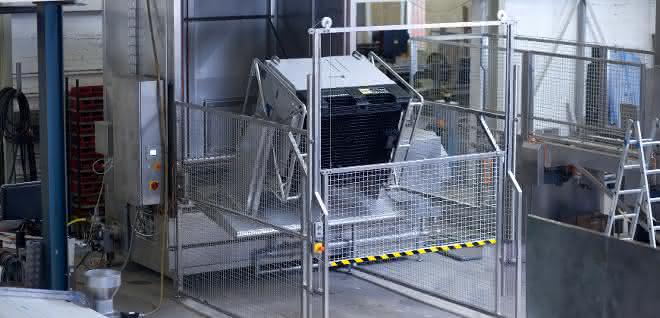
Reusable containers include all types of crates, vegetable crates, bottle crates, trays, bread baskets, pallets, KLT containers and pallet boxes. Depending on the type of soiling and construction, very different procedures are required for cleaning. These can be adapted using the following parameters, provided that the system manufacturer has the necessary experience:
- low washing temperatures for soiling caused by animal or vegetable protein
- High washing temperatures for all types of grease residues
- Vertical transport for trays and VDA-KLT containers
- Adapted conveyor technology for folding boxes
- Precisely configured soaking time
Drying with a sense of proportion
After cleaning, it is always necessary to remove more or less adhering moisture from the items to be washed. This prevents the operating rooms from being contaminated with water residues and areas with a high risk of slipping. This often also reduces the amount of fresh water required. When configuring the blow-off system, less is more, as unnecessarily high operating costs should be avoided. Almost 100% drying is possible, but may not even be necessary, for example if the wash items can be stored for a few hours or even days. Containers that can no longer be freely ventilated after cleaning naturally require comprehensive drying in any case. Similar to a car wash, powerful blowers are used, and the process is further assisted by the addition of a surface relaxant for the final water rinse and/or by heating the blow-off air. Centrifugal dryers are also used today to further reduce the costs associated with drying.
Significant thermal energy factor
Among other things, Kitzinger has developed systems for pallets or hinged pallet boxes. With the latter, conventional drying is not possible with acceptable results due to the corners, edges and capillaries in the area of the hinges. This is where spin drying shows its great advantage of energy savings combined with first-class results. With 150 pallets or pallet boxes per hour, only around 4 kW of motor power is required. Centrifuges in chamber design are also possible for all types of hinged boxes. Mechanical container cleaning is very energy-intensive. The need for thermal energy is significant. The wash liquor must be kept hot. Cooling is achieved by heat radiation to the outside via the machine housing, by spraying the wash liquor itself and, of course, by heat absorption by the wash ware itself. In Kitzinger systems, for example, heat radiation to the outside is minimized by a completely double-walled insulated wash tunnel, which also reduces the operating noise of the machine. Depending on the size of the system, heating via electric heating, via a carrier medium such as hot water, steam or thermal oil, or direct gas heating can be considered.
About Kitzinger Maschinenbau
The manufacturer of crate washers, bottle washers, container washers and washers for reusable containers was founded in 1986. The company near Flensburg designs the systems according to customer requirements using standard components with add-on parts from well-known manufacturers.


You might also be interested in
Winner material flow PRODUCTS OF THE YEAR 2023
Conductix-Wampfler: ChargeLine 0865
Two-pole conductor rail segments for efficient opportunity charging of shuttles, suitable for thousands of cycles per day.
 read more...
Hermann Grewer celebrates his 80th birthday
Hermann Grewer, Honorary Chairman of the North Rhine-Westphalia Transport and Logistics Association (VVWL) and Honorary President of the German Road Haulage, Logistics and Disposal Association (BGL), celebrated his 80th birthday on June 6.
read more...Well chilled for sure
V-Zug Kühltechnik AG, developer and manufacturer of refrigeration appliances and part of the successful V-Zug Group, has set up a new production facility for refrigerators of all heights and dimensions at its Swiss site in Sulgen.
read more...Advantageous automation of small parts warehouses
The RSX1 shuttle system will be at the center of Rocketsolution's presence at this year's Logimat trade fair.
read more...Reduced energy requirements in the high-bay warehouse
One of Germany's leading premium car manufacturers is already focusing on energy efficiency in the production of its new SUV model with electric drive. The storage and retrieval machines in a high-bay warehouse at the production site have been...
read more...Low lift pallet truck for light duty applications
Clark has launched a new low lift pallet truck with the model designation LWio15 for light transport tasks. The truck has a load capacity of 1500 kg and is suitable for short distances in goods distribution, production or warehousing.
read more...Internationalization as an opportunity
E-commerce is in a state of flux. Changes in purchasing behavior and procurement problems are keeping e-commerce retailers busy. Logistics plays a decisive role in the overall online shopping experience.
read more...Fulfillment Center for Frisco.pl
Polish eGrocery specialist and TGW deepen partnership
TGW is building a highly automated fulfillment center for Frisco.pl in the Polish capital Warsaw. This is the second project in a row that the two companies have implemented together.
read more...Which world will it be in 2023?
Michael Schreckenberg teaches at the University of Duisburg-Essen as Professor of Physics of Transport and Traffic. Once a year, he addresses the readers of materialfluss, formerly LT-manager, with a critical and humorous expert article on transport...
read more...