
From LT-manager 5/2019
The transport turnaround in 2020
Michael Schreckenberg teaches at the University of Duisburg-Essen as Professor of Physics of Transport and Traffic. Once a year, he addresses the readers of LT-manager with a critical and humorous expert contribution on transport policy.
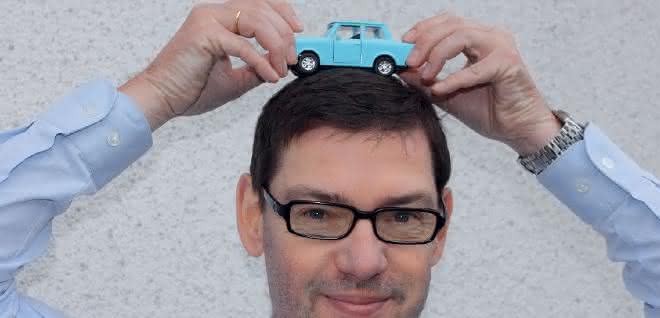
The great thing about traffic is that there really are no limits to your imagination. You can look wherever you want, everywhere is round, sorry, angular. Whether road, rail, water or air: a bombardment of daily reports leaves you with hardly any room to breathe - and as we all know, it's already stressful enough.
Our transport minister "Andi" Scheuer is always at the forefront of the action. Without achieving anything - or perhaps because of this? - he always makes it to the front row of the illustrious media world. Whatever he tackles turns into toxic waste that has to be disposed of at great expense. Whether it's the unspeakable car toll, Deutsche Bahn, waterways or air cabs - everything remains on the ground in the truest sense of the word.
The issue of the car toll is still virulent, but not because it is coming, but because of the millions in collateral damage (wonderful word!) that the attempt to introduce it has caused. As is so often the case, the most nonsensical things go wrong behind closed doors - Pisa sends its regards (tower and studies!). Austria is showing us how to do it the other way round. First the German car toll is sued away before the ECJ and then Austria's own toll is suspended on five stretches of highway close to the border. To be honest, of course, it has to be said that the reason is not German friendliness, but to lure traffic away from the country roads.
The railroads are now investing heavily. There is talk of 156 billion euros for the infrastructure by 2030. But there are also supposed to be a million charging stations for electric cars by then, apart from everything else in the 2030 Federal Transport Infrastructure Plan. But nobody knows exactly what and how the railroads are supposed to achieve this. Unfortunately, there are always overly critical doubters ...
The great thing about DB is that only around one in four trains is delayed today. But delay means six minutes or more. And here's the thing: canceled trains are not considered late and don't even appear in the statistics. Railroad boss Richard Lutz said on "Hart aber Fair" that this was decided once. The railroad itself refers to the lack of a "sensible mathematical model" for taking into account canceled or prematurely terminated train journeys. In view of around 140,000 per year, this is not a bad sleight of hand. It's best to falsify statistics yourself. We're not even talking about rail freight transport, which is even worse off, as one in four trains was more than 15 minutes late in 2018. A completely new idea (or maybe not?) is the quick and uncomplicated approval of major infrastructure construction projects directly by the Bundestag, (almost) ignoring public protests. The procedure is to be tested on twelve pilot projects (five waterways and seven railways). Ultimately, critics will only have recourse to the Federal Constitutional Court. This will then also be canceled at some point, following the Chinese model ...
Flying cabs are also set to make their mark in the air. This worked really well at the presentation by Transport Minister Scheuer and Digital Minister of State Dorothee Bär on March 11 in Ingolstadt, as the model presented could neither fly nor did it have doors - a monument, after all. It is not for nothing that the CSU has been the Federal Minister of Transport for over ten years.
But 2020 will finally be the year in the fight against air pollutants, especially nitrogen oxides. Politicians are trying to outdo each other with (too) quick and (too) cheap solutions to master the situation and prevent whatever. Doctors and politicians argue, and the population looks on traumatized. What was that again about the effect of nitrogen oxides?
A speed limit has been debated for years on the highways in Germany. Once again, it has been rejected and the arguments are being shot back and forth like poisoned arrows on the Amazon. We won't be getting out of this battle any time soon, especially as the Dutch want to come up with a completely new variant. There, a limit of 100 kilometers per hour is to apply on all freeways between 6 a.m. and 7 p.m. Norway and Cyprus have a general limit of 100 kilometers per hour. Even Prime Minister Mark Rutte called this a "shitty measure", but one that was necessary to combat these nitrogen oxides.
Now this is indeed an interesting approach. Because the result is not entirely clear. Do many people now travel in the morning before six or in the evening after 7 pm? There's not much going on at lunchtime anyway. And things don't move any faster in rush hour anyway. Not a realistic model for Germany, because traffic conditions are getting worse and worse. More truck traffic, more foreign cars (also from the Netherlands). Even when this is reported in the media, there is no contradiction. That's just the way it is (stop). It would be better to introduce a minimum speed limit, let's see what else can be done.
Cities are being inundated with new ideas on how to avert the threat of (diesel) driving bans after all. The most popular means are speed restrictions. They cost little, but often achieve just as little in the end. In many cases, a 30 km/h speed limit makes the situation worse due to the high speed, but is quickly installed. However, this is only recommended for short distances, otherwise driving becomes too boring and there is a risk of distraction. A congestion charge is repeatedly brought up (unsuccessfully), a classic pipe-dream, as examples show. But there are other ideas. Cologne has come up with a (not really) new traffic light system. On an access road in the district of Weiden, only 700 instead of 1,200 vehicles per hour are to be allowed to enter via traffic lights. Of course, this flopped immediately and the traffic lights were then switched manually.
Düsseldorf is one step ahead. The environmental lane is supposed to do the trick. In addition to buses, bicycles, electric vehicles and cabs, cars with at least three occupants should also be allowed to drive there. A mother with two children on board was already warned that it was not a carpool. This was later withdrawn. But the icing on the cake was a funeral home - you can guess what's coming. Two drivers and in the back ... The city then announced that there should be at least three living people on board. Alternatives will only be considered in the event of protests. Free public transport or at least for one euro a day is also being discussed. People are experimenting haphazardly without knowing where this will ultimately lead. My proposal for 2020 would therefore be radical and really consistent. First a congestion charge (really expensive), then the gatekeeper traffic light to finally be allowed to drive next to the environmental lane and not find a parking space. Hello e-scooters, you are actually the last resort!
About the author:
Prof. Dr. Michael Schreckenberg, born in 1956, studied theoretical physics at the University of Cologne, where he received his doctorate in statistical physics in 1985. In 1994, he moved to the University of Duisburg-Essen, where he was awarded the first German professorship for the physics of transport and traffic in 1997. For
LT-manager since 2012, Schreckenberg has been summarizing the transport year coming to an end.


You might also be interested in
Emission-free heavy goods transport: Gruber Logistics, Iveco and AIT start practical test
As part of the Empower research project, a six-month test phase with a battery-electric, zero-emission truck prototype from Iveco for heavy commercial vehicles will start in mid-June 2026. In collaboration with Gruber Logistics, the prototype based...
 read more...
IKEA launches all-electric heavy-duty logistics project
Together with Mercedes-Benz Trucks and LC3 Trasporti, the Inter IKEA Group is focusing on battery-electric trucks and driving forward the decarbonization of road freight transport in Italy.
read more...Commitment to greater sustainability
Contargo strengthens e-truck fleet with 33 tractor units
Contargo puts 33 new battery-electric DAF XD Electric trucks into operation and reaches a milestone in the decarbonization of its fleet with now 90 e-trucks.
read more...Schuon relies on a sustainable fleet
In 2025, the Alfred Schuon company will integrate 68 new trucks, including trailers and semi-trailers, into its fleet at the Haiterbach and Veszprém (Hungary) sites. Among the new acquisitions: Mercedes-Benz Actros L with aerodynamically optimized...
read more...Automated trucks: live tests in Hamburg city traffic
As part of the EU MODI project, two successful practical tests on the automation of heavy goods traffic were carried out this spring - both in the inner city area of Hamburg and on the highway. The project partners tested two important use cases in...
read more...TST initiates depot charging network for e-trucks
The TST Group wants to usher in a new era of truck electrification with a cooperative-oriented depot charging network. TST is building an ecosystem for charging heavy commercial vehicles and delivery fleets that covers all relevant aspects: from...
read more...Daimler Truck celebrates the start of series production of the Mercedes-Benz eActros 600 for long-distance transport in Wörth
Karin Rådström, CEO of Daimler Truck, and Daniela Schmitt, Minister for Economic Affairs, Transport, Agriculture and Viticulture of Rhineland-Palatinate, give the go-ahead for series production of the new model.
read more...Renault Trucks showcased the all-electric future of transportation in Berlin
Renault Trucks was represented at this year's Transporter Days in Berlin, which took place from November 28 to December 1, 2024.
read more...Emission-free e-truck for Siemens plant in Leipzig
Since the beginning of June, an e-truck has been transporting goods within a radius of 100 kilometers for Siemens Smart Infrastructure's Leipzig plant for low-voltage switchgear.
read more...