
Premiere of the new MAN models
Stars of the ring
MAN sends the new lion trucks into the ring. With completely redesigned cabs for all series, an innovative interior concept and modern assistance systems, the Munich-based company is offering many new features at the world premiere of the truck family.
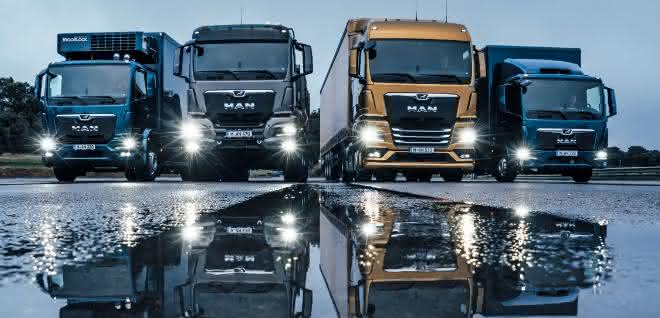
Customers and connoisseurs have had to wait a long time - almost too long - for the renewed MAN generation. At the beginning of February, the Traton subsidiary MAN finally let the new lions off the leash: heavily revised cabs with new inner values and the drive trains further optimized for Euro 6D should bring MAN back to its old strength. To give the competition a run for its money, the MAN designers, above all Head of Design Holger Koos, have reached deep into their design bag of tricks. With the fierce glare from the new LED headlights and the taut, taut lines from the large radiator grille to the completely redesigned flanks, the look actually resembles that of a lion. The dynamic lines mean that the bodyshell of the cab, which has been retained at its core, is not only stylishly elegant, but also aerodynamically efficient.
The large radiator is due to the increased cooling requirements of the modern Euro 6 drivetrains and extends far down into the bumper level, which has been styled with aerodynamic fine-tuning and swings around the cab corner to the side section of the new trucks in a pleasing and streamlined manner. The new doors catch the eye here with a door leaf that extends down to the second entrance step, triangular door handle shells and a different window frame. The side window flows visually uninterrupted into the rear section, where three horizontal metal folds signal the characteristic brand image. The designers have interpreted this typical MAN design element, which the predecessor TGA already wore at its debut in 2000, as the battle scars of a sharp claw on the Lion King.
New cab design
So much for the exterior values of the new cab generation, which is being introduced across all classes in eight different variants from the TGX, TGS and TGM to the small TGL. The launch of MAN's long-awaited cab revolution has been the subject of much excitement. Has the Munich-based company really achieved the great success that has been expected for so long? The first impression is convincing: plenty of space, a low engine box and the finally free passage to the passenger side signal new size and impressive living space in the cubic cab. The gear selector lever and the new electric parking brake are no longer located on the gearshift bracket next to the driver, but on the steering column and in the dashboard. The driver benefits directly from this space.
For example, with the wider comfort seats with robust partial leather upholstery, which can be adjusted in a variety of ways and are optionally air-conditioned and heated, replacing the too narrow chairs of the predecessor. The folding front passenger seat in particular finally offers enough space for long legs thanks to the redesigned dashboard.
Everything is also new at the workplace: the 45-centimetre diameter steering wheel can be adjusted for all driver statures with an articulated joint high up in the steering column - optionally also very steeply. The multifunction panels are also new: small buttons and control paddles, which are now located in the spoke arms of the leather valance to prevent operating errors. The controls for the driving dynamics with cruise control, brake control and radar guidance are located on the left, while the radio and telephone as well as the menu navigation are controlled on the right using the logical sub-menu structures, some of which are shown on the fully digitized display in 3D clear graphics in the main field of vision.
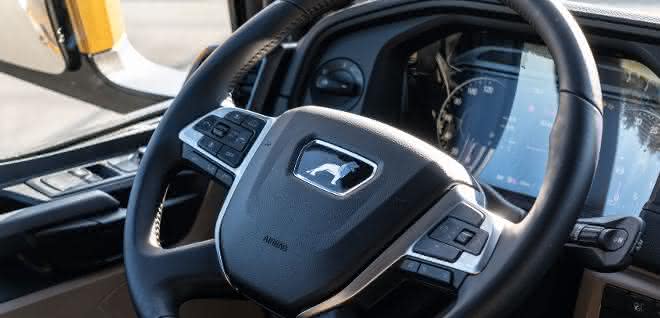
The new workplace is therefore immediately appealing. And there is also a real highlight in the dashboard facing the driver: a central rotary/push dial with two adjustment rings and a central control knob takes control of the journey through the extensive menus. Something like this is new in the truck industry and is only known from luxury cars. MAN calls the easy-to-grip control panel, which is reminiscent of a computer mouse, "SmartSelect" in its own denglish language. In fact, the designers have invested a lot of brainpower in the compact input device. The driver's hand rests on a fold-out hand rest, which is used to move through the menu levels with a gentle twist of the high-quality metal ring. By pressing buttons and using the miniature touchpad surface, you can access further logically structured submenus, which are displayed in clear graphics on the somewhat too compact LCD screen to the right of the steering wheel. You get used to the intuitive operating concept surprisingly quickly. A particular plus: the view from the road does not have to be completely refocused when quickly switching to the slightly too small display. In contrast to touchpads located further to the side, you always have the traffic situation in the corner of your eye. Unfortunately, MAN is once again playing the price card here: the larger 12-inch display and the digitalized displays in the central instrument cost extra. This means that the cabs in the more price-sensitive distribution truck class will probably be launched as leanly equipped variants and the wealth of equipment will be reserved for the heavy TGX.
Navigate effectively
One highlight is included free of charge: For example, you can use your pointed fingers to draw letters for navigation on the compact touch pad surface, which the clever on-board computer also recognizes and implements when you enter the first letters for the navigation search. This in turn saves you having to scroll through complete alphabet displays.
The redesigned dashboard with its numerous shelves, sockets and cup holders has everything you would expect from a modern workplace. Practical details such as the fold-out tray in the glove compartment show that the needs of the driver have been taken into account. This also includes the folding front passenger seat, on which a plate can be swung over to serve as a dining or work table.
With interior features such as the easily accessible refrigerator drawer under the bed, removable waste box, exterior storage compartments that are also easily accessible from the inside and the comfort beds with multi-zone mattresses and slatted frame, the new cab clearly scores points with drivers. An extra feature of the lower berth: it can be set up as a reclining berth for reading or watching TV using the five positioning catches. From the resting or sleeping position, the driver can control the most important functions such as lights, air conditioning, door lock or audio either via a handset with color display or via a dedicated app on the cell phone.
The usual storage space is available in the high-roof cab in sufficient volume in two lid compartments as well as a central container, which does not restrict the standing room under the roof hatch with a practical roller blind. In addition, open storage compartments above the doors and around the lower bed provide plenty of space for small items used on a daily basis. Equipped in this way, the MAN lives up to its image as a driver's buddy. And this is exactly what the developers have geared the vehicle concept towards: Appreciating the drivers, so that they do a good job or, in the age of the current driver shortage, are lured back into the truck cockpit in the first place.
Save on consumption
The digitalization of many applications in apps, which is common practice today, and real-time uptime maintenance control, which makes service manuals obsolete and demand-based maintenance a reality, are more of a compulsory exercise than an optional extra. Consumption savings are also clearly in the specifications for the new TG generation. With the help of the new Euro 6D engines and sophisticated aerodynamics, average consumption is to be cut by up to eight percent compared to the previous engine series, especially in long-distance traffic.
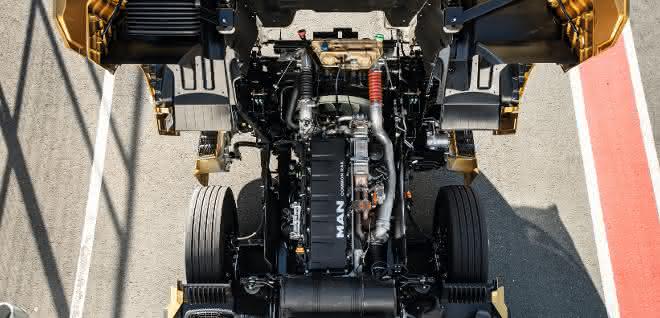
Apart from the changeover to the latest Euro 6D standard, the engines under the new cab will remain in the range. The engines for the TGX range from the entry-level D15 with 330 to 400 hp, through the popular D26 with 430 to 510 hp, to the top-of-the-range D38 engine with up to 640 hp. The TGS for construction and construction supply applications or as a national long-haul truck can also be supplemented with the Hydrodrive front-axle drive, just like the TGX in the non-all-wheel drive variants. For the TGS with the 20 centimeter slimmer, 2.24 meter wide cab, the D26 and the nine-liter D15 are available in the 330 to 510 hp range. A short NN cab for construction or the flat FN cab for car transporters complete the cab selection. The axle formulas range from the classic 4x2 tractor unit to 6 x 2, 6 x 4, 4 x 4, 6 x 6, 8 x 6 and the heavy 8x8 four-axle vehicle. Like the TGX in the non-all-wheel drive versions, the TGS can also be supplemented with the Hydrodrive front axle drive.
For light and medium-duty applications, MAN offers the TGL as a two-axle 7.5 to 12-tonner and the TGM with two or three axles in the 12 to 26-ton range. The TGS is powered by a modern four-cylinder engine with up to 220 hp. A six-cylinder engine with 250 hp is also available as an option, which is also used in the TGM with outputs of up to 320 hp. For the time being, the engine line-up remains the same.
To this end, MAN has upgraded its assistance systems. Lane guidance assistants automatically guide the truck back onto the road, traffic jam assistants make everyday driving easier, a new turning assistant and the latest generation of emergency braking systems ensure safety. The satellite-based cruise control, which increasingly relieves the driver of responsibility for the appropriate use of power and consequently fuel consumption, especially on long journeys, is also impressive in the first driving test.
These modern systems put MAN back on a par with the competition. With the new modular cab concept, the developers can be said to have really succeeded. The somewhat outdated TGX predecessor has once again been transformed into an ultra-modern vehicle that is refreshingly independent and autonomous in its technology from its sister company Scania, and which can certainly give its competitors a run for their money.
About the author:
Expert and specialist journalist Oliver Willms has been writing about the commercial vehicle sector for LT-manager since 2010.


You might also be interested in
Emission-free heavy goods transport: Gruber Logistics, Iveco and AIT start practical test
As part of the Empower research project, a six-month test phase with a battery-electric, zero-emission truck prototype from Iveco for heavy commercial vehicles will start in mid-June 2026. In collaboration with Gruber Logistics, the prototype based...
 read more...
IKEA launches all-electric heavy-duty logistics project
Together with Mercedes-Benz Trucks and LC3 Trasporti, the Inter IKEA Group is focusing on battery-electric trucks and driving forward the decarbonization of road freight transport in Italy.
read more...Commitment to greater sustainability
Contargo strengthens e-truck fleet with 33 tractor units
Contargo puts 33 new battery-electric DAF XD Electric trucks into operation and reaches a milestone in the decarbonization of its fleet with now 90 e-trucks.
read more...Schuon relies on a sustainable fleet
In 2025, the Alfred Schuon company will integrate 68 new trucks, including trailers and semi-trailers, into its fleet at the Haiterbach and Veszprém (Hungary) sites. Among the new acquisitions: Mercedes-Benz Actros L with aerodynamically optimized...
read more...Automated trucks: live tests in Hamburg city traffic
As part of the EU MODI project, two successful practical tests on the automation of heavy goods traffic were carried out this spring - both in the inner city area of Hamburg and on the highway. The project partners tested two important use cases in...
read more...TST initiates depot charging network for e-trucks
The TST Group wants to usher in a new era of truck electrification with a cooperative-oriented depot charging network. TST is building an ecosystem for charging heavy commercial vehicles and delivery fleets that covers all relevant aspects: from...
read more...Daimler Truck celebrates the start of series production of the Mercedes-Benz eActros 600 for long-distance transport in Wörth
Karin Rådström, CEO of Daimler Truck, and Daniela Schmitt, Minister for Economic Affairs, Transport, Agriculture and Viticulture of Rhineland-Palatinate, give the go-ahead for series production of the new model.
read more...Renault Trucks showcased the all-electric future of transportation in Berlin
Renault Trucks was represented at this year's Transporter Days in Berlin, which took place from November 28 to December 1, 2024.
read more...Emission-free e-truck for Siemens plant in Leipzig
Since the beginning of June, an e-truck has been transporting goods within a radius of 100 kilometers for Siemens Smart Infrastructure's Leipzig plant for low-voltage switchgear.
read more...