
From LT-manager 1/2020
More efficient packaging
Inappropriately large packaging annoys online shoppers and freight forwarders alike, who drive a lot of air across the country. Shippers who want satisfied customers should therefore rethink their packaging strategy.

Some supposedly scream with happiness, others pull out their cell phone and take a photo. People who receive a parcel after ordering online sometimes react in very different ways. A British woman recently reached for her cell phone when the parcel carrier placed a special delivery in front of her house. The reason for her photo motif was not the contents of the parcel, but the packaging: the British woman had ordered a simple belt, but it came in a parcel that was almost as big as she was.
Her cousin immediately shared the photo with the size ratio on Twitter with the comment: "Could someone from Amazon explain why it takes so much packaging to send a belt to my cousin? How many trees had to suffer for it?" A short time later, this tweet was doing the rounds on social networks.
Volume often poorly utilized
Admittedly: A belt being delivered in a package the size of an adult woman is an extreme case. However, packaging that is significantly larger than the contents it is supposed to protect is the rule rather than the exception in this country. It is estimated that parcels in online retail are on average only half full. Random samples carried out by the Fraunhofer Institute for Material Flow and Logistics (IML) have shown that shipments that are only a fifth full also end up in people's living rooms. The rest: filling material. Martin Böhmer, head of the Information Logistics and Assistance Systems department at the Fraunhofer IML, can even report on spare parts that make up just one percent of the parcel volume. Large parcels for small products: Recipients have no desire to rummage through crumpled paper or dispose of high-quality foam. Customers want as little packaging material as possible, says Böhmer. His theory is also backed up by statistics: according to KPMG's "Consumer Barometer Packaging", 91% of consumers surveyed would like online shippers to reduce their shipping packaging to the bare minimum.
However, the wishes of the customers apparently do not always reach the ears of the shipper. Instead of thinking about how the size of the packaging can be adapted to the product, they prefer to use cheap boxes in a few standard sizes and buy them in large quantities to make even more savings. The transport packaging is then stuffed with filling material. E-commerce in the 21st century still works like it did in the 20th: lots of air is carted around in parcel vans or trucks.
What are the alternatives? Fashion suppliers on the net sometimes refer to transporting clothing in bags that can be stacked quite tightly on top of each other in DHL, DPD, Hermes & Co. trucks. There is then not much air in either the bag or the truck. But plastic bags are not the ideal packaging when it comes to climate protection either. And when it comes to shoes or hats, fashion retailers don't use the box of tricks either, but cardboard boxes instead. It is also a fact that reusable packaging is already being used in online food retailing. Couriers hand the customer a box and then take it straight back with them. However, online food retail is only a niche in the overall e-commerce market. According to the German Economic Institute, food accounted for just two percent of total online retail in 2018.
Cardboard is here to stay
The majority of orders from the Internet end up in cardboard packaging. And that's not wrong, because corrugated cardboard packaging has many advantages: The packages are light, stable and can be folded easily. Experts therefore assume that the cardboard cuboid will also be the packaging material of the future. Especially as the industry is continuously improving the load-bearing capacity of cardboard boxes with the help of drop tests. In addition, more and more retailers are discovering the easily printable surface for their advertising messages. What the top dogs in the online business are demonstrating is also catching on with smaller companies.
It can therefore be assumed that the annual mountain of boxes in Germany will continue to grow rapidly. According to the German Parcel and Express Logistics Association (BIEK), around 3.5 billion parcels were transported in Germany in 2018. Forecasts predict 4.4 billion in 2023.
The statistics also show that Germans continue to shop online with growing enthusiasm. In 2019, the volume of orders for goods in e-commerce amounted to around 72.6 billion euros. According to the German E-Commerce and Distance Selling Trade Association (bevh), this corresponds to an increase of 11.6% compared to the previous year's figure of 65.1 billion euros. The number of parcels per person per year says even more than the total volume.
According to a study by McKinsey, Germany is the European leader with 24 parcels ordered per person per calendar year - ahead of online-savvy shoppers in the UK, who receive 22 deliveries. Incidentally, the Chinese receive significantly more parcels delivered to their homes: There it is a whopping 70 per person per year.
Large mountains of parcels also mean that shippers have to think about how to optimize their packaging portfolio so that it matches the product range. If you start out as a small start-up, you can initially stock boxes in various sizes. However, as the number of orders increases, so does the space required to store the packaging and filling material. "Cartons in different sizes are only recommended if a company ships a very manageable number of products of different sizes," emphasizes Richard Nijboer, Director of Sales and Operations at Packaging by Quadient. The company from the Netherlands has been producing automated packaging solutions for seven years. "Anyone who is confronted with many different product sizes and combinations should switch to packaging solutions that produce individual cartons for each product or basket," says Nijboer.
Return on investment can be achieved after two years
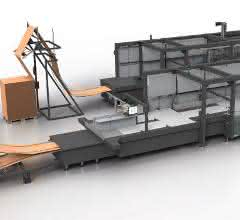
The number of parcels required for an automated solution that automatically measures, cuts, folds, glues and labels shipping cartons depends on the individual case. The Internet Fusion Group in the UK, for example, has calculated a return on investment (ROI) of around two years. The company is primarily known to skaters, surfers and motor sports enthusiasts for its lifestyle clothing. The online specialist has installed two solutions from the CVP Impack series from Packaging by Quadient in Kettering and produces more than 50,000 parcels a month for its customers. Each of these machines can produce up to 500 cartons per hour. The result: thanks to the customized cartons, the company can "save 92 truckloads per year in terms of transport volume," calculates Adam Hall. The Englishman is Head of Sustainability at the Internet Fusion Group. This protects the environment - and the company's coffers, because the transport volume is significantly cheaper than before for the same throughput. In addition, large quantities of filling material are avoided. Companies in other European countries also rely on the continuous corrugated cardboard solution, which can also be branded. In Switzerland it is MyStore, in Germany KS Tools.
Such a machine can be used to pack not only very small but also large products - from a fountain pen to a travel trolley. It is only for extremely small goods or bulky products that companies cannot avoid using prefabricated cartons. Anyone using such a packaging solution can, in the case of the CVP Everest from Quadient for example, individually produce up to 1,100 packages per hour. However, if the machine is defective, nothing works in the packaging area. This is why the manufacturer invests in support, offering remote maintenance, reports and maintenance packages. In addition, trained technicians are available in all markets to provide rapid assistance if the worst comes to the worst. This is because the managers of large shippers who are unable to deliver quickly lose patience - and sometimes go ballistic.
"The customer creates pressure"

Richard Nijboer, Director of Sales and Operations at Packaging by Quadient, explains why modern shippers are breaking new ground in their packaging strategies.
LT-manager: Mr. Nijboer, when was the last time you shopped online?
Richard Nijboer: It wasn't that long ago. Anyone who is on the move a lot and appreciates the convenience of online orders simply reaches for their smartphone and saves a lot of time compared to shopping in bricks-and-mortar stores.
LTM : When was the last time you were annoyed by a package that was far too big for a small order?
Nijboer: It wasn't that long ago either. I'm surprised that even large shippers with a throughput of several million parcels a year still rely on three or four standard parcel sizes and have the goods packed manually by warehouse staff. As a consumer, it regularly annoys me that a lot of air and packaging material has been transported in my delivery.
LTM: You could just accept that...
Nijboer: Many consumers still do that. But I don't. The climate discussions are currently causing a massive rethink. Not just in the younger generation, but in my age group and that of my parents. I am sure that in future consumers will pay much more attention than they do today to whether their goods have been produced, transported and packaged sustainably. Of course, there will always be those who choose the cheapest product and don't care about anything else. But the great advantage of the internet is that it creates transparency. Critical consumers go for the product that has been produced under environmentally friendly conditions, transported in a carbon-neutral way and packaged without air. With a single click, customers create immense pressure on everyone involved in the supply chain. And this doesn't just apply to B2C business.
LTM : What do you mean by that?
Nijboer: A rethink is also taking place in the B2B sector. More and more large companies are setting ambitious climate protection targets. And then they look at how suppliers produce, package and transport their goods. Who wants to receive a spare part for a machine that has been sent halfway around the world in a box that is far too big? That leaves a bad impression.
LTM : Every good freight forwarder has new vehicles in use, optimizes its routes and avoids empty runs...
Nijboer: Yes, of course we use modern tools. But virtually no freight forwarder can claim that every trailer is 100 percent full at all times. And the freight forwarder can't do anything about parcels that are far too large for small goods. Some experts say that one in five truck journeys would be superfluous if all supply chain partners acted optimally. Our automatic packaging solutions for tailor-made parcels also have many other advantages for the consumer - apart from the fact that no air is packed and filling material is only required in exceptional cases.
LTM : What are these advantages?
Nijboer: For example, the avoidance of transport damage. Tailor-made packages are stable - the goods are better protected than in standard packages.
LTM : However, shippers have to pay a lot of money for one of these machines that automatically cut, glue and label parcels.
in hand.
Nijboer: Yes, of course a high-performance machine like this, which produces up to 1,100 customized parcels per hour, also costs money. But in addition to satisfied customers and a contribution to environmental protection, there are also decisive advantages for the user: he saves on labor costs for an average of 20 manual packing stations per machine. And at least as important: delivery reliability can also be maintained during the peak season. In Germany alone, the Christmas season accounts for around 350 million shipments. Ultimately, every supply chain manager in the e-commerce sector today has two huge problems: labor shortages and fluctuating demand. Automation is one of the key solutions. Large shippers face the challenge of needing a large number of employees at short notice, for example at Christmas or on promotional days such as Black Friday. Finding staff for this is very difficult.


You might also be interested in
The air is out here
Many online retailers still rely on conventional packaging methods and use standardized box sizes. This means that goods are often shipped in packages that are far too large or in plastic bags.
 read more...
100th anniversary of Sparck Technologies
On June 20, 2024, Sparck Technologies, provider of automated packaging solutions, celebrates its 100th anniversary.
read more...Shelving Systems for Dynamic Environments
In modern production and logistics environments, modular shelving systems do much more than simply serve as storage solutions. They improve material flow, reduce travel times, and support processes in line with lean management principles....
read more...Ricola modernizes intralogistics with Stöcklin
Ricola relies on Stöcklin for the retrofit of its high-bay warehouse at the Laufen site.
read more...Shelving technology - these are the trends
The most frequently mentioned trends in intralogistics at the moment are artificial intelligence, robots and automation. However, every efficient warehouse solution is still based on the right racking technology. Giovanni Cataldi from heavy-duty...
read more...Highly automated in all product ranges
Richard Kearns knows how his supply chain and his new warehouse in Hernando (Mississippi, USA) are doing because he receives feedback every day.
read more...PepsiCo Polska relies on Mecalux
PepsiCo Polska is working with Mecalux to drive forward the automation of its logistics and is planning an intelligent warehouse.
read more...Sixth AutoStore project for New Wave
Element Logic is implementing its sixth joint project with the New Wave Group: a future-proof AutoStore system for the logistics center in Geiselwind.
read more...One of the largest Autostore facilities in...
Buttinette automates with Element Logic
For the new logistics center of Buttinette Textil-Versandhaus GmbH, the system integrator Element Logic is responsible for planning and implementing the automated intralogistics solutions for storage and order processing. One of the largest...
read more...