
Interview with Hans-Georg Frey
"We are going our own way"
The recent history of Hamburg-based material handling equipment manufacturer Jungheinrich is a brilliant one: sales have grown enormously, as has the number of employees, and the development of the new warehouse automation market is progressing rapidly. Time to take stock, as CEO Hans-Georg Frey talks to LT-manager.
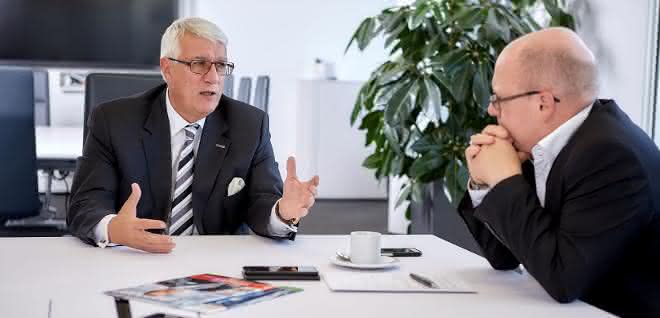
LT-manager : Jungheinrich turned 65 this year and the company is experiencing the most successful period in its history. Where did the leap come from? Who are the fathers of this success?
Hans-Georg Frey: There are three key elements that form the basis for the company's current success. One is a very clear and detailed strategy that we developed in 2012/13. We want to achieve a turnover of four billion by 2020, which at the time of planning corresponded to annual growth of seven percent. This strategy was defined right down to the lowest department. It was not just a vision, but very concrete with thousands of measures for every unit in the company. The second element is the Jungheinrich Way of Leadership, a topic of corporate culture. Seven percent organic, sustainable growth year on year in a mechanical engineering company is a pretty ambitious growth target. At the time, we asked ourselves very honestly how we could achieve this. The basic tenor was that if every manager and every employee thinks, decides and acts like an entrepreneur, we will achieve the target. We then defined in the Board of Management and with a few selected managers what we understand entrepreneurship to be or what forms the foundation for it. We worked this out using the Jungheinrich value cloud with a total of 15 values and terms such as trust, drive and responsibility.
It was clear to us that we need employees who inspire and motivate people with passion and courage, create trust and, of course, break new ground. People who are innovative and good communicators. They will create the necessary added value for themselves and their teams on the way to the growth target. We have written a book that describes exactly this and rolled it out in the company. But this process does not stop; culture in the company is a never-ending task. Now I come to the third element: we then measured our employees and managers on whether they are willing to participate, develop and internalize the topic of entrepreneurship. As a result, we have already taken one or two people out of a management role and brought in better managers instead. Our 18,000 employees are the true foundation of our success.
LT-manager : I'll come back to the topic of leadership in a moment. Let's talk about the major technological developments of recent years. Which was the most important one for Jungheinrich?
Frey: The topic of technology was clearly defined in the strategy with the aim of developing innovative, superior products and marketing them successfully. Over time, Jungheinrich has evolved from a pure machine manufacturer - think of the ant 65 years ago - to a provider of complete logistics systems. This naturally includes the topic of automation. Otherwise, the complexity that we find in logistics processes today would no longer be manageable. Then there is the general trend towards electric vehicles. That's wonderful, because this market trend coincides with our company's core competence. We have been electricians since the company was founded 65 years ago! The combustion engine accounts for less than five percent of the vehicles we produce.
LT-manager : How has the ratio of electric to combustion engine trucks changed?
Frey: The proportion of IC engine-powered trucks was always small for us, the share has fallen from ten to five percent, but this was due to the fact that we sell considerably more trucks overall. When I started at Jungheinrich at the beginning of 2007, the combustion engine had a 28 per cent market share in Europe, today it's 15 per cent. That's why we're concentrating on electric trucks and in particular on lithium-ion, the technology of the future. Although this is still more expensive, we are working on equalizing the price difference compared to lead-acid batteries. The first series-produced vehicle with lithium-ion technology came onto the market in 2011, and it was from Jungheinrich. We only exhibited lithium-ion vehicles at CeMAT. We are the innovation leader in our sector. Last year, we delivered 5,500 trucks with lithium-ion batteries, this year we will deliver 12,000 and in 2019 around 20,000. This shows how quickly this development is progressing.
LT-manager : Jungheinrich as a general contractor: did you ever dream of this development in the past?
Frey: A fully automated warehouse is a logistics system that consists of many elements. In the past, these components were offered by various manufacturers. Many companies then developed in this direction, take SSI Schaefer as an example - from shelving into the complete system. We came from the forklift trucks and have developed into this complete system. The systematic process began around 2008. We have been a system integrator for a very long time. But we bought in a lot of elements: Shelving, stacker cranes, warehouse management software and so on. We only provided the forklift, the integration and the service. It was clear to us that we had to get the most important elements in a warehouse from our own value chain. First, we bought the brains of the warehouse by taking over the software company ISA. Then we built up our expertise in racking production internally through an engineering team. Finally, we wanted to add a storage and retrieval machine and took over the company MIAS. Today, we also develop stacker cranes for AKL ourselves. All these topics were bundled in a separate division under the management of Klaus-Dieter Rosenbach and locally at the Moosburg site.
LT-manager : Are you planning further acquisitions in the medium term or will you continue to grow organically?
Frey: Jungheinrich's strategy is to grow organically. But there is always an exception to a rule. If we can acquire a technology that suits us, that we need and we can get it at reasonable prices, then we would take a closer look at it. Examples: The purchase of MIAS or ISA. Another exception is distribution. Jungheinrich is a company that successfully uses direct sales. Whenever we have the opportunity to gain direct access to a market under attractive conditions, we will take a closer look. Examples are the purchases from dealers in Malaysia and Australia. Recently also in Ecuador, Colombia, Peru and Serbia. Ultimately, however, we are talking about manageable investments. We are not taking on any bulk risk. I have a bit of a thing with Thomas Mann, who writes in "Buddenbrooks": "My son, be happy to do business by day, but only do it so that we can sleep peacefully at night." And I like to sleep at night.
LT-manager : You're welcome for that. Are you really not planning any takeovers?
Frey: No, definitely not. We don't do mega deals and we don't take over competitors.
LT-manager : At the moment, people are happily buying ...
Frey: Let the others do that. We are going our own way. And we are very satisfied with the result so far.
LT-manager : Is Jungheinrich big enough to be able to afford this restraint?
Frey: You raise a very important point. That was precisely the reason why we developed this strict growth strategy in 2012 and 2013. Because our two major competitors are so much bigger than us that, in case of doubt, our sheer size alone would put us under pressure. We had to reach the critical size. Back then, with sales of two billion, I was of the opinion that this was not enough. Today, with around 3.7 billion euros, we are positioned differently and carry more weight. We are no longer a flyweight against heavyweights.
LT-manager: What is the decisive advantage of this weight? Weight can also be a burden...
Frey: Yes, the advantage of large numbers plays a role in purchasing, for example. But also in other respects - imagine a company that makes eight billion in sales and spends one percent of that on research and development or advertising. If you are half that size and want to keep up, you have to spend another two percent of your turnover. Always assuming that we are just as smart as the other companies. This has the effect of squeezing our margin. We have to be profitable, because we can only invest with the result. A company that is not profitable disappears from the market. It cannot invest in research and development, advertising or market positioning. It is absolutely essential to be profitable.
LT-manager : How has the margin developed?
Frey: The margin has remained almost the same compared to then, but we are now almost twice as big. So has the absolute EBIT. Back then, we had just over 10,000 employees. Today we have 18,000. We have created over 8,000 jobs, half of them in Germany.
LT-manager : What is the situation like for Jungheinrich as a general contractor?
Frey: The margin there is better than in the simple forklift truck business. It has developed positively; we used to have to buy a lot from outside in the systems business, but that is no longer the case. It is not without reason that Logistics Systems was given its own Executive Board department in 2015. The division will continue to expand and become even more important. We want to reach a turnover of 700 million euros in this area in 2020. I assume that we may even reach this figure earlier. In the medium and long term, this area will grow faster than other segments.
LT-manager : On the other hand, I still ask myself the question of "why", because you don't have a hedge fund breathing down your neck or unpleasant shareholders demanding growth at any price...
Frey: We claim to be a "good and successful company". As such, we didn't just want to achieve average growth, but above-average growth. We are currently achieving almost double-digit growth in turnover and incoming orders for the year, as we have done in recent years. At the end of this year, we have achieved a 60 percent increase in turnover over the last five years. As I mentioned earlier, you need a certain critical mass to develop and manufacture the kind of machines we want worldwide. You can't do that with a turnover of 500 million, for example.
LT-manager:... and are taken on more easily?
Frey: Yes. But that doesn't work for us. We are a family business, listed on the stock exchange, but all voting shares are held by the founder's two daughters and their families. This means that we cannot simply be taken over. Independence is very important for a family business. We don't have a hedge fund sitting on our back. We are not the plaything of short-term investors. The families decide on their own, in very close and constructive cooperation with the Management Board. This is a valuable pillar of our success.
LT-manager: In 2019, you completed a dozen years as Chairman of the Board of Management. How did you find Jungheinrich at the beginning of your tenure?
Frey: Smaller, but a good company with a lot of growth potential. However, the team always had very "yellow" blood, i.e. a great passion for the company. But we weren't gaining any market share back then, so we were only as good as our competitors. I wanted to change that; more dynamism and growth were essential for me. And the development of the business model. If you exclude the acquisitions, we are now the most dynamic company in terms of growth compared to the competition. We are even being copied again and again with our integrated business model with our direct sales and our own leasing companies. Or take our systems business, which we have had for a long time and which Toyota and KION are now imitating with their purchases of Vanderlande, Bastian and Dematic. We are being copied - and feel honored (smiles).
LT-manager : They probably see it the other way around.
Frey: I like to say: "The lowest level of research and development is copying a good competitor". You don't have to invent everything yourself (smiles).
LT-manager : Was that your first mission as CEO - to bring in speed?
Frey: Also, but above all, to take the business to Asia.
LT-manager: And then the journey began. Things got really difficult at first, with the Lehman crisis looming... What memories do you have of that time?
Frey: It was dramatic, within three months our core market in Europe had halved. I still remember it today as if it were only yesterday. As soon as we had the new planning month by month, we had to come up with new figures. That was also a challenging time for me personally, especially as I was also the CFO at the time. It wasn't until September 2009 that everything got back on track.
LT-manager : As a manager, were you able to learn any lessons from this time?
Frey: To be vigilant and react quickly. In other words, don't wait and see, with the motto "It won't be so bad". That's the most dangerous thing you can do. When things go down, you have to plan for the downturn and when things go up again, you can plan for the upturn. That is certainly the most important thing you can learn from this. And what else? Saving, right down to the smallest cost centers! That was new to almost all of my employees at the time, they didn't know any crisis in that sense. Nevertheless, we had to cut a thousand jobs.
Even though we did this as fairly and decently as possible, it caused me many sleepless nights. But we had to do it, otherwise the entire company would have been in jeopardy.
LT-manager : What is your economic outlook for 2019?
Frey: The longer things go well, the closer we get to the point where the situation changes. And things have only gone up since 2010. The signals we are currently receiving and perceiving are mixed. The trade war between the USA and China, the unpredictability of American politics, the isolation of markets, burgeoning nationalism and protectionism: these are issues that give me pause for thought. Trade barriers are not good for anyone. Especially not for the people. If a BMW is subject to a 20 percent tariff in the USA, this does not make a Cadillac a better car. The BMW becomes more expensive, so the competitor can also raise its prices. I have been working in mechanical engineering all over the world for 33 years. During this time, I have seen how excellently China and India have developed due to the opening up of their own economies. This applies to all countries that have done this. Some of these countries previously had uncompetitive industries, but these have improved as a result of opening up. Nationalism and protectionism are not good, the consumer pays the bill in the end.
LT-manager : Your modesty honors you, but the question still has to be asked: What is your part in the development of the company?
Frey: I am part of this successful team of 18,000 employees around the world. I'm more like the conductor in an orchestra who has to coordinate, lead, accompany and take the team along. I see that as my part. And the great thing is that I have a great management team that has developed together with me. That is, if you like, my share. The strategic direction must come primarily from the CEO, but also the topic of corporate culture. I can't preach water and drink wine. That doesn't work. My car is always one of the first in the company parking lot in the morning and one of the last in the evening. This also means that commitment is exemplified.
LT-manager : Is there anything else you absolutely want to achieve before the end of your active time as CEO?
Frey: Yes, it would be great if we could reach the four billion turnover mark as early as 2019. If the market cooperates, we have a good chance.
LT-manager : Would that be a fitting farewell present?
Frey: That would be great, I would be delighted to achieve this goal, which everyone thought was unattainable and crazy at the time, a year earlier.
LT-manager : But you will no longer be involved in shaping Strategy 2030?
Frey: No. We have a Strategy 2025, which of course I played a key role in developing. This has already been approved by the Supervisory Board. 2030? Honestly, that's too far away for me. I think a horizon of seven years is actually too long in our business. Just assume that we want to continue to grow decently and profitably and intensify our presence on the global market.
LT-manager : Is there really no field that you really want to cultivate first?
Frey: No, everything is going well. My colleagues on the Executive Board are doing a great job.
LT-manager: Thank you very much for the interview.
Martin Schrüfer spoke with Hans-Georg Frey. The interview took place at the company's headquarters in Hamburg.
About the person
Hans-Georg Frey is Chairman of the Board of Management of Jungheinrich AG. Born in Stuttgart in 1956, Frey initially studied law at the universities of Erlangen, Lausanne (Switzerland) and Tübingen (graduating with a 2nd state examination in law in 1986) and then began his career as a manager. This took him to the Liebherr plant in Ehingen, where he worked as Managing Director Sales until 2007. Frey became Chairman of the Board of Management of Jungheinrich AG in 2007. Born in Swabia, he also sits on the Supervisory Board of Fielmann AG and is a member of the Advisory Board of Hoyer GmbH. Hans-Georg Frey is also involved in voluntary work as Chairman of the Board of the Ostasiatischer Verein e. V. (East Asian Association).


You might also be interested in
Sixth AutoStore project for New Wave
Element Logic is implementing its sixth joint project with the New Wave Group: a future-proof AutoStore system for the logistics center in Geiselwind.
 read more...
Everything is in its place
Vet-Concept produces and sells high-quality dry and wet food. The company sells almost exclusively online and also has its own small store in Föhren for customers to collect their own products. BITO-Lagertechnik has supported the company since its...
read more...Designing crisis-proof warehouse technology
Geopolitical tensions, rising costs and increasing protectionism have fundamentally changed the economy. The days when goods were simply stored are long gone - today it's all about remaining flexible, reacting quickly and finding ever smarter...
read more...Sustainable logistics - a sustainable approach
In recent years, environmental protection has become a fundamental concern of society. Sustainable logistics focuses on minimizing the environmental impact of logistics activities without compromising the economic efficiency of companies.
read more...Shelving specialist Elvedi celebrates its 40th anniversary
The shelving system provider Elvedi is celebrating its big anniversary in 2024. The shelving manufacturer intends to continue on this growth path in the future and is planning to expand its sales territory in Europe.
read more...Drill core storage for the Mont Terri rock laboratory
The plant and racking specialist Stöcklin received the order for an unusual racking system in an unusual location and found an unusual solution for it.
read more...MS Motorservice International relies on Kardex Mlog
MS Motorservice International, the sales organization for Rheinmetall's global aftermarket activities, has commissioned Kardex Mlog as general contractor to build a four-aisle high-bay warehouse at its Neuenstadt site. The high-bay warehouse will be...
read more...Warehouse concept from Schulte impresses at Liebherr-Logistics
Liebherr-Logistics built a new warehouse at the Oberopfingen site. Schulte equipped this with a complete package: Within a short space of time, pallet, cantilever and shelving racks were installed in all three sections of the new building.
read more...Mayr-Melnhof Packaging optimizes logistics operations with AR racks
The Chilean subsidiary of the European group for the production and distribution of paper and cardboard packaging has carried out a comprehensive logistics optimization project at its distribution center in Santiago, Chile.
read more...