
Palletizing robots
Kuka provides the right logistics for Pepsi
In the warehouse of the Pepsi branch in Jordan, a Kuka robot stacks soft drinks of different shapes and sizes on the same pallet.
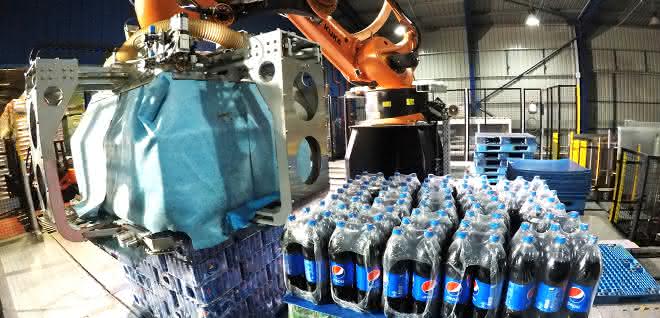
Fully automatic mixed palletizing is considered the supreme discipline among palletizing robots. At the Pepsi branch in Jordan, a Kuka robot masters this task. For five years, the KR 700 PA has been ensuring that supermarkets and other stores are supplied with the desired selection of soft drinks. Bottle by bottle, can by can, layer by layer, pallet by pallet. "By using the robot, we have been able to increase productivity and significantly reduce the error rate caused by manual intervention," says Bechara Nassar, Sales Manager at Technica International SAL, a Lebanese provider of automation and robotics solutions, which installed the robot station at Pepsi.
There, everything now revolves around the KR 700 PA and the robot around the beverage packages to be palletized. It stands in the middle of a hall, surrounded by five to six pallets with various bottles and cans that are already packed into small packages. Pepsi stocks more than 500 product variants of its 23 brands such as Lipton, 7UP and Pepsi itself - and in different sizes. A challenge for every robot, which has to grip the packages and place them precisely. First, a forklift truck brings the pallets with the drinks to the robot station, along with empty pallets and the necessary intermediate layers.
The challenge of mixed palletizing
Then it starts: after it has prepared an empty pallet on the loading station, the KR 700 PA grips a layer of beverages with its gripper arm and lifts them onto it. It then uses a vacuum function to suck up an intermediate layer, places it on the beverages and picks up the next layer. The heaviest beverages go to the bottom, lighter ones to the top. This optimizes the workflow between the warehouse and the palletizing system. Once the robot has finished its part, the pallets are transported away on a conveyor belt and finally taken to the truck loading area.
The KR 700 PA has a load capacity of up to 700 kilograms - with beverage cans of 0.33 liters, this corresponds to more than 2,100 cans. Even with the maximum payload, the robot works precisely and quickly, managing up to four work cycles per minute thanks to its powerful motors. And it works exactly according to plan. Bechara Nassar explains: "Different types of beverages are stacked on the pallets according to a predefined system. The customer specifies the sequence per layer and per pallet via the software." This offers enormous advantages for retailers in particular: The pallets can be individually stocked with drinks, tailored to the requirements in the store. This makes it easier to restock the shelves on site, for example.
Maximum efficiency through automation
The task that the robot now performs was carried out manually by numerous employees in the Pepsi Jordan warehouse until 2016. One of the customer's wishes was to relieve the people who have to perform this heavy physical work through automation. "Automation was the only way to make the process as effective as possible. And Kuka had the most suitable robot for us," says Bechara Nassar, explaining the choice of the KR 700 PA. For Pepsi, it was important to use as little space as possible for the automation. Thanks to its reach of up to 3.3 meters and its compact design, the model was therefore well suited to the warehouse of the beverage manufacturer, which had a global turnover of over 70 billion US dollars in 2020.


You might also be interested in
Sixth AutoStore project for New Wave
Element Logic is implementing its sixth joint project with the New Wave Group: a future-proof AutoStore system for the logistics center in Geiselwind.
 read more...
Everything is in its place
Vet-Concept produces and sells high-quality dry and wet food. The company sells almost exclusively online and also has its own small store in Föhren for customers to collect their own products. BITO-Lagertechnik has supported the company since its...
read more...Designing crisis-proof warehouse technology
Geopolitical tensions, rising costs and increasing protectionism have fundamentally changed the economy. The days when goods were simply stored are long gone - today it's all about remaining flexible, reacting quickly and finding ever smarter...
read more...Sustainable logistics - a sustainable approach
In recent years, environmental protection has become a fundamental concern of society. Sustainable logistics focuses on minimizing the environmental impact of logistics activities without compromising the economic efficiency of companies.
read more...Shelving specialist Elvedi celebrates its 40th anniversary
The shelving system provider Elvedi is celebrating its big anniversary in 2024. The shelving manufacturer intends to continue on this growth path in the future and is planning to expand its sales territory in Europe.
read more...Drill core storage for the Mont Terri rock laboratory
The plant and racking specialist Stöcklin received the order for an unusual racking system in an unusual location and found an unusual solution for it.
read more...MS Motorservice International relies on Kardex Mlog
MS Motorservice International, the sales organization for Rheinmetall's global aftermarket activities, has commissioned Kardex Mlog as general contractor to build a four-aisle high-bay warehouse at its Neuenstadt site. The high-bay warehouse will be...
read more...Warehouse concept from Schulte impresses at Liebherr-Logistics
Liebherr-Logistics built a new warehouse at the Oberopfingen site. Schulte equipped this with a complete package: Within a short space of time, pallet, cantilever and shelving racks were installed in all three sections of the new building.
read more...Mayr-Melnhof Packaging optimizes logistics operations with AR racks
The Chilean subsidiary of the European group for the production and distribution of paper and cardboard packaging has carried out a comprehensive logistics optimization project at its distribution center in Santiago, Chile.
read more...