

Positive conclusion, but ...
Stena Germanica: Five years of the methanol ferry
Five years ago, the Stena Germanica ferry, which operates between Kiel and Gothenburg, made its first voyage as the world's largest methanol ferry. The conversion to methanol operation was and is an important milestone for the Stena Line shipping company.
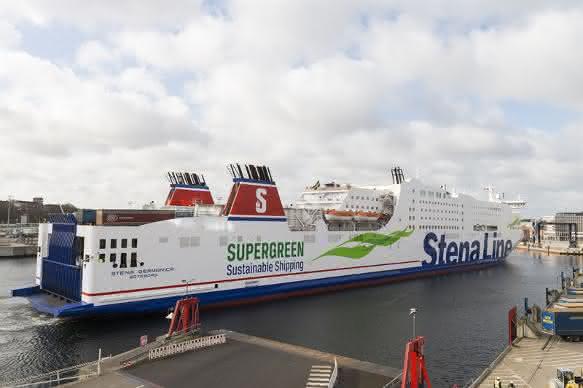
At the beginning of 2015, the 240-metre-long Stena Germanica was equipped with a combined methanol propulsion system at the Remontowa shipyard in Poland. The first voyage between Kiel and Gothenburg took place at the end of March of the same year and established methanol as a fuel for large ferries. Technically, it is a so-called dual fuel solution that allows the ferry's four engines to be powered by both methanol and traditional fuels such as marine gasoil (MGO).
Since the conversion five years ago, Stena Line has regularly used methanol as the main or supplementary fuel on the Stena Germanica, thus saving 25% of traditional fuel.
"The conversion of the Stena Germanica to methanol propulsion was and is an important milestone on our journey towards more sustainable shipping. Despite the current challenging times, we are delighted to have five years of methanol in the tank and to be a pioneer for further projects of this kind," says Erik Lewenhaupt, Head of Sustainability, Brand and Communication Stena Line.
Methanol can be produced from natural gas, coal, biomass orCO2. The use of methanol reduces sulphur emissions by 99%, nitrogen emissions by 60% and particulate emissions by 95% compared to traditional fuels. If the methanol is obtained from renewable raw materials,CO2 emissions no longer play a major role either.
Despite the very positive experience and the great potential of methanol as a ship fuel, Stena Line is not currently planning to equip any more ferries with methanol propulsion.
"We are working in parallel to reduce the fuel consumption and air and water emissions of our ferries and to further develop the fuel of the future. At present, methanol is not a competitive alternative to traditional fuels for cost and logistics reasons. However, we see great future potential for methanol in combination with batteries or fuel cells," says Erik Lewenhaupt.


You might also be interested in
Winner material flow PRODUCTS OF THE YEAR 2023
Conductix-Wampfler: ChargeLine 0865
Two-pole conductor rail segments for efficient opportunity charging of shuttles, suitable for thousands of cycles per day.
 read more...
Hermann Grewer celebrates his 80th birthday
Hermann Grewer, Honorary Chairman of the North Rhine-Westphalia Transport and Logistics Association (VVWL) and Honorary President of the German Road Haulage, Logistics and Disposal Association (BGL), celebrated his 80th birthday on June 6.
read more...Well chilled for sure
V-Zug Kühltechnik AG, developer and manufacturer of refrigeration appliances and part of the successful V-Zug Group, has set up a new production facility for refrigerators of all heights and dimensions at its Swiss site in Sulgen.
read more...Advantageous automation of small parts warehouses
The RSX1 shuttle system will be at the center of Rocketsolution's presence at this year's Logimat trade fair.
read more...Reduced energy requirements in the high-bay warehouse
One of Germany's leading premium car manufacturers is already focusing on energy efficiency in the production of its new SUV model with electric drive. The storage and retrieval machines in a high-bay warehouse at the production site have been...
read more...Low lift pallet truck for light duty applications
Clark has launched a new low lift pallet truck with the model designation LWio15 for light transport tasks. The truck has a load capacity of 1500 kg and is suitable for short distances in goods distribution, production or warehousing.
read more...Internationalization as an opportunity
E-commerce is in a state of flux. Changes in purchasing behavior and procurement problems are keeping e-commerce retailers busy. Logistics plays a decisive role in the overall online shopping experience.
read more...Fulfillment Center for Frisco.pl
Polish eGrocery specialist and TGW deepen partnership
TGW is building a highly automated fulfillment center for Frisco.pl in the Polish capital Warsaw. This is the second project in a row that the two companies have implemented together.
read more...Which world will it be in 2023?
Michael Schreckenberg teaches at the University of Duisburg-Essen as Professor of Physics of Transport and Traffic. Once a year, he addresses the readers of materialfluss, formerly LT-manager, with a critical and humorous expert article on transport...
read more...