
Container handling
Neural networks at the container depot
In the run-up to truck handling at logistics hubs such as port terminals, fluctuating handling times are the rule - often with unacceptable dwell times. The associated planning uncertainties prevent optimal scheduling. A solution co-developed by the Fraunhofer Center for Maritime Logistics and Services (CML) can change this.
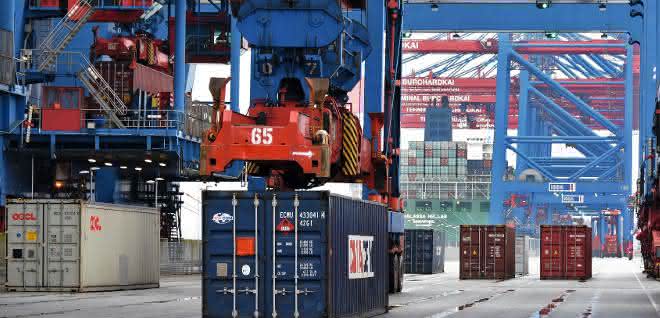
In addition, the peak requirements result in increased equipment and personnel requirements on the part of the system operators, which can affect profitability. Existing solutions for peak loads are usually limited to traffic management information or booking systems.
HCS Hamburger Container Service GmbH (HCS) operates one of the largest empty container depots in the Port of Hamburg and thus supports the maritime transport chain by providing interim storage, maintenance, repair and therefore the supply of ready-to-use ISO containers. Competitive pressure and, above all, the role as a service provider in port logistics do not allow slot booking systems here. At HCS, incoming trucks are always dispatched, which can result in significant waiting times at peak times. An information system that predicts the current utilization of the depot and reliable handling times should eliminate this problem.
With the help of this system, drivers and freight forwarders can estimate the handling times ahead of time. In contrast to slot booking, they retain full flexibility and therefore full scope for optimization. Times with lower capacity utilization should therefore be used more and peak loads avoided. There are further advantages for the empty container depot. As a handling process can sometimes involve several stations, optimizing the allocation of available employees in line with the workload also has the potential to optimize the overall process duration. Another expected advantage is that the traffic situation will ease.
Use of neural networks
The number of trucks arriving at a depot and therefore the processing time depends on many factors. In addition to the time of day and the day of the week, other influences such as ship arrivals, traffic conditions and the weather also play an important role. However, there can be different influencing factors not only for the arrival of trucks, but also for their "throughput time" at the depot: Whether it is delivery or collection, for example, or even the type of container itself.
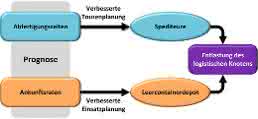
In operational practice, dispatch time forecasts are based on employees' experience. Accordingly, in most cases the deployment plan based on this is not optimal. Research and interviews with relevant stakeholders have confirmed that there is currently a lack of individual solutions for optimization that are specific to empty container depots. In practice, hardly any use is made of modern forecasting methods. If at all, standard methods such as extrapolation or autoregressive procedures are usually used. Small and medium-sized companies are quickly overwhelmed by the independent development of systems with highly developed mathematical models for truck turnaround time reduction. Costs for IT
Integration and for the operational organization reinforce this trend. Due to the large number of influencing factors and the non-obvious correlation between them, the use of neural networks lends itself in this case. The fundamental advantage of this is that no prior knowledge of the system is required. A neural network uses the linking of simple elements, known as neurons, to calculate a good estimate of the target variable based on the input variables, also known as predictors. The links and neurons are trained using large amounts of data. The network, or rather the training algorithm, finds correlations in the data set and adjusts the parameters of the connections and neurons accordingly. A solution was developed and implemented in cooperation with the Fraunhofer CML.
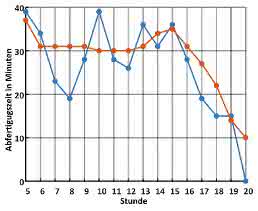
The Fraunhofer CML has been working on the use of neural networks for several years, particularly in the area of predicting time series. In detail, a model was developed that uses a digital image of the depot's handling processes. The arrival rates and handling times were averaged to the hour and divided into meaningful categories. One example is whether the driver picks up or delivers a container.
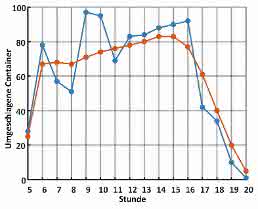
Typically, a data analysis is carried out beforehand for such projects. This allows errors in the data set to be identified and filtered. This sometimes time-consuming step ensures higher data quality. It also identifies procedures that should be used in the future to generate more accurate predictions. After analyzing the data, the neural network is also used in the further course. The main focus here is on the sensitivity of the input variables.
The main predictors used are the day of the week and the calendar week. Public holidays are also included in the training of the neural networks. Weather and traffic data can also be integrated. However, previous studies have shown that these variables are difficult to predict and contribute little or nothing to the forecast quality. Another point is ship arrivals. A similar situation arises here: the procurement and categorization of the data is not in proportion to the improvement in forecast quality that the predictor brings. This results in a manageable set of predictors. The advantage of a small number of predictors is the lower computing effort. This means that the software can be run locally without expanding the depot's IT infrastructure. This includes in particular the adaptive training of the neural network.
Results in practice and next steps
After adjusting the parameters of the neural networks, such as the number of neurons, and filtering the data set, the described variables can be estimated well during operation. The handling times are provided as minimum, maximum and mean values. The same applies to the arrival rates. The accuracy of the estimate is in the region of around 10%. On average, the predicted values only deviate by ±8 trucks. The duration of the handling times can be narrowed down to ±6 minutes. This quality is sufficient for the identification of peak loads and enables improved deployment planning in the depot. For example, employees can divert trucks at peak times at an early stage to prevent traffic jams at adjacent roads and junctions. Drivers and hauliers also have reliable information about the estimated capacity utilization in the depot and can therefore optimize their routes. Once the business processes have settled down for all those involved, a reduction and flattening of operating peaks can generally be expected. The data is made available via the HCS website. In future, however, it will also be used via an interface for pre-registration and booking systems.
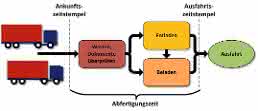
The next project will be the integration of pre-announcement systems. TR02 communication" is already being used in connection with slot booking for delivery and collection at the port terminals.
In summary, the initiative provides the opportunity for process optimization via networked systems in the port. The idea is to exploit the optimization potential in the overall port system. HCS thus deliberately avoids the method of slot bookings, which is too rigid for dynamic and flexible route optimization.
The authors: Olaf Rendel, Ole John (both Fraunhofer CML) and Dr. Roland Karnbach, Managing Director of HCS Hamburger Container Service GmbH.
The Fraunhofer Center for Maritime Logistics and Services CML develops and optimizes processes and systems along the maritime supply chain. In practice-oriented research projects, the Center supports private and public clients from the shipping, port and logistics sectors in initiating and implementing innovations. Depending on project and customer requirements, the CML puts together interdisciplinary teams of engineers, economists, mathematicians, computer scientists and nautical experts to create customer-specific solutions for ship and fleet management, nautical and maritime traffic, ports and transport markets.


You might also be interested in
e2open bonded warehouse solution for several European countries
e2open, a provider of networked supply chain platforms, has expanded its customs warehouse management in Europe. Companies that import goods to Europe now have the option of using various customs warehouse programs.
 read more...
New start-up aims to facilitate access to robotics
Pssbl.Robotics, a start-up founded jointly by Schubert and Weiss, aims to simplify the introduction of robotics in mechanical and plant engineering.
read more...Test shipment with RoRo Car Carrier via Bremerhaven
Last August, the RoRo Car Carrier MV Cosco Shengshi moored in the northern port of Bremerhaven and started its first test shipment in order to expand the service to Europe.
read more...Rhenus grows at sea and on the road
At the northern tip of Lower Saxony, the logistics service provider is preparing for the growing import of cars via Cuxhaven; in Nuremberg, Rhenus is building a new logistics center next to the existing high-bay warehouse; in Dietzenbach, Hesse, the...
read more...Hermann Grewer celebrates his 80th birthday
Hermann Grewer, Honorary Chairman of the North Rhine-Westphalia Transport and Logistics Association (VVWL) and Honorary President of the German Road Haulage, Logistics and Disposal Association (BGL), celebrated his 80th birthday on June 6.
read more...Group7 expands corporate headquarters
The logistics service provider is planning 60,000 square meters of service and logistics center and an administration building with 5,000 square meters of floor space near Munich Airport.
read more...Cross-channel logistics: overcoming hurdles after Brexit
Hardly any other event has presented European road freight transport with such enormous challenges as Brexit. But there are solutions.
read more...Transport Logistic 2023
After a four-year break with a virtual interlude in 2021, Transport Logistic will return to the Munich exhibition grounds from May 9 to 12, 2023.
read more...Focus on internationalization
L.I.T. will be represented twice at Transport Logistic. The Brake-based logistics service provider's service portfolio ranges from warehousing and transportation using various modes of transport to contract logistics and comprehensive value-added...
read more...