
Port of Hamburg
The turnaround in turnover is looming
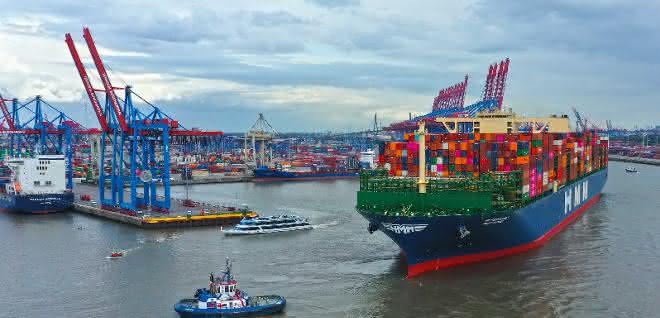
At eight percent, the decline in seaborne cargo handling in Germany's largest universal port in the third quarter was significantly lower than in the second quarter. The Port of Hamburg still recorded a decline of 16.2 percent. The negative effects of the coronavirus pandemic, which are being felt worldwide, continue to be reflected in the handling trend at the Port of Hamburg.
According to Port of Hamburg Marketing (HHM), the result in the third quarter gives hope that the double-digit decline in turnover has been halted. This was caused in particular by the downturn in many sectors of the economy and weaker consumer demand. According to HHM, a positive upward trend can be seen again in the third quarter.
"Since July, we have seen a stabilization in the handling trend and thus a smaller overall decline in seaborne cargo handling at the Port of Hamburg. The lower infection figures in the summer and the subsequent easing of measures to contain the pandemic, as well as the replenishment of warehouses for the Christmas business, are among the causes," explained Axel Mattern, Port of Hamburg Marketing Executive Board member. It should be emphasized that the Port of Hamburg continues to provide its handling and logistics services 24/7. "The reliable supply of goods and raw materials to the population and the economy is running smoothly even under the difficult global economic conditions," emphasizes Mattern, adding: "The port is fully operational with its handling terminals, logistics and service operations as well as its transport links with the inland."
In the first three quarters of the year, 93.2 million tons of seaborne goods were loaded or unloaded at the terminals in the Port of Hamburg. This is a decrease of 10.7 percent compared to the same period last year. Both main handling segments are affected. General cargo throughput of 65.2 million tons (-9.9 percent) and bulk cargo throughput of 28 million tons (-12.4 percent) were both well below the previous year's good result. In the container handling segment, a total of 6.3 million TEU (20-foot standard containers) were lifted over the quayside in Hamburg in the first three quarters. This represents a year-on-year decline of 9.9 percent.
The development of container throughput in the Port of Hamburg's ten most important trading partners varied in the first three quarters. In particular, the decline in seaborne container throughput volumes with China (-11.3 percent), Hamburg's most important trading partner by far, could not be offset by positive developments with other countries. In addition to China, Russia (-15.1 percent), Sweden (-11.8 percent), South Korea (-11.8 percent), Denmark (-3.4 percent) and Poland (-9.6 percent) also recorded double-digit declines in seaborne container throughput in some cases.
In addition to the USA (+0.1 percent), the Port of Hamburg's top ten trading partners with growth in container traffic include Singapore (+7.1 percent), the United Kingdom (+41.0 percent) and Malaysia (+5.5 percent). The USA, which follows Hamburg in second place in the ranking of container partners, recorded growth in the first three quarters with a total of 439,000 TEU. "The continued positive container traffic development with the USA is surprising in light of the economic performance there, which has been impacted by coronavirus, and falling demand. The positive development in container traffic with the UK is due to increased transportation of empty containers for the German market and increased deliveries to the UK ahead of the upcoming Brexit," explains Ingo Egloff, Axel Mattern's colleague on the Executive Board.
At 14.4 percent, the decline in imports in the Port of Hamburg was greater than the decline in exports (-5.5 percent). On the import side, the drop in steel production in particular led to less handling of ore and coal. In contrast, agribulk handling in the suction goods segment developed positively in the first three quarters, reaching a volume of 5.6 million tons (+20.1%). Significantly more exports of grain and fertilizer are the main reason for the very good handling development.
"Despite the recovery since the middle of the year, we will not be able to match last year's strong result," concludes Egloff. "But the development from July onwards gives us hope that we will only have losses in the single-digit range at the end of the year."


You might also be interested in
Karsten Dirks becomes operational managing director
As of today, the 53-year-old will take over the operational management of BLG AutoTerminal Bremerhaven. In future, he will be responsible for the site together with Commercial Managing Director Jan Bellendorf.
 read more...
Vahle and Swedish start-up Elonroad cooperate
Paul Vahle is cooperating with the Swedish e-mobility start-up Elonroad. Both companies have signed a memorandum of understanding to announce their partnership.
read more...Vollers Hamburg invests in terminal equipment
With the new eco reachstacker from Kalmar, Vollers can now empty containers weighing up to 32 tons directly.
read more...Port of Hamburg suffers from loss of Russian business
The difficult economic development of the global economy is affecting the handling figures of the Port of Hamburg. As in other ports in Northern Europe, seaborne cargo throughput in Hamburg is declining, although individual trade lanes are...
read more...Hamburg Nautical Center steers shipping traffic with the power of the sun
The Nautical Headquarters in the Port of Hamburg will be relying fully on solar energy for its energy supply in future: Q.Partner Betrieb Nordic Solar GmbH has installed a solar system with Q Cells solar modules on the roofs of the Nautical...
read more...25 years of Weserport
Bremen-based seaport service provider Weserport looks back on a quarter of a century of company history on April 4.
read more...There's still room for improvement
New container gantry crane delivered to Hamburg
The first of a total of six new container gantry cranes for Eurogate Container Terminal Hamburg was delivered on March 27.
read more...Port of Hamburg defers rents and fees to the port industry
All tenants of the Hamburg Port Authority (HPA) in the Port of Hamburg can now apply for an interest-free deferral of building and land rents for the months of April, May and June.
read more...Hamburger Hafen und Logistik AG
HHLA CEO: Stable operations at the port guaranteed
The supply of the population and companies with goods via the terminal facilities of Hamburger Hafen und Logistik AG (HHLA) is ensured regardless of the measures taken to protect against the spread of the coronavirus, says the head of HHLA.
read more...