
Lighting/floor cleaning/fire protection
Sensor-controlled light in the warehouse
Reducing energy consumption through intelligent lighting control in the high-bay warehouse was the goal of a medium-sized technology company with its own production facility in North Rhine-Westphalia. Based on the data and recommendations of the PROLog planning tool from Steinel Professional, a savings potential of 96% was identified as a result of the changeover.
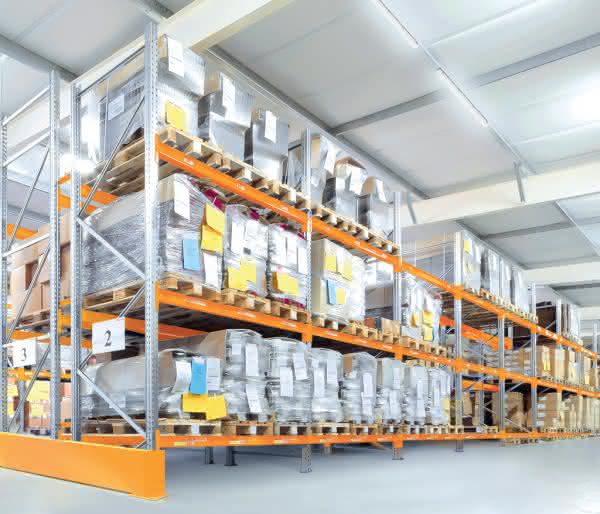
Sensor-controlled light in a high-bay warehouse can reduce energy consumption without having to compromise on safety and functionality. However, whether such an investment is worthwhile and how much energy can actually be saved is often only roughly estimated in practice or based on empirical values. However, Steinel Professional has developed the PROLog measuring device to provide a sensible, fact-based basis for decision-making. In the example case, real data on the use of the storage areas and the existing lighting conditions were to be obtained in order to be able to quantify energy savings through sensor-controlled light.
The warehouse in question has seven aisles without daylight. In each of these aisles, 25 standard linear luminaires with an output of 65 watts each are used for permanent lighting during the warehouse's period of use. With a service life of around 10,000 hours, the luminaires consume 28,386 kWh of electricity, which generates costs of EUR 5,677 per year.
Facts instead of estimates
In the first stage of the analysis, the off-grid PROLog measuring device was installed at selected points in the warehouse aisles. With a range of up to 20 meters, it records data on user behaviour and the actual brightness in the warehouse. Over a period of 21 days, the device collected almost 300,000 measurement data. The PROLog evaluation software records all the data for the respective measuring range. The desired brightness value is set manually on the PROLog device before the measurements begin - in the example case, this is 100 lux.
The PROLog evaluation shows exactly how long the artificial light was switched on, how many hours people were present and therefore needed light and how long the light was switched on unnecessarily as the corresponding room area was not used. These real actual values are compared with ideal values through the use of sensor-controlled lighting. In addition to this specific usage and lighting data, other values such as energy and service cost rate, service life of the light sources and inflation rate are also included. This database is used to create a projection over one, three, five and ten years.
Highbay sensor for automatic light
For the high-bay warehouse in question, PROLog recommends reducing the number of luminaires to 13 per aisle. The output of only 43 watts is also considered sufficient. In future, 2 motion detectors are to be installed per aisle to control the light switching depending on usage. This means that the light will only be switched on when it is actually needed, i.e. when vehicles or people are in the aisle. Due to the high ceiling in the warehouse, the sensors must also provide precise detection results from a great height and also have a long and narrow detection field typical of aisles.
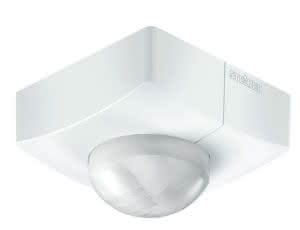
The installed IS 345 MX Highbay aisle sensor from Steinel Professional meets these requirements. The passive infrared sensor with an aperture angle of 90 degrees can be installed up to a maximum mounting height of 14 meters. When motion is detected, it switches the light on automatically and depending on use. The run-on time has been set to one minute in the example case. The desired response brightness can be between 2 and 1000 lux.
The result
After evaluating the PROLog measurement data, the number and power of the lamps in the high-bay warehouse is reduced. Special highbay sensors from Steinel Professional are installed for lighting automation. This means that the light is no longer switched on permanently, but is controlled according to use. These measures save 96.38% of the total costs, i.e. energy, replacement and service costs per year.


You might also be interested in
Fire-Rated Doors for Sandwich Panel Walls
Teckentrup is expanding its product line to include fire-rated doors for sandwich panel walls. The certified EI₂60 and EI₂90 door assemblies are suitable for industrial facilities, logistics centers, and office buildings.
 read more...
LED projection warns of hazards in the warehouse
With OX-Spot, Orgatex introduces an LED-based warning system designed to enhance safety on the shop floor. The solution projects warning symbols and instructions onto floors or walls as needed, thereby complementing traditional safety markings in...
read more...Signaling systems: More safety and fewer accidents
In the fast-paced world of logistics, safety and efficiency are of paramount importance. Stagnoliaccessories presents a range of loading bay lighting and signaling systems designed to prevent accidents and ensure smooth operations at loading and...
read more...More autonomy in the logistics sector
Kärcher once again presented numerous high-performance cleaning and maintenance solutions for the logistics industry at Logimat. These include the new KIRA B 50 scrubber-dryer robot, which has now been equipped with even more powerful sensors and...
read more...Structured warehousing saves space and time
At Logimat in Stuttgart, ONK will be presenting a wide range of solutions for warehouse labeling. The main focus will be on floor markings and block storage signs.
read more...Full safety during ascent and descent
Optimum efficiency and occupational safety for all trades in construction. Munk Günzburger Steigtechnik pursues this claim.
read more...Always clean
Nilfisk presents the new Viper ROS1300 ride-on sweeper for cleaning large areas in industry, logistics and retail.
read more...Hekatron companies continue to grow
Despite a wide range of challenges, the Hekatron companies will close the 2021 financial year with a turnover of around 215 million euros. For the fire protection experts and EMS specialists, this means continued growth and an increase of 5.5...
read more...Nilfisk presents new ride-on sweeper Viper ROS1300
The new Viper ROS1300 ride-on sweeper from cleaning equipment manufacturer Nilfisk has two side brushes, 24V batteries and a maximum working speed of 8 km/h.
read more...