
From materialfluss 5/2020
Battery charging technology mounted overhead to save space
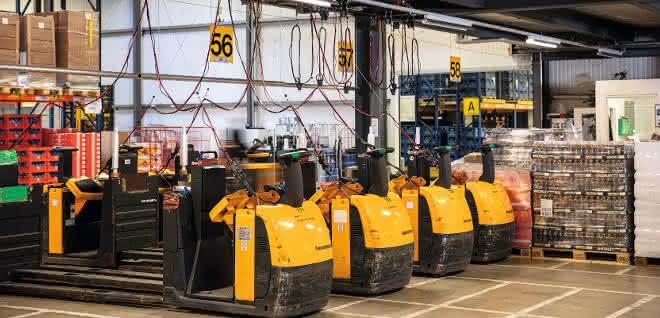
Around 100 electric industrial trucks at the SPAR Group's Swiss central warehouse in St. Gallen ensure that the approximately 8,800 items in the range can be dispatched to stores and partners throughout the country. To increase the availability and efficiency of the fleet, the retail chain relies on battery charging technology from Fronius.
According to the company, SPAR is the world's largest voluntary association of retailers in a franchise system. Although the stores, wholesalers and supermarkets operate under the same name and with a uniform logo, they are independent companies. Under the emblem of the fir tree, SPAR stores are now known in 49 countries on four continents - including Switzerland. The Swiss SPAR Group was founded in 1989 and is now a holding company with three operating companies: SPAR Handels AG, TopCC AG and SPAR Management AG. The store network now comprises 185 neighborhood and convenience stores as well as eleven TopCC pick-up stores for restaurateurs, business customers, associations and public institutions.
Around 8,800 articles
These are supplied from the SPAR Group's central warehouse, which is still located in St. Gallen today. On an area of 33,000 square meters, around 8,800 different items with a total value of around 26 million Swiss francs are stored in the modern logistics center. More than 600,000 roll containers leave the halls every year and are transported by truck to stores and partners throughout the country. Internally, a fleet of 100 electric industrial trucks ensures a fast and efficient flow of goods. As SPAR works in shifts, forklifts and batteries must be designed for long periods of use. The company does not use exchangeable batteries.
Until recently, SPAR mainly used devices with 50-Hertz technology to charge the traction batteries. The massive devices took up a lot of space, which is why they were housed in a separate room in the basement. "However, this solution was quite cumbersome," recalls Daniel Stohr, Head of Warehouse. "Each forklift had to be brought into the loading area individually by freight elevator and connected there - with such a large fleet, it takes quite a lot of time. The operating and maintenance costs for the elevator were also considerable due to the constant workload." Those responsible at SPAR therefore decided to modernize the charging infrastructure. The company became aware of Fronius at a trade fair: Fronius develops customized complete systems for charging traction batteries. "Together, we first took a close look at the current situation at SPAR and then developed proposed solutions to improve the processes in day-to-day work," explains Reto Baumgartner, Sales Battery Charging Systems at Fronius Switzerland. "We agreed these with the customer and then implemented them together."
Space-saving and standard-compliant installation
The most important change was to move the battery charging technology from the basement to the first floor, in the working area of the forklift fleet. The Selectiva chargers from Fronius are ideal for this: They are much smaller and lighter than the 50 hertz devices previously used and can therefore be installed flexibly and in a space-saving manner. Fronius set up several decentralized charging areas at SPAR, which are easy for the forklift drivers to reach. The chargers are mounted on the wall, for example - or in one case even integrated overhead into the steel construction of a high-bay warehouse. A spring balancer ensures that the charging cables do not lie on the floor when no battery is connected. "With all variants, we naturally made sure that all safety regulations and standards were complied with," reports Baumgartner.
Employees also benefit from the external start-stop function of the chargers. All they have to do is connect the cable to charge the batteries - no settings need to be made directly on the device. The Selectiva devices automatically detect the voltage, capacity and condition of the connected battery and adjust the charging characteristic accordingly. A pilot contact in the plug also prevents sparks from forming if the charging cable is disconnected prematurely - "after all, highly explosive oxyhydrogen gas can be released when charging lead batteries," explains Baumgartner. However, Fronius technology ensures safety in warehouses - and at the same time simple operation.
Gentle charging preserves battery capacity
With their Ri charging process, the Selectiva devices also supply the traction batteries with energy gently and efficiently. They measure the internal resistance (Ri) of the batteries, which depends on various factors such as their age, temperature and state of charge - so each battery receives exactly the charge it needs. This reduces harmful heating to a minimum, maintains the capacity of the batteries and extends their service life. At the same time, charging times are now significantly shorter than before. "This has noticeably increased the availability of our fleet," says Thomas Broder, Head of Logistics Technology at SPAR. "The forklifts have to visit the charging stations less often and are also ready for use again more quickly."
Another positive effect is the lower operating costs. On the one hand, the energy consumption for charging the industrial trucks is up to 30 percent lower with the new Selectiva devices. Secondly, Fronius and SPAR have been able to extend the service life of the traction batteries by around a third, meaning that the expensive batteries need to be replaced less frequently. Water consumption has also fallen thanks to the gentle charging process, which in turn reduces maintenance costs. "The new charging infrastructure enables us to make significant savings," says Warehouse Manager Daniel Stohr with satisfaction. "We have also gained valuable space."
A total of 35 Selectiva chargers are now in use at SPAR's central warehouse. Those responsible are completely satisfied with the result - just as they are with the cooperation with Fronius. "We received competent, constructive and success-oriented advice right from the start," praises Stohr. "It was particularly positive for us that we had a fixed contact person from planning to implementation and operation - that made the changeover much easier for us."


You might also be interested in
Winner material flow PRODUCTS OF THE YEAR 2023
Conductix-Wampfler: ChargeLine 0865
Two-pole conductor rail segments for efficient opportunity charging of shuttles, suitable for thousands of cycles per day.
 read more...
Hermann Grewer celebrates his 80th birthday
Hermann Grewer, Honorary Chairman of the North Rhine-Westphalia Transport and Logistics Association (VVWL) and Honorary President of the German Road Haulage, Logistics and Disposal Association (BGL), celebrated his 80th birthday on June 6.
read more...Well chilled for sure
V-Zug Kühltechnik AG, developer and manufacturer of refrigeration appliances and part of the successful V-Zug Group, has set up a new production facility for refrigerators of all heights and dimensions at its Swiss site in Sulgen.
read more...Advantageous automation of small parts warehouses
The RSX1 shuttle system will be at the center of Rocketsolution's presence at this year's Logimat trade fair.
read more...Reduced energy requirements in the high-bay warehouse
One of Germany's leading premium car manufacturers is already focusing on energy efficiency in the production of its new SUV model with electric drive. The storage and retrieval machines in a high-bay warehouse at the production site have been...
read more...Low lift pallet truck for light duty applications
Clark has launched a new low lift pallet truck with the model designation LWio15 for light transport tasks. The truck has a load capacity of 1500 kg and is suitable for short distances in goods distribution, production or warehousing.
read more...Internationalization as an opportunity
E-commerce is in a state of flux. Changes in purchasing behavior and procurement problems are keeping e-commerce retailers busy. Logistics plays a decisive role in the overall online shopping experience.
read more...Fulfillment Center for Frisco.pl
Polish eGrocery specialist and TGW deepen partnership
TGW is building a highly automated fulfillment center for Frisco.pl in the Polish capital Warsaw. This is the second project in a row that the two companies have implemented together.
read more...Which world will it be in 2023?
Michael Schreckenberg teaches at the University of Duisburg-Essen as Professor of Physics of Transport and Traffic. Once a year, he addresses the readers of materialfluss, formerly LT-manager, with a critical and humorous expert article on transport...
read more...