
Research project with Still
Autonomous driving in the warehouse takes shape
The European research project IMOCO (Intelligent Motion Control) aims to bring the vision of autonomous transport vehicles in production halls and warehouses within reach.
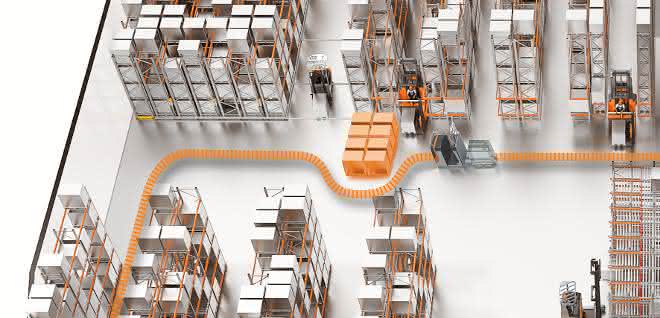
On the German side, the project is being led by Hamburg-based intralogistics specialist Still. The project is scheduled to end in the fourth quarter of 2024. Transport vehicles that can navigate completely autonomously through warehouses and production facilities, analyze and "understand" their surroundings, reliably detect and avoid obstacles and people and at the same time transport goods quickly and reliably from one place to another - that still sounds like science fiction at the moment. However, this vision is soon to become reality, if the initiators of the European research project IMOCO have their way. Four scenarios were defined within the research project that are characterized by digital twins and AI principles (machine learning / deep learning): intelligent navigation, picking up the goods, transport and placement at the destination. "Such processes place very high demands on the processes and also on the vehicle. With our OPX iGo neo, we have therefore sent an order picker into the project which, thanks to its intelligent equipment and the resulting capabilities, already comes very close to the idea of this autonomously driving vehicle," explains Ansgar Bergmann, responsible for the IMOCO project at Still.
Highly sensitive sensor technology is required
Current automated guided vehicles still have their limits when it comes to actually moving fully autonomously in the warehouse or in production. Although they can detect obstacles and brake autonomously, they are not yet able to avoid obstacles, intelligently search for the most efficient routes and analyze their surroundings. To do this, they need highly sensitive sensor technology in the form of laser scanners, cameras or radar to detect spatial objects such as shelves or signs, markings and displays. They must also "understand" their surroundings, register changes and be able to deal with them. This is the only way these vehicles will be able to navigate independently to their destination, recognize and handle loads, avoid obstacles or find suitable parking spaces for the transported goods.
The OPX iGo neo is already autonomous in the aisle, recognizes and understands its environment and derives its actions from this. However, leaving the shelving aisle fully autonomously and navigating through the halls at the customer's premises and planning optimal paths, for example, is not yet part of the product. However, because it is already equipped with the corresponding environmental sensors, this makes it the starting point for the further developments planned for this project. "For the OPX iGo neo, the aim of the project is to further increase the level of understanding of the environment and the decision-making capabilities in order to continuously increase the autonomous capabilities, the intelligence of the robot, and allow it to operate autonomously in the warehouse beyond the shelf aisle. Machine learning and deep learning approaches play a very important role here," explains Ansgar Bergmann.
Detect obstacles in real time
IMOCO has set itself the goal of creating the conditions for this challenging use of mobile robotic systems in dynamic intralogistics environments. Autonomous and situation-dependent changes to the planning of a route, including the consideration of moving objects such as people or vehicles, should then be possible throughout the warehouse. Ansgar Bergmann explains: "The research project aims to further develop the conventional triad of recognizing, analyzing and acting using artificial intelligence - to perceive, understand and solve." Within the research project, the vehicles are to be enabled to perceive the spatial environment using different sensors and not only recognize trained objects, but also assess their movements. "This recognition of obstacles must take place in real time to ensure a smooth process," says the expert.
Hamburg becomes a "research center"
A demonstrator will be set up at Still's headquarters in Hamburg, where all of the project partners' successful work will be brought together. In addition to Still as a representative of the KION Group, the Fraunhofer Institute for Material Flow and Logistics (IML), Hahn Schickard, IMST GmbH, Nuromedia and Digital Twin Technology are also taking part in the project on the German side. IMOCO is funded by the European Union through the research organization "Electronic Components and Systems for European Leadership" (ECSEL) and by the German Federal Ministry of Education and Research.


You might also be interested in
Sixth AutoStore project for New Wave
Element Logic is implementing its sixth joint project with the New Wave Group: a future-proof AutoStore system for the logistics center in Geiselwind.
 read more...
Everything is in its place
Vet-Concept produces and sells high-quality dry and wet food. The company sells almost exclusively online and also has its own small store in Föhren for customers to collect their own products. BITO-Lagertechnik has supported the company since its...
read more...Designing crisis-proof warehouse technology
Geopolitical tensions, rising costs and increasing protectionism have fundamentally changed the economy. The days when goods were simply stored are long gone - today it's all about remaining flexible, reacting quickly and finding ever smarter...
read more...Sustainable logistics - a sustainable approach
In recent years, environmental protection has become a fundamental concern of society. Sustainable logistics focuses on minimizing the environmental impact of logistics activities without compromising the economic efficiency of companies.
read more...Shelving specialist Elvedi celebrates its 40th anniversary
The shelving system provider Elvedi is celebrating its big anniversary in 2024. The shelving manufacturer intends to continue on this growth path in the future and is planning to expand its sales territory in Europe.
read more...Drill core storage for the Mont Terri rock laboratory
The plant and racking specialist Stöcklin received the order for an unusual racking system in an unusual location and found an unusual solution for it.
read more...MS Motorservice International relies on Kardex Mlog
MS Motorservice International, the sales organization for Rheinmetall's global aftermarket activities, has commissioned Kardex Mlog as general contractor to build a four-aisle high-bay warehouse at its Neuenstadt site. The high-bay warehouse will be...
read more...Warehouse concept from Schulte impresses at Liebherr-Logistics
Liebherr-Logistics built a new warehouse at the Oberopfingen site. Schulte equipped this with a complete package: Within a short space of time, pallet, cantilever and shelving racks were installed in all three sections of the new building.
read more...Mayr-Melnhof Packaging optimizes logistics operations with AR racks
The Chilean subsidiary of the European group for the production and distribution of paper and cardboard packaging has carried out a comprehensive logistics optimization project at its distribution center in Santiago, Chile.
read more...