
Conveyor technology
Overhead conveyor systems - an alternative to KLT transport
In logistics, companies are faced with the challenge of optimizing their internal material flow in order to maximize productivity, cost savings and efficiency. Overhead conveyor systems play an important role in this context. Due to their flexible and efficient use, they can be an alternative to small load carriers (SLCs).
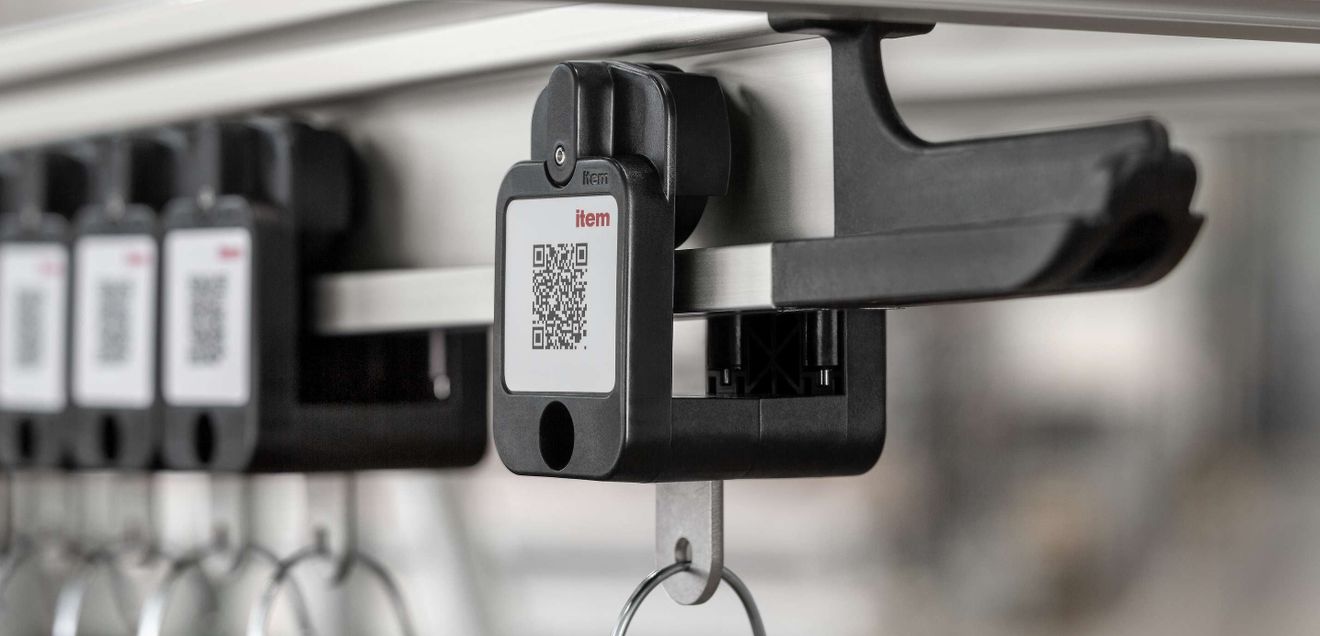
Overhead conveyor systems enable the productive provision of materials. Overhead conveyor systems are particularly useful when it comes to transporting goods that take up too much space in conventional small load carriers or get caught up easily. They are cost-effective, flexible and space-saving. Overhead conveyor systems usually consist of a structure with trolleys on which the transported goods are suspended. These trolleys move along a profile to the removal point. In contrast to small load carriers, which are available in many different designs in terms of length, width and height, the trolleys are available in a defined uniform size. They are significantly smaller than KLT and therefore require less space for storage.
An example: In the "traditional" transportation of glove compartment lids in the automotive industry, four pieces per KLT can be fed to the production line via two feed levels. The empty containers are transported away via two return levels. While the KLTs take up just as much space on the outward journey as they do when empty on the return journey, the situation is different when the glove compartment flaps are transported in a suspended state using a conveyor system. This reduces the volume of empty material, as the trolleys are significantly smaller than the KLTs and therefore take up less space. Once the material has been removed, it can be collected and returned in a single KLT. As a result, two of the four levels no longer need to be kept ready for the return of the empty KLTs, but can also be used for supplying material to the production line. "By replacing the small load carrier transport with an overhead conveyor system, around one and a half times more material can be supplied to the production line. Depending on the component, this factor can be even higher," explains Michael Guntermann, Product Manager and Team Leader Application & Support at Item Industrietechnik.
Significant space gain
Headliners can also be transported efficiently using the overhead conveyor system. It can also be used to feed in more material and at the same time make much better use of the space on the production line and in the warehouse. Headliners are available in many different versions, with sliding or panoramic roofs or completely closed. They are also available in different colors and materials. All these different versions are stored flat on top of each other. To avoid damaging the lower headliners, the number is limited or they have to be stored separately from each other, resulting in many stacks that take up a lot of space. "The pallets, including the walkways, can quickly take up to 20 m². That's an enormous amount - the space could be significantly reduced by using an overhead conveyor system," says Michael Guntermann.
For suspended transportation of the headliners, two trolleys could be attached next to each other so that two trolleys (one per rail) could transport one headliner. This would save around half the space for the same amount of material, which in turn could be used to store more headliners. An additional advantage: the suspended system eliminates the need for pallets, which has a positive effect on the space required in the warehouse. At the same time, the risk of damage from ground vehicles or forklifts is minimized considerably thanks to the suspension of the headliners. This is an important factor, as headliners are fragile and can be easily deformed or soiled.
In addition to glove compartment flaps and headliners, overhead conveyor systems are also suitable for many other components such as cables, cockpit panels, floor mats, measuring instruments and other parts from the automotive industry. The systems can also be used for products and components from other industries, which can be efficiently supplied for further processing thanks to an overhead conveyor system.
Transported by gravity
There are already some overhead conveyor systems on the market. "However, most of these are powered, or if they are not, they are mainly made of steel and connecting them to a modular system is difficult and cumbersome," says Michael Guntermann. "Our system consists of an aluminum profile that can be easily shortened and optimally combined with the other Item components." According to the supplier, a very low inclination of 3° compared to other systems is sufficient to ensure suspended transportation using the weight of the transported goods alone. This saves energy and reduces the loss of height during transportation.
The Item overhead conveyor system consists of track profiles up to six meters long, which can be combined with each other as required. They are attached to a frame made from the D30 profile tube system at an angle of 3° using intelligent connection technology. This creates transport trolleys or racks with an integrated overhead conveyor system. The ESD-safe trolleys have a universal connection point on the underside to which any hooks etc. can be attached, which then hold the transported goods with a maximum weight of 5 kg. The trolleys are simply pushed onto the infeed and move empty or with the transported goods by gravity on the low-friction track profile to the removal point. There, the end stop enables simple and ergonomic removal. The stop at the removal point stops the trolleys and offers additional protection, for example when transporting with automated guided vehicles. Despite movement, the transported goods remain securely in place and can also be transported over longer distances to save space.
System extension: Transport over curves
Currently, the overhead conveyor system can be used to transport goods along a straight route. However, it is also possible to transport goods along curves, which means that the range of applications can be extended even further. In future, the system will offer the option of separating the trolleys, braking them and automatically returning empty goods. "In addition, the system can also be used as a mechanical partial automation system in Karakuri applications or for shooters. This means that goods can be transferred to staging racks without manual handling of transport vehicles," says Michael Guntermann. Ultimately, the connection to an overhead conveyor system opens up a wide range of possibilities for efficient, semi-automated transport in intralogistics.


You might also be interested in
"Dancing with Robots"
With a live performance under the motto "Dancing with Robots", Trapo will be presenting intelligent automation and robotics solutions for the packaging industry at Interpack 2026.
 read more...
China's industry undergoing AI transformation
China has launched its 15th five-year plan and is positioning robotics as a central component of its modern industrial system. The aim is to transfer artificial intelligence more strongly into physical applications and thus boost economic growth.
read more...Bosch Rexroth at the Logimat 2026
Humanoid robot on AMR platform
Mobile robotics is well established in intralogistics, now humanoid robotics is moving more into focus. At Logimat, Bosch Rexroth is presenting a mobile humanoid robot on an AMR platform for the first time.
read more...Exoskeleton: strength to put on
Automation specialist Comau is expanding its portfolio of wearable robots with a new exoskeleton. The wearable system reduces muscle strain by up to 50 percent and is aimed at a wide range of applications in industry and SMEs.
read more...Flexible lever solutions
Aero-Lift Vakuumtechnik will be exhibiting at Fachpack in Nuremberg from September 23 to 25, 2025. There, the supplier from Baden-Württemberg will be presenting its portfolio of tube lifters from the Force-Lift series - including the Force-Lift | 2,...
read more...Save costs with a retrofit
The Spinner Group updated its ageing logistics system with the help of system integrator Klinkhammer Intralogistics: a targeted retrofit of the automated small parts warehouse and conveyor technology meant that it was no longer necessary to invest...
read more...Handling devices and more
Expresso aims to enable customers to improve the efficiency of their intralogistics processes through the use of high-quality handling and transportation equipment. In addition to positioning and conveying systems, the German manufacturer offers a...
read more...Compact motorized castor for pallets and heavy loads
Rulmeca has launched a new motorized roller onto the market. The EPS-AS1 roller motorizes roller conveyors for heavy loads of up to 1,500 kilograms.
read more...Transportation by gravity: Item receives the IF Design Award 2024
Item Industrietechnik is once again one of the winners of the IF Design Award in 2024. The Solingen-based family business has already won the coveted award over ten times.
read more...