
Retrofit
Keep the good, sort out the bad
What do you do when your own sorting system is getting on in years, important components are no longer available on the market or are only available as custom-made products, or the requirements for the system have changed?
The magic word is retrofit. Wikipedia defines retrofit as "the modernization or expansion of existing (usually older and no longer produced) systems and equipment". The advantages for the system operator of replacing outdated components with new, up-to-date ones are obvious - modernizing a system preserves the good basic substance and eliminates the weak points at a lower cost compared to a new purchase. In addition to the reduced time required for retrofitting, changes do not have to be taken into account in the approval process, as the protection of existing equipment applies when individual components are replaced.
Inventory of the existing system
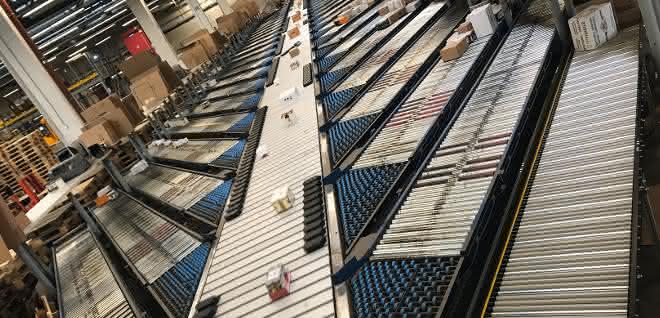
Importhaus Wilms/Impuls GmbH & Co KG, the leading distribution platform for premium consumer goods brands in the German retail sector, has been operating a fully automated sorting system for non-refrigerated food products supplied by Vanderlande at its Alzey site since 1996. Order pickers remove the required foodstuffs from the rack locations as specified by Pick-by-Light and Pick-by-Voice and place them on nearby discharge conveyors. The goods are fed into a circulating loop and, after a 5-sided reading in a scanner gate, fed to a Posisorter with 50 outlets. At these end points, customer-specific pallets are packed according to the order and moved manually to the outgoing goods area. The Posisorter from Vanderlande is a sliding shoe sorter that combines conveying technology with gentle product handling. The shoes glide over the load carriers and push the products gently into the sorting outlets by means of a diagonal movement. The system is available for sorting to one or two sides and is suitable for totes, trays, cartons and bags. It is particularly used in batch picking processes and cross-docking systems as well as for dispatch sorting. The end stations supplied in 1996 consist of conveyors with tubular steel rollers mounted on ball bearings, which are driven intermittently by a central belt with welded-on elevations via a 400V motor so that the requirements described are met. A light barrier for full signaling and a maintenance switch for switching off the terminal for repair and maintenance work are available as electrical equipment at the start of each chute.
These were the requirements
Following a control system retrofit in 2015, the sorter area and its end points are now being modernized as part of a performance package. In addition to the general mechanical overhaul of the POSISORTER, during which the carriers, shoes, chain and deflections are replaced, the focus is now particularly on the end points. Now that the existing outlets have been in service for more than 20 years, the maintenance and repair work is increasing. Gerd Braun from Importhaus Wilms describes the motivation for the performance package: "On the one hand, the amount of maintenance required on the not entirely uncomplicated mechanics increased, on the other hand, the maintenance costs rose noticeably and ultimately failures were often associated with several days of downtime." In addition to the replacement of belts and rollers, the noise pollution caused by the steel tube rollers is particularly significant for the employees working in the palletizing area." Due to the range of products to be conveyed, which covers a wide spectrum in terms of both weight and dimensions, the end points, also known as chutes, require a special design. The challenge is to ensure that all products are transported to the end of the chutes without heavy products damaging previously discharged lighter products. In addition to taking into account the existing functions and ergonomic aspects, emphasis is also placed on optimizing the performance of the overall system. During the conversion work, daily sorting operations should be affected as little as possible.
Future concept found
Together with Interroll Fördertechnik, a new chute configuration was designed based on the Rollerkit Light product. This now consists of five individual modules, each consisting of 30 rollers with a diameter of 30 mm and a roller pitch of 35 mm. Including the slide plate and removal roller, each end section has a length of 5,850 mm. Plastic and tubular steel rollers are used in a 3:1 ratio. Friction rollers are used to prevent light items from being "crushed" by heavier ones. Their friction clutch ensures that they are only driven by the PolyVee belt as long as there is no load on them. Each of the five modules is driven by its own Roller Drive EC 310, which are interconnected via prefabricated cable connections so that the entire terminal can be switched on or off as a whole in terms of control technology. If required, the speed and direction of rotation can be changed via the Interroll DriveControl DC20 control card. Each end point is now supplied electrically via a 24V power supply unit. The light barrier for full signaling and the maintenance switch are also used in the new configuration, so that the control technology adjustments are minimal. "The new mechanics are easy to maintain and can be managed with fewer spare parts," explains Gerd Braun about the new chutes.
The conversion concept
The Posisorter from Vanderlande has 50 exits in the sorting system at Importhaus Wilms in Alzey, 25 on the right and 25 on the left. Initially, the existing first chute in the conveying direction on the right (chute 26) will be dismantled and replaced with an end point with a new configuration. During a 2-week test phase, this slide will be tested for suitability in daily operation and optimized if necessary. The test phase ends with the determination of the final configuration of the new terminus, on the basis of which the material production for the other 49 slides will take place. In order to achieve the shortest possible conversion time, attention is also paid to the correct support height and installation angle. After delivery of the required material, the right-hand side with the missing 24 slides is first converted during operation. For this purpose, the right-hand side will be protected by a construction fence and the Posisorter will only discharge the products on the left-hand side. The release of the newly constructed terminals is planned after completion of the right-hand side, but will probably always take place in groups of five, so that the loss of performance during the conversion is kept to a minimum. Once the right-hand side has been completed, the same procedure will be followed for the left-hand side. Once all the end points have been replaced, the Posisorter will be examined with a view to optimizing the conveying speed. This project, which is currently being implemented, shows how solutions can be found in close cooperation between the customer and supplier that fully meet the customer's expectations with regard to optimizing the system while keeping costs as low as possible, the conversion time as short as possible and the impact on ongoing operations as low as possible.


You might also be interested in
Compact motorized castor for pallets and heavy loads
Rulmeca has launched a new motorized roller onto the market. The EPS-AS1 roller motorizes roller conveyors for heavy loads of up to 1,500 kilograms.
 read more...
Torwegge presents new Eco transport trolley
Torwegge has added a new eco transport trolley to its product portfolio. The trolley was developed to facilitate the transportation of heavy loads of up to 250 kilograms in various sectors such as the food industry, retail, catering, healthcare and...
read more...New transport trolley at Logimat
Fetra is also coming to Logimat. The manufacturer of transport equipment for efficient intralogistics processes will be presenting new products and program highlights. Wuppi" will also be there: The aluminum compact trolley is a powerful helper on...
read more...AR Racking equips new Lekkerland logistics centers
The German company, which specializes in consumer goods to go, recently opened two new warehouses in Germany, one in Kerpen and one in Wedemark, which have a storage capacity for 57,459 pallets.
read more...Paper manufacturer with innovative production logistics
Paper manufacturer Franz Veit has made its intralogistics operations much more efficient with the help of Linde Material Handling and Ernst Müller Fördertechnik.
read more...AR Racking equips new Lekkerland logistics centers
Lekkerland is reorganizing its logistics in Germany by 2030 to make it fit for the opportunities and challenges in out-of-home consumption today and tomorrow. As part of this, the storage solutions specialist has supported AR Racking in the opening...
read more...Automated intralogistics system
AMI Förder- und Lagertechnik exhibited an automated intralogistics system at Logimat that covers the entire packaging process right through to shipping.
read more...High-performance electric floor track
Transport system for small load carriers and pallets
Where efficiency and high availability are important, electrically driven floor conveyors are often an alternative to continuous conveyors.
read more...Satellite warehouse turns 40
Westfalia Logistics Solutions celebrated the 40th anniversary of the Satellit load handling device at Logimat. The system is designed for storage on pallets, other loading aids or without pallets.
read more...