
Industrial trucks
More robots in the warehouse for more freedom in designing warehouse processes
Has traditional warehouse automation had its day? Exotec wants to apply the principle of robotics to all automated warehouse logistics. What are the benefits?
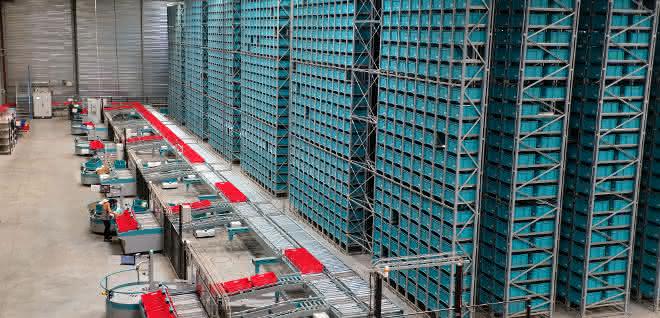
A typical scenario of traditional warehouse automation: here the classic storage and retrieval machine that constantly stores and retrieves small load carriers (SLCs). There in the aisles, the driverless transport system scurries to the picking station, where people distribute the goods into shipping cartons. Everything has been tried and tested for years.
Nevertheless, Markus Schlotter has some complaints about traditional warehouse automation. "It's too inflexible for us," says the Managing Director of Exotec Central Europe. What he has in mind is more robotics in the warehouse and therefore more freedom to flexibly design warehouse processes. "Warehouse logistics processes must be scalable. It is just as important that companies can quickly realign their intralogistics." For example, when a retailer has to cope with fluctuations in supply and demand, fundamentally changes its product portfolio or when a B2B retailer expands its range in the direction of B2C.
Storage and retrieval machine and transport system in one
The robotic warehouse has long since ceased to be a vision; Exotec's customers have already made it a reality. Skypods - warehouse robots whose name stands for the entire system - are the linchpin. This includes standardized components such as shelves, bins, conveyor systems, picking stations for humans and robots and the Deepsky control software.
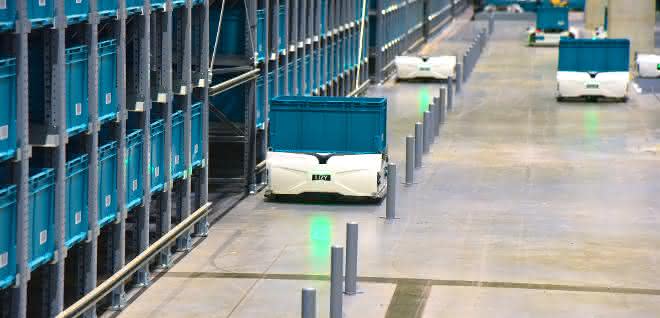
The 65 x 65 centimeter Skypod robots are the clearest example of what Markus Schlotter means by flexibility. The autonomous mobile robots (AMR) are, to a certain extent, a storage and retrieval machine and transport system in one. They climb the racks up to 12 meters high, pick up a small load carrier and make their way to the picking station. They navigate without rails or induction loops. Laser technology makes it possible. The robots receive their orders via the Deepsky warehouse software. Exotec's in-house production can be integrated into common warehouse management systems and warehouse control systems. The robots have access to every recorded article.
More shelf space during operation
If the warehouse allows, the shelving area can be extended at any time - without interrupting operations. While shelf block after shelf block is being installed on one side, Skypod storage and retrieval continues elsewhere. As soon as the extension is completed, the Skypod robots already in use climb up the shelves in the new sector. If it is necessary to increase their number, the fleet can be expanded at short notice. Exotec rents out the robots to quickly expand capacity during peak periods. These "temporary workers" can do just as much as the permanent robot workforce and are integrated into ongoing operations.
Because not every transport through the warehouse can be realized economically with AMR, the conveyor technology is also part of the Skypod system. It differs significantly from traditional warehouse automation systems. With the Skypath conveyor technology, which was added to the range in 2023, everything is plug-and-play and therefore not at all "traditional": no complex installation with a cabling team, no loading or programming of control software. Instead, Exotec offers warehouse operators conveyor technology preconfigured with sensors and light barriers. The structure of curves, straight lines and inclines is reminiscent of the railroad that used to be put together on long winter evenings.
Robot use without customizing
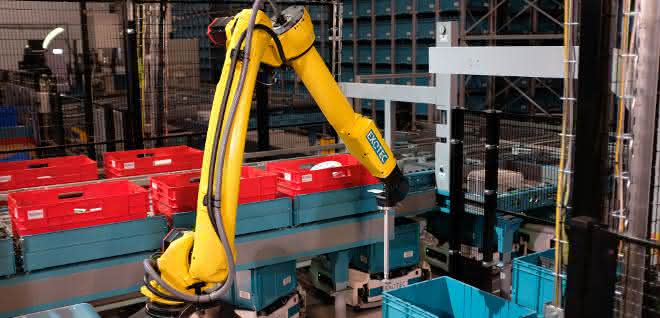
The Skypod system offers two options for the picking station. One is familiar from traditional warehouse automation, where a person takes the goods brought in by the Skypod from the KLT and assigns them to the shipping carton. The second option brings robotics back into play. With the Skypicker, Exotec offers an articulated arm robot that picks up and places goods weighing up to two kilograms.
The special thing about the Skypicker is that it is allowed to have "weaknesses". But only supposed weaknesses! Because Exotec does without any customizing, the robot cannot pick everything with its suction cup that the Skypod robots bring in. But it is precisely the absence of time-consuming customization that makes the Skypicker interesting for warehouses that are moving in the direction of robotics. The articulated arm robot is ready for immediate use. And immediately means immediately: plug-and-play in its purest form.
"Our skypickers perform semi-finishing," explains Schlotter. The iron arm does the preparatory work, the rest is done by a human employee. In this way, the robot relieves the human of a large part of the picking work, but does not replace them completely.
80 percent of picking orders by picking robot
A robot can leave something lying around. For many, this way of thinking is new. But Markus Schlotter encourages his customers to change their perspective: "What the pick-and-place robot puts in the boxes is done. Depending on the warehouse, this can be 50 to 80 percent of the picking orders." Schlotter counters the argument that picking robots are too expensive with "What needs to be proven". Apart from the fact that you first have to find employees, that labor costs are rising and that no one works in three shifts: The robot carries with it a certain frugality. Activities that are stubbornly repetitive and have a certain monotony about them are rarely in demand among jobseekers, and certainly not if the whole thing involves physical exertion.
Whether storage, retrieval, transportation or order picking. Today, when people say "the robots are coming", nobody thinks of the unspeakable horror movie from the 80s. Instead, it's more about countering the horror of the shortage of skilled workers with something effective and opening the doors to robotics. We hardly ever use the word "robot" for hard work in connection with human activity anymore. A robot, on the other hand, robots at our command all day long. And if required, even 24 hours without a break. This paves the way for them in intralogistics.
This article appeared in issue 3/23


You might also be interested in
Sixth AutoStore project for New Wave
Element Logic is implementing its sixth joint project with the New Wave Group: a future-proof AutoStore system for the logistics center in Geiselwind.
 read more...
Everything is in its place
Vet-Concept produces and sells high-quality dry and wet food. The company sells almost exclusively online and also has its own small store in Föhren for customers to collect their own products. BITO-Lagertechnik has supported the company since its...
read more...Designing crisis-proof warehouse technology
Geopolitical tensions, rising costs and increasing protectionism have fundamentally changed the economy. The days when goods were simply stored are long gone - today it's all about remaining flexible, reacting quickly and finding ever smarter...
read more...Sustainable logistics - a sustainable approach
In recent years, environmental protection has become a fundamental concern of society. Sustainable logistics focuses on minimizing the environmental impact of logistics activities without compromising the economic efficiency of companies.
read more...Shelving specialist Elvedi celebrates its 40th anniversary
The shelving system provider Elvedi is celebrating its big anniversary in 2024. The shelving manufacturer intends to continue on this growth path in the future and is planning to expand its sales territory in Europe.
read more...Drill core storage for the Mont Terri rock laboratory
The plant and racking specialist Stöcklin received the order for an unusual racking system in an unusual location and found an unusual solution for it.
read more...MS Motorservice International relies on Kardex Mlog
MS Motorservice International, the sales organization for Rheinmetall's global aftermarket activities, has commissioned Kardex Mlog as general contractor to build a four-aisle high-bay warehouse at its Neuenstadt site. The high-bay warehouse will be...
read more...Warehouse concept from Schulte impresses at Liebherr-Logistics
Liebherr-Logistics built a new warehouse at the Oberopfingen site. Schulte equipped this with a complete package: Within a short space of time, pallet, cantilever and shelving racks were installed in all three sections of the new building.
read more...Mayr-Melnhof Packaging optimizes logistics operations with AR racks
The Chilean subsidiary of the European group for the production and distribution of paper and cardboard packaging has carried out a comprehensive logistics optimization project at its distribution center in Santiago, Chile.
read more...