
Warehouse-/Picking technology
Automatic centers for heavy steel profiles
Mannstaedt GmbH in Troisdorf, the world's leading manufacturer of hot-rolled special steel profiles, has completely automated its profile dispatch. The third system supplied by H+H Herrmann + Hieber for the automatic cutting, stacking and packing of heavy profile sections was recently successfully put into operation.
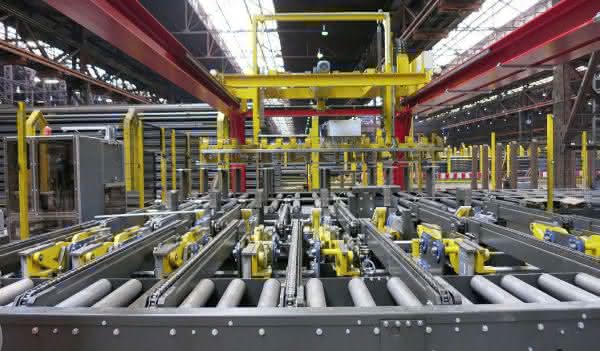
The processing and dispatch of the rolled profiles is largely automated. The heavy weights (up to around 100 kilograms per meter) and the necessary throughput make automated processing absolutely essential. Mannstaedt has now installed a total of three fully automated systems for sawing, stacking and packaging in this area.
Objectives and logistical tasks
For shipping, the profile sections are stacked on squared timber and strapped into bundles. In order to achieve a high level of stability for the profile bundles, the layers are nested within the profile package. The stacking pattern for the various profile cross-sections is specified individually. The finished profile bundle is placed on squared timber, strapped and prepared for transportation. In addition, the overall objective is to minimize the amount of scrap in the rolled, 20-metre-long initial profile.
In addition to the accuracy required for sawing and stacking and the variety of stacking patterns, the dimensions and the large weights that have to be handled are among the distinguishing features of these systems. Here is some data:
- Max. Output length 26 m
- Max. Dimensions of profiles 325 mm (W) and 150 mm (H)
- Section length 500 to 5,100 mm
- Number of cross sections: > 50
- Max. Bundle weight 5,000 kg
- Stacker cycle capacity: matched to the cold circular saw.
The rolled profile is weighed, measured in length and placed on the infeed roller table with the help of a crane system. Electromagnets are distributed along the crane beam to pick up the load. The profile placed on the roller table is adjusted with the help of vertically arranged rollers and fed to the saw.
The sawn profile sections pass through a turning device on the way to their stacking position, where they are turned if necessary. The systems differ in terms of stacking: an industrial robot is used in the last system installed, while the other two, in which two stacking stations are operated side by side, work with a movable stacker gantry. In all cases, the load is picked up with the help of a strong magnet.
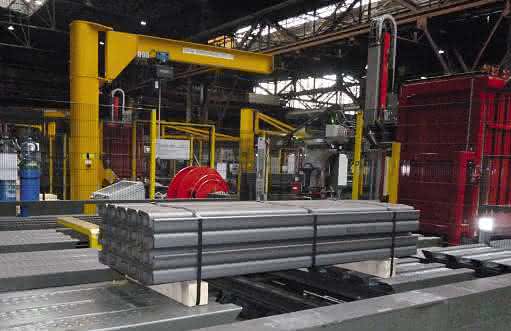
In the strapping station, the required squared timber is taken from a magazine and automatically positioned. The length, number and spacing of the timbers used are variable. In addition, the exact positioning is matched to the transport equipment that takes the finished packages. The positions are specified by the computer on a case-by-case basis.
Complex control system
The control of the system is extremely complex due to the different requirements and objectives. At this point, the strategies used to meet the objectives will be explained in brief. In order to be able to use the rolled output profile as fully as possible, different orders may have to be combined with each other in such a way that the length of all sections reaches a maximum in total. The combination of different orders offers significantly greater scope for optimization.
This optimization is possible on two of the three installed systems. Each individual profile is measured and weighed before sawing. These values are used by the process computer to variably plan the cut-off lengths. When stacking, this means that two lengths have to be stacked in parallel to form different packages. Two roller conveyors are provided in parallel for this purpose. If the delivery specifications are different, the two parallel stacks can even be structured differently - this is also provided by the control system.
Different profile shapes require differentiated stacking. The arrangement in the stack is defined for each profile cross-section and stored in the control system. In addition, the positioning under the stacking device must be specified for each individual section.
However, a working example shows the many options that the control system must take into account. This profile can be stacked in two ways, whereby it should be borne in mind that both types of stacking may have to be carried out simultaneously next to each other. First option: Ten profiles are stacked on top of each other and strapped to form a bundle. Three of these bundles form a package that is strapped again with squared timber. And: There is also the alternative option of forming the entire bundle on the stacking system. In this case, three profiles are placed at a distance from each other on the roller table. The next three profiles are turned and positioned. The result is a package of the same type that is not divided into bundles.
www.herrmannhieber.dewww.mannstaedt.de


You might also be interested in
Compact motorized castor for pallets and heavy loads
Rulmeca has launched a new motorized roller onto the market. The EPS-AS1 roller motorizes roller conveyors for heavy loads of up to 1,500 kilograms.
 read more...
Torwegge presents new Eco transport trolley
Torwegge has added a new eco transport trolley to its product portfolio. The trolley was developed to facilitate the transportation of heavy loads of up to 250 kilograms in various sectors such as the food industry, retail, catering, healthcare and...
read more...New transport trolley at Logimat
Fetra is also coming to Logimat. The manufacturer of transport equipment for efficient intralogistics processes will be presenting new products and program highlights. Wuppi" will also be there: The aluminum compact trolley is a powerful helper on...
read more...AR Racking equips new Lekkerland logistics centers
The German company, which specializes in consumer goods to go, recently opened two new warehouses in Germany, one in Kerpen and one in Wedemark, which have a storage capacity for 57,459 pallets.
read more...Paper manufacturer with innovative production logistics
Paper manufacturer Franz Veit has made its intralogistics operations much more efficient with the help of Linde Material Handling and Ernst Müller Fördertechnik.
read more...AR Racking equips new Lekkerland logistics centers
Lekkerland is reorganizing its logistics in Germany by 2030 to make it fit for the opportunities and challenges in out-of-home consumption today and tomorrow. As part of this, the storage solutions specialist has supported AR Racking in the opening...
read more...Automated intralogistics system
AMI Förder- und Lagertechnik exhibited an automated intralogistics system at Logimat that covers the entire packaging process right through to shipping.
read more...High-performance electric floor track
Transport system for small load carriers and pallets
Where efficiency and high availability are important, electrically driven floor conveyors are often an alternative to continuous conveyors.
read more...Satellite warehouse turns 40
Westfalia Logistics Solutions celebrated the 40th anniversary of the Satellit load handling device at Logimat. The system is designed for storage on pallets, other loading aids or without pallets.
read more...