
The 100-mile tour with a MAN Pro Lion 640
On course for the east
A 1000-mile round trip through Germany's eastern neighboring states is not only suitable for testing the MAN flagship Pro Lion 640 - a survey of the current situation from the truck driver's seat, with flying visits to the foreign branches of Kögel and MAN.
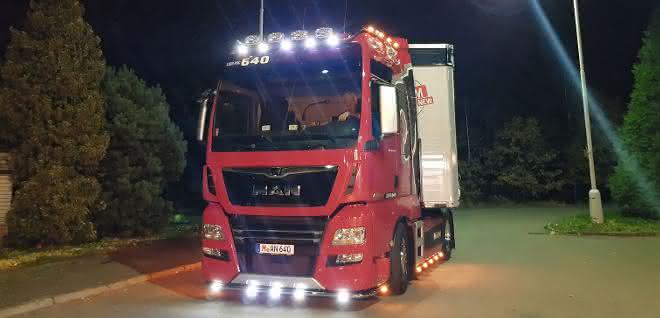
Driving in circles to determine sterile test readings is one thing. However, experiencing everyday driving on and off the highways of Europe on a real tour abroad with a fully loaded 40-ton truck is a completely different story. After all, it's only when you get up close and personal with the tour and the truck for several days that you can get an optimum assessment of both.
This time, the long-established 1000-mile long-distance trip will cover almost 1900 kilometers to the east - from MAN's main production site in Munich via the Czech Kögel plant in Chocen to the Polish MAN production plant near Krakow and back to Munich via Austria. The four-day trip is an impressive experience of what real long-distance driving is like today. On well-known long-distance routes, you have to contend with traffic congestion and toll boxes, stop at rest stops instead of hotels and visit destinations that are directly connected to the truck or its trailer.
This time it is MAN's turn as a tractor unit supplier. The current top model, the TGX 640 Pro Lion, has the modern MAN plant in Krakow as its destination, where thousands of its brother models, the TGS and TGX, have been rolling off the production line for ten years. Before that, Chocen, 150 kilometers northeast of Prague, is on the route plan. There we visit Kögel's chassis production facility, the same plant from which the chassis of our Novum trailer originates. So it's going to be a tough round this week.
Power galore
With a sonorous engine sound from the depths of 15 liters of displacement, the 40-ton train departs from the MAN factory site in Munich, heading northeast on the freeway. Continuing along the A9 on the hilly A93 via Regensburg to the first stop in Weiden in the Upper Palatinate, the powerful MAN offers plenty of opportunity to get to know the latest version of an old acquaintance.
The cab has existed in its basic form since the first TGX in 2000, but the interior has been consistently updated and modernized over the many years of production, so that today you can live with a solid, albeit no longer dewy interior. Anyone switching from another manufacturer will be surprised by the size of the huge windshield in the XXL cabin from Munich, which is almost the size of a bus. This puts the black and beige interior in the best light. In the afternoon hours on the hilly A 93 towards the Upper Palatinate, when the sun is low, a sun visor is quickly required, which on the MAN is lowered at the flick of a switch in the form of a wide roller blind. Over the coming days, this roller blind will often remain at half-mast, raising the question of the real added value of the large window. After all, the panoramic window doesn't really have any particular advantages apart from an unobstructed view of the sky. On the other hand, many practitioners at the MAN wheel blame it for the increased heating of the generally spacious long-distance cab in summer. This is a particularly handy argument if you have to make do without a stationary climate during the hot season. However, as a fully equipped model, the Pro Lion has this on board, as well as all the available safety and assistance systems.
Sacrifices in seating comfort
The MAN flagship, which is set to be replaced by a completely redesigned truck at the IAA 2020, is a comfortable way to travel through the country. The draught-free air conditioning can be finely adjusted and does a decent job. Despite the abundance of space in the cubist TGX house, the seating situation is ambivalent. The air-conditioned driver's seat in fine leather offers a wide range of adjustment options, but the seat surface is simply too small. Full-size drivers sit with parts of their extended back and thighs extending beyond the seat flanks. And wide-legged asphalt cowboys are quickly disturbed by the bulge of the dashboard at the right knee. Quiet complaints come from the passenger side after the first few hours of driving. Here, too, legroom is restricted by the bulge in the dashboard. So after a few hours of driving in the same leg position, you inevitably get a little rusty. This is because, despite the seat belt being integrated into the seat, the elegant seat on the passenger side can only be turned when the vehicle is stationary - as required by German safety regulations. On the other hand, the supple leather steering wheel sits comfortably in the driver's hand. At 47 centimetres, the diameter is generous, but the thick, smooth leather-covered rim makes the grip experience almost perfect. Only the cruise control buttons, which are located too far out, disrupt the haptic harmony on the steering wheel.
Fully automated on the road
Controlled by the lane guidance assistant, satellite-supported cruise control and distance assistant, the driver's only task on the agenda is discreet steering. On the long inclines in the Hallertau up to Regensburg, the hour of the drivetrain strikes. The 15-liter six-cylinder engine under the XXL house is in its territory here. This is where the powerful in-line engine with its high torque and hill-climbing qualities really comes into its own. It performs confidently with its 3000 Newton meters of torque, which tugs at the crankshaft at just 900 rpm. The D38 six-cylinder only becomes clearly audible at higher power demands - just as a true lion should. When it comes to driving performance, the big MAN is second to none. The red 640 clearly dominates heavy traffic on the mountain.
Show interlude at the truck stop
The big MAN also cuts a fine figure at the first stopover to comply with the European toll system. At the first service area in the Czech Republic, the first of a total of three toll boxes has to be purchased in order to legally drive through the Czech Republic, Poland and Austria. We pay 55 euros for the box and credit and stick another box on the truck's windshield, which is actually big enough for it. The drivers taking a break at the truck stop take good note of the muscle MAN in the red and black Lion Pro special edition. Carbon design applications, wide tires on aluminum, chrome pipes on the front apron, side panels and around the roof give the truck best-ager a fresh cell treatment, which is topped with a lighting set all around. All the chrome pipes are illuminated all around with LED lights, giving the MAN an impressive shine at night.
Quite a lot of tinsel for a grown-up truck - this MAN is eye-catching and self-confident. And these days, a fully equipped vehicle with lots of bling-bling is no longer just a driver's whim. As contradictory as it may seem: with the accessories, the MAN consumes less because it can retain and, above all, motivate good drivers. After all, if you love your truck and are proud of it, you won't be bludgeoning it over the road. So the investment of a few thousand euros in driver happiness can also quickly pay for itself economically.
Lots of light in the dark
The MAN pulls another equipment joker when dusk slowly settles over the very well-developed Czech highway. Passing an endless traffic jam of trucks in the opposite lane of the highway ring around Prague, the MAN-Kögel train continues to work its way towards the day's destination. The xenon headlights provide optimum illumination of the road. This is particularly important when we roll off the highway along narrow country roads towards Chocen. We reach the Kögel factory site here in the evening. At night, the motto of the Bavarian shining light among the trucks is a lot of glamor at the cabin.
The new Kögel Novum trailer returns to the place where its frame backbone was once welded. A lot of automotive industry has settled in the region. The search for suitable skilled personnel, some of whom are recruited from far away, is correspondingly difficult. After visiting the trailer production facility, the tour continues the next morning along narrow country roads towards Poland. With its precise and very smooth steering, the MAN can be steered accurately past verges and oncoming traffic. The suspension does not cut the best figure: the front axle bumps noticeably into the cab on uneven roads, which leans relatively heavily into bends due to its comfort-oriented suspension on four air bellows. Another point of criticism: the navigation system in the relatively compact screen to the right of the driver proves to be of little use. Despite the latest software, the program does not know many roads and repeatedly tries to lure us onto unsuitable paths for trucks, which can only be mastered with difficulty and a lot of faith in the resilience of the bridges. The simple Google Maps on the cell phone doesn't know any truck limits, but it does a much better job of finding the route and is free of charge.
Amazed by a top highway
The following highway trip to Poland is easy thanks to perfectly developed roads. What amazes the driver is the remarkably well-developed infrastructure: new highways throughout, exclusive design of highway bridges and state-of-the-art traffic routing. Small signs on the structures indicate how many millions of euros the EU has invested here and leave a strange feeling at the thought of German road conditions.
But the newcomer to the Polish tour doesn't manage to find the nearest toll booth straight away. Only after driving 40 kilometers on the Polish freeway do we find one and stick the third toll box on the windscreen. The newly built highways hardly challenge the MAN. At 1140 revs, the big MAN grumbles quietly along at 85 km/h. The extremely high-torque engine could even have a longer gear ratio and thus be more fuel-efficient. The evening's destination, the MAN plant in Niepolonice near Krakow, which opened in 2007, is almost in sight when, despite the truck program, the unconventional on-board navigation system lures us into a side road with a ten-tonne limit, which requires not only a lot of driving skill but also nerves of steel when driving over the small bridge.
MAN in top form
The 40-ton truck later rolls into the MAN factory premises without breaking a bridge or frame. 240,000 square meters of hall space, a state-of-the-art production line and a total of 680 dedicated workers on the assembly line, the majority of them trained skilled workers, give the lie to any preconceptions about production facilities in the East. Around 140 trucks from the TGS and TGX series are produced here in two shifts using state-of-the-art production methods. Around 30 percent of the MAN trucks built here remain in Poland, the rest are exported. The interaction between the assembly line workers, organized in teams, is exemplary. Many a truck plant could learn a thing or two from the highly modern, organized production process. The peace and quiet on the production line is remarkable. By switching to power tools on the assembly line, the noise level has been almost halved. After a quiet night in the cab, it's time to get going again the next morning. The slatted sleeping couch offered plenty of space and provided a decent bed for the matt driver on a multi-zone mattress. Storage compartments above the windshield offer sufficient space for belongings on long journeys, although the high windshield limits the storage volume.
Bavarian flight inserts
With a discreet idling whisper, the Bavarian flagship awaits its crew after a lap of honor in front of the Polish factory halls. Because now it's time to put on the kilometers. At a cruising speed of 85, the journey continues back to the Czech Republic. Only once does the MAN get really stubborn. On long, pronounced undulations on the highway, it wants to throw off its crew all at once. The overly soft cab suspension combines with the rather hard front axle set-up to create a suspension surge and literally lifts the passenger out of his seat. As a special extra, the large MAN has a comfort box on the rear wall of the cab. With its solid design, which somewhat departs from the style of the cab, it contains a small coffee machine, microwave and a safe compartment. Of course, at around 13,020 euros, the mini kitchen on board costs almost as much as a small car. But the Lion Pro buyer won't be looking too closely at that. Because the fully equipped Munich model has a gross list price of a hefty 261,415 euros. Like almost everything in life, the price is a matter for discussion, as is the strategy of the satellite-supported Efficient Cruise 2 cruise control to drop the truck to up to 75 km/h before the hilltop in order to make the most of the coming downward momentum in a cost-optimized manner. This is undoubtedly good for the fuel account, but annoys many colleagues from the east.
Controlled downhill
The clever freewheel system comes into play from 50 km/h, fortunately without the need for cruise control, as some other manufacturers prescribe. On the descent, the turbo EVBec engine brake, together with the high-gear retarder, delivers such a powerful 857 brake horsepower that the finely adjustable disc brakes are only needed for stopping. The engine braking power can be programmed precisely in advance on the "Bremsomat". This saves you having to tap the steering column lever several times.
On the Austrian highway from Vienna to Salzburg, the MAN is already smelling home air again. With the fourth toll box on the windshield, the desire for a universal box for all countries, which has already been available for several months, is growing.
Pleasure without remorse
During the smooth drive along the Austrian highway, which is apparently permanently littered with roadworks, it is time for an initial conclusion: together with the Kögel-Novum trailer, which tracks true to the road, the large MAN is clean on the road despite the 385 front axle tires and thanks to the precise, smooth steering. Comfort is only compromised on poor road surfaces and in the passenger footwell. The truck clearly plays its trump card in the drivetrain: Its 15.2-liter six-cylinder engine with a generous 640 hp is a masterpiece of Nuremberg engine construction, and the powerful engine brake always keeps the train under control. The Traxon twelve-speed gearbox does its job so well that we simply forgot to mention it. When we arrive back at the main plant in Munich in the evening after four days of MAN touring, the favorable average fuel consumption of 31.6 l/100 km over the 1934 kilometers driven on the tour makes us happy. A few quirky quirks, such as the bitchy navigation system, the occasionally erratic key remote control and the rodeo interlude on long bumps can be forgiven the Nestor among long-distance trucks. The eye-catching look as a power show truck also suits the senior lion well for its last big appearance before the changing of the guard.
About the author:
The expert and specialist journalist Oliver Willms has been writing about the commercial vehicle sector for LT-manager since 2010


You might also be interested in
Kögel strengthens sales in northern Germany
Torsten Lau is Key Account Manager North, Roman Luboch takes over as Area Sales Manager in the Hamburg region.
 read more...
80 Kögel trailers for Gruber Logistics
Gruber Logistics is taking delivery of 60 new trailers from Kögel's Cargo Coil Rail series, which will be used in combined transport. A further 20 Kögel Mega trailers of the Novum generation will support the fleet in transport tasks with high...
read more...Emission-free heavy goods transport: Gruber Logistics, Iveco and AIT start practical test
As part of the Empower research project, a six-month test phase with a battery-electric, zero-emission truck prototype from Iveco for heavy commercial vehicles will start in mid-June 2026. In collaboration with Gruber Logistics, the prototype based...
read more...IKEA launches all-electric heavy-duty logistics project
Together with Mercedes-Benz Trucks and LC3 Trasporti, the Inter IKEA Group is focusing on battery-electric trucks and driving forward the decarbonization of road freight transport in Italy.
read more...Commitment to greater sustainability
Contargo strengthens e-truck fleet with 33 tractor units
Contargo puts 33 new battery-electric DAF XD Electric trucks into operation and reaches a milestone in the decarbonization of its fleet with now 90 e-trucks.
read more...Schuon relies on a sustainable fleet
In 2025, the Alfred Schuon company will integrate 68 new trucks, including trailers and semi-trailers, into its fleet at the Haiterbach and Veszprém (Hungary) sites. Among the new acquisitions: Mercedes-Benz Actros L with aerodynamically optimized...
read more...Automated trucks: live tests in Hamburg city traffic
As part of the EU MODI project, two successful practical tests on the automation of heavy goods traffic were carried out this spring - both in the inner city area of Hamburg and on the highway. The project partners tested two important use cases in...
read more...TST initiates depot charging network for e-trucks
The TST Group wants to usher in a new era of truck electrification with a cooperative-oriented depot charging network. TST is building an ecosystem for charging heavy commercial vehicles and delivery fleets that covers all relevant aspects: from...
read more...Daimler Truck celebrates the start of series production of the Mercedes-Benz eActros 600 for long-distance transport in Wörth
Karin Rådström, CEO of Daimler Truck, and Daniela Schmitt, Minister for Economic Affairs, Transport, Agriculture and Viticulture of Rhineland-Palatinate, give the go-ahead for series production of the new model.
read more...